

BNB enters 2026 with a renewed focus on infrastructure upgrades as its core blockchain, BNB Chain, outlines plans to significantly increase transaction throughput and reduce execution latency. The roadmap reflects growing pressure among Layer 1 networks to meet the performance demands of decentralized finance (DeFi) and emerging AI-linked applications, where speed and cost efficiency are becoming decisive factors.
More users and more activity shouldn’t mean slower transactions or higher fees.
The 2026 Tech Roadmap lays out how BNB Chain is pushing performance forward from here.
Learn more ? pic.twitter.com/WBTXK6DOJb
— BNB Chain (@BNBCHAIN) December 31, 2025
According to BNB Chain Tech Road Map 2026, BNB Chain aims to scale transaction capacity to as much as 20,000 transactions per second (TPS) while achieving sub-second finality. If implemented successfully, these changes would place the network closer to the performance benchmarks set by high-throughput competitors and could reshape its positioning within the broader smart contract ecosystem.
Network Upgrades Focus on Speed and Efficiency
The proposed gains in performance are expected to come from architectural changes, including parallel transaction execution and the introduction of a Rust-based client. Parallel execution allows multiple transactions to be processed simultaneously, reducing congestion during periods of high demand. Meanwhile, a Rust client is designed to improve execution efficiency and system reliability, areas that have become increasingly important for complex decentralized applications.
Faster finality and lower latency could translate into a more predictable user experience for DeFi protocols, particularly those involving high-frequency interactions such as decentralized exchanges, lending markets, and on-chain derivatives. Reduced transaction costs may also lower barriers for smaller users and developers evaluating where to deploy new products.
Implications for DeFi and AI Workloads
As competition among Layer 1 blockchains intensifies, infrastructure capabilities are playing a larger role in determining developer migration. Networks that can support consistent, low-cost execution at scale are better positioned to attract applications requiring real-time processing, including AI-integrated services and data-driven protocols.
For BNB Chain, attracting such workloads would likely increase on-chain activity and reinforce the role of BNB as a utility token used for transaction fees, governance participation, and ecosystem incentives. Increased usage, rather than speculative demand, remains a central metric watched by institutional and long-term participants.
Market Structure and Key Technical Levels
From a market perspective, BNB’s longer-term outlook is being assessed alongside these proposed upgrades. Analysts Thomas Anderson have identified the $875 area, near the 50-day simple moving average, as a key reference point for medium-term price structure. Sustained strength above higher resistance zones could indicate growing confidence in the network’s roadmap, while weakness below established support levels would suggest continued caution.
Looking at the BNBUSD M15 chart, price is currently trading at $877.59 and appears to be consolidating near the upper resistance trend line of the ascending channel, with the 200 MA (red line) providing dynamic support around $862-863 levels. The momentum indicators suggest a… pic.twitter.com/9MjdEpIjxx
— Thomas Anderson (@veryquest1onab1) January 3, 2026
Tomáš Janota also shared a similar view, mentioning that as long as price holds above $890, upside momentum intact.
LONG $BNB: Supertrend turned bullish after breakout from $860 range. RSI holding above 50, MACD strong but flattening. As long as price holds above $890, upside momentum intact. pic.twitter.com/enoD6lZfXh
— Tomáš Janota (@tomjntx) January 5, 2026
Broader Context and Closing Thoughts
BNB Chain’s ambitions arrive amid a wider industry push toward scalability, with multiple Layer 1 networks prioritizing throughput, finality, and execution improvements. Past cycles have shown that technical promises alone are insufficient; delivery and adoption ultimately determine outcomes.
If the roadmap translates into measurable performance gains, BNB Chain could strengthen its competitiveness in DeFi and AI-related sectors. However, execution risks, regulatory considerations, and broader market conditions will continue to influence how quickly such upgrades are reflected in network activity and investor sentiment.
Bitcoin Hyper: Aiming To Transform Bitcoin Utility
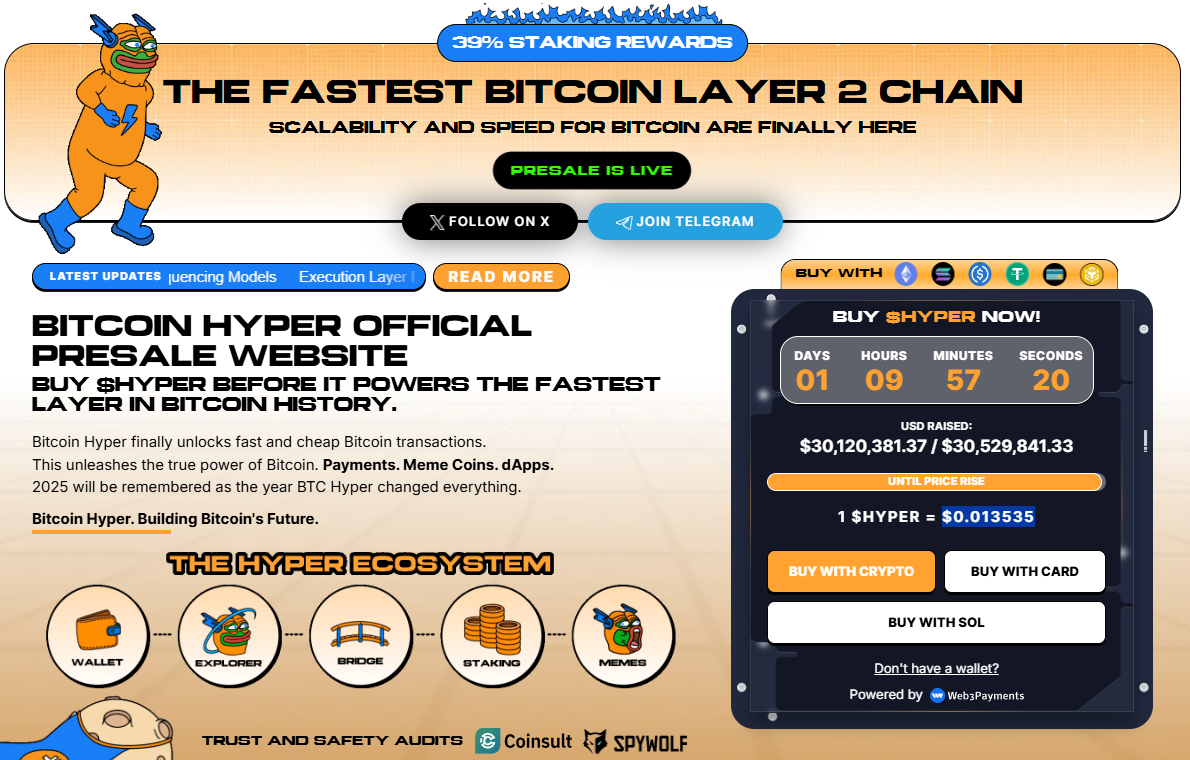
Bitcoin Hyper is stepping in as a low-risk investment with real utility. The project has emerged as the best crypto presale of 2026, targeting $2 trillion in Bitcoin utility, and a small share of this could be a billion-dollar market in itself.
Bitcoin Hyper solves Bitcoin’s most significant usability issues without changing how Bitcoin itself works. Instead of altering the main network, it adds a fast second layer on top. This Layer 2 uses Solana Virtual Machine (SVM) to handle thousands of transactions per second, enabling quick, extremely cheap transfers. Based on disclosed data, the Bitcoin Hyper presale has accumulated roughly $30.1 million so far.


