


In an era where the DeFi ecosystem is gradually reshaping global finance, StakeStone emerges as a symbol of comprehensive innovation in liquidity staking.
With the ambition to break through all liquidity fragmentation limits, StakeStone is not just a staking platform – but a foundational infrastructure protocol designed to serve a rapidly evolving cryptocurrency world moving towards a multi-chain (omnichain) model.
What is StakeStone?
Founded in 2024, StakeStone is a decentralized liquidity infrastructure protocol specializing in issuing high liquidity profit-generating assets such as STONE (for Ethereum) and STONEBTC (for Bitcoin).
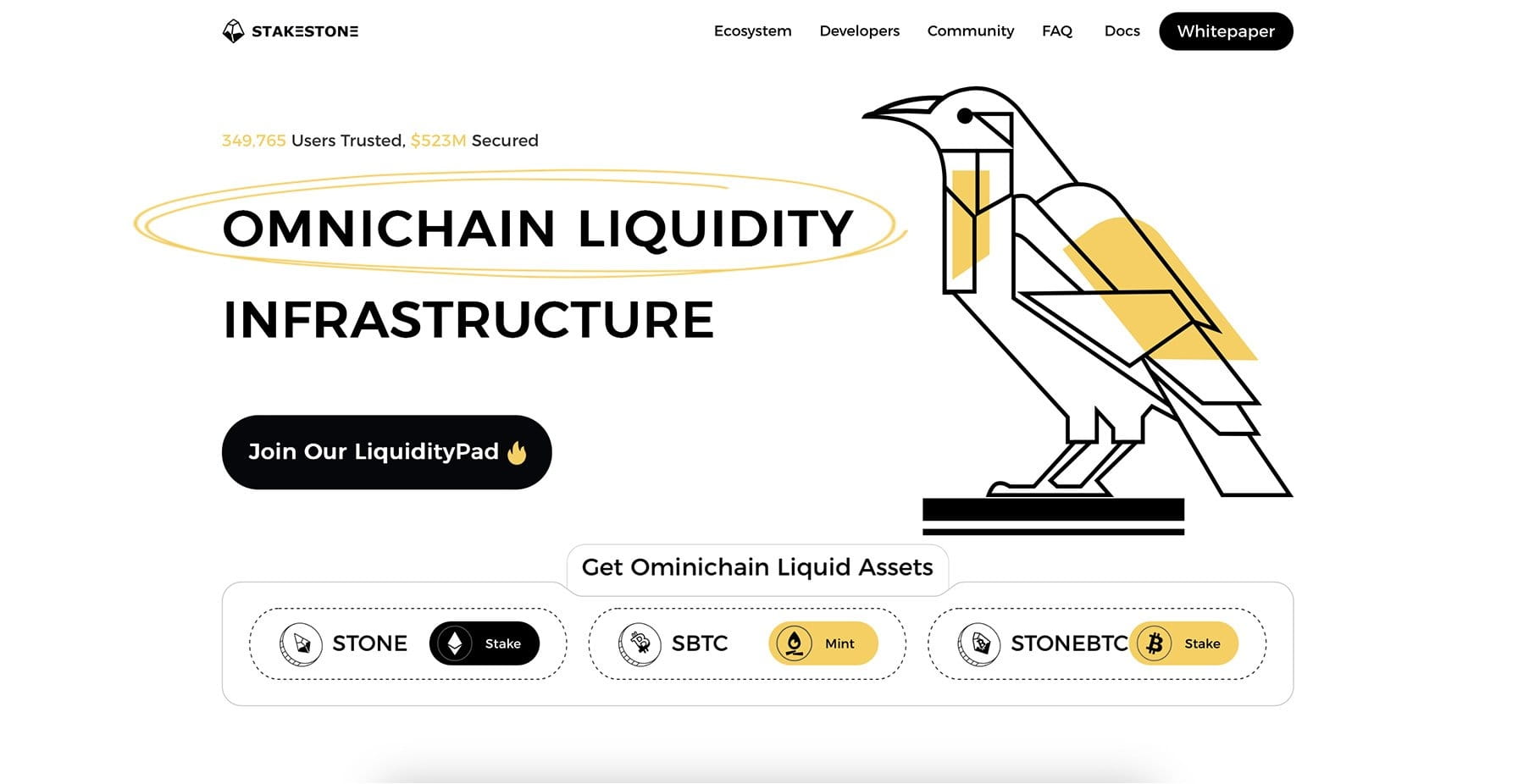
What sets StakeStone apart is its omnichain compatibility – allowing for seamless conversion, swapping, and deployment of assets across multiple blockchains without being constrained by technological boundaries.
StakeStone's mission is to optimize capital efficiency, expand the combinability of chains, and maximize on-chain profits while maintaining liquidity.
With a modular, secure, and flexible model, StakeStone reshapes how the DeFi community approaches staking ETH and BTC.
Achievements of StakeStone
As of April 2025
Total Value Locked (TVL): 525.1 million USD.
Annual revenue: 3.96 million USD.
Number of circulating STONE tokens: 225 million.
Strategic partners: Cobo, Coincover, EigenLayer, Native.
Operation mechanism of StakeStone
StakeStone operates under a modular mechanism combining omnichain, where users can convert ETH and BTC into profit-generating liquid assets:
STONE (for Ethereum): Created when users stake ETH.
STONEBTC (for Bitcoin): Issued based on BTC transferred into the system.
Staking process:
ETH/BTC is sent to the StakeStone Vault.
Then distributed to the Strategy Pool.
Liquidity tokens STONE or STONEBTC are minted through the Minter.
Profit-generating strategies that StakeStone implements:
Staking stETH.
Reusing assets through EigenLayer.
Leveraging BTC liquidity for DeFi profit strategies.
Users can also leverage cross-chain bridges to deploy STONE into the STONE-Fi Pool, thereby earning LP liquidity rewards, which can be locked to increase APY.
STONE and STONEBTC
STONE (ETH)
STONE is not simply a 'wrapped ETH' – it is a liquidity staking asset that profits from multiple sources:
stETH.
Reinvestment strategies through EigenLayer.
Other customized DeFi strategies.
STONE can be used across various networks thanks to its cross-chain bridging capability, while also providing:
Passive income.
High liquidity.
Governance participation.
Flexibility in multi-chain applications.
STONEBTC and SBTC
BTC has been limited in its integration with DeFi due to a lack of native compatibility. StakeStone solves that problem by:
SBTC: Represents liquid Bitcoin, usable on EVM-compatible networks.
STONEBTC: Upgrades SBTC with a profit layer, allowing BTC to not only retain value but also generate profit.
This pairing makes Bitcoin no longer a 'frozen' asset but a flexible capital layer, allowing for borrowing – lending, participating in LP, and integrating into cross-chain DeFi protocols seamlessly.
Token STO
Basic information
Token name: StakeStone
Symbol: STO
Blockchain/Contract:
BNB Smart Chain: 0xdAf1695c41327b61B9b9965Ac6A5843A3198cf07
Ethereum: 0x1D88713b483A8E45cfF0e5CD7c2e15E5Fab4534d
Total supply: 1,000,000,000
Token allocation
Investors: 21.5%
Platform: 18.65%
Community: 17.87%
Development team: 15%
Marketing & partners: 9.13%
Airdrop & future incentives: 7.85%
Liquidity & ecosystem treasury: 10%
The emission rate is designed to gradually decrease by 2031 – ensuring a sustainable economic model over time.
Token use case
STO is the native token serving governance and utility within the StakeStone ecosystem, with a total supply capped at 1 billion tokens.
Users can lock STO into veSTO to receive privileges:
Vote on OPAP proposals.
Increase staking rewards.
Access the 'bribery' program to optimize profits.
Exchange
The STO token can be traded on centralized cryptocurrency exchanges and decentralized exchanges.
The most popular exchange for buying and trading StakeStone is Bitget, where the most actively traded pair STO/USDT has a trading volume of 11,712,306 USD in the past 24 hours.
Other popular options include Gate.io and PancakeSwap V3 (BSC).
In addition, the STO token is the 17th project on Binance HODLer Airdrops and is expected to be listed at 23:00 (Vietnam time!) on February 2, 2025 on Binance exchange.
Investor
The project has raised significant funding from major investment funds such as: Polychain Capital, Binance Labs, OKX Ventures, Amber Group, HashKey Capital, and Bankless Ventures.
These partners not only invest capital but also support ecosystem expansion and long-term development strategies.
Team
Charles K, a veteran with over a decade in the cryptocurrency industry – from CEX exchanges, hardware wallets to DeFi protocols – is the person behind StakeStone.
Along with him is a talented team including Rose Li (Strategic Director) and Ivan K (Marketing Director), who have contributed to bringing StakeStone closer to the goal of building a pioneering staking platform.
Development roadmap
2023: Foundation Building phase
Q3/2023
July: Launch testnet, marking StakeStone's official entry into the DeFi space.
September: Official mainnet launched with a starting TVL of 1.1K ETH.
Q4/2023
December: Establish liquidity relationships with Manta New Paradigm.
Featured metrics:
TVL: 290K ETH (~645 million USD), becoming the 5th largest stETH holder on-chain.
Users: 93,560 users have participated.
Ecosystem: Successfully integrated with over 10 protocols.
2024: Expansion & Strategic Growth
Q1/2024
February: Partnering with the BTC ecosystem to initiate liquidity.
TVL: Over 310K ETH (~870 million USD).
Users: 96,000 people.
March: Received Strategic investment from Binance Labs and OKX Venture.
Q2/2024
May: Initiate liquidity for Scroll, contributing to the growth of the DeFi ecosystem.
June:
Berachain
Linea
Monad
Plume
Integrate restaking solutions with Eigenlayer and Symbiotic.
Establish strategic relationships with emerging ecosystems:
Collaborate with leading DeFi protocols like Aave and Morpho.
Q3/2024
August: Integrate intent-native liquidity infrastructure, using PMM lending pools to build deep and efficient omnichain liquidity.
September: Organize Liquid Asset Summit in collaboration with Berachain and Hashkey Cloud as part of Token2049 in Singapore.
Q4/2024
November:
Launch of SBTC and STONEBTC products, revolutionizing BTC liquidity.
Complete Series A funding round led by Polychain Capital.
December:
Deploy top deposit DeFi vault on Berachain, targeting retail users.
Establish partnerships with Lido and P2P.org.
2025: Diversifying products & expanding ecosystem
Q1/2025
Launch LiquidityPad to reshape the future of omnichain liquidity, allowing users to mine alpha and receive token rewards for contributing liquidity to a series of cross-chain applications and ecosystems.
Q2/2025
Collaborate with Monad & WLFI to deploy StakeStone's omnichain liquidity solution, building strategic alliances with blockchain pioneers.
Launch StakeStone governance DAO based on the Vote-Escrowed Token (veToken) model, supporting conversion, locking, voting, and Swap&Burn.
Develop innovative cryptocurrency payment products tailored for each personal economy, applying artificial intelligence.
Q3/2025
Restructure the STONEBTC product with CeDeFi and RWA integration to optimize and maintain sustainable yields.
Fully deploy the payment application 'Pebbles' with the following features:
Fully support EIP-7702.
Smart Savings generate stable yields.
Customized AI financial analysis for each personal economy.
Q4/2025
Expand omnichain liquidity services to various real assets (RWA) and high-performance chains.
Develop advanced financial solutions applying AI for users in personal economies, providing an unprecedented smart account experience.
Conclusion
StakeStone is not just a product, but a multidimensional liquidity staking ecosystem. The combination of profit-generating capability, instant liquidity, and omnichain compatibility makes it an essential link for the next generation of decentralized finance.
STONE, STONEBTC, and STO – the three strategic pillars of StakeStone – are gradually reshaping how users extract value from digital assets.
While many DeFi platforms are struggling with the limitations of traditional staking, StakeStone has chosen to take a step ahead, paving the way for decentralized, flexible, and infinitely scalable DeFi.


