

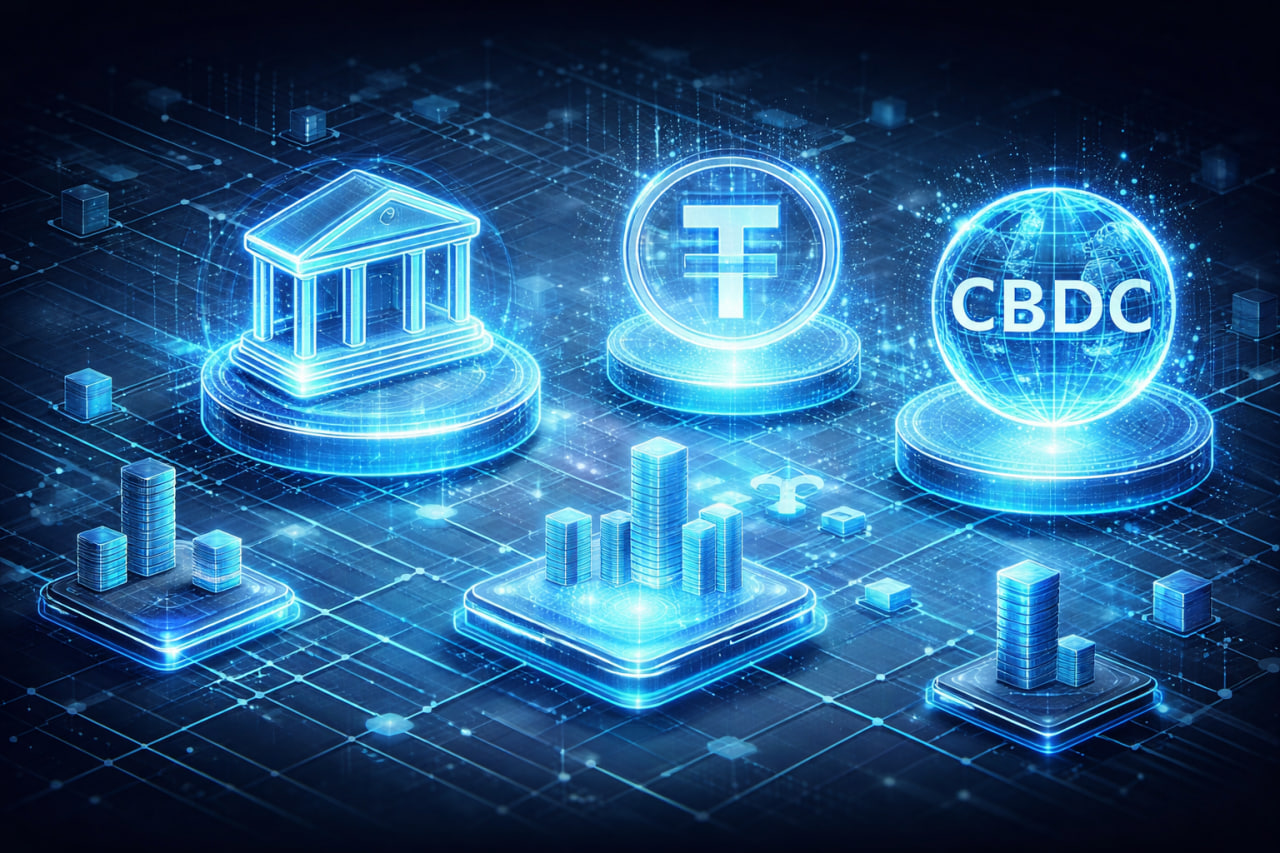
Digital money has moved from a niche experiment to a core topic in global finance over the past few years.
What began with cryptocurrencies has expanded into a much broader ecosystem that now includes tokenized bank deposits, on-chain money market funds, stablecoins, and central bank digital currencies. Governments, banks, asset managers, fintechs, and global corporations are all experimenting with the same underlying technology, but for very different reasons.
Key Takeaways
Digital money includes very different instruments that are often wrongly grouped together.
Similar technology does not mean the same purpose, issuer, or role in the financial system.
Understanding these differences is essential for trust, regulation, and long-term adoption of digital finance.
As adoption has accelerated, so has confusion. Many people tend to group all forms of digital money together, assuming they are interchangeable versions of the same idea. In reality, these instruments sit in different parts of the financial system, are issued by different actors, and are designed to solve very different problems. Treating them as one and the same blurs important distinctions around risk, regulation, and real-world use.
Below is a clear breakdown of the main types of digital money and what actually separates them.
Tokenized deposits vs. everything else
Tokenized deposits are traditional commercial bank deposits represented on a blockchain. They remain a direct claim on a bank’s balance sheet and operate under existing banking laws. Their purpose is efficiency, not reinvention.
These instruments are primarily used for wholesale payments, settlement between financial institutions, and corporate treasury management. By moving deposits on-chain, banks and large companies can achieve faster settlement, reduced reconciliation costs, and more efficient liquidity management. Despite the blockchain wrapper, tokenized deposits are still bank money at their core.
Tokenized money market funds vs. payment money
Tokenized money market funds represent shares of regulated investment funds issued as digital tokens. The underlying assets are typically high-quality instruments such as Treasury bills or repo agreements. Unlike deposits, these tokens are investments, not money.
Their main role is cash management and yield generation. Institutional investors, treasurers, and increasingly on-chain financial platforms use tokenized fund shares to earn returns while maintaining liquidity. They are also emerging as high-quality collateral in digital markets. While they move on blockchains, they are governed by securities law and behave like traditional fund products.
Stablecoins vs. bank-issued instruments
Stablecoins are privately issued tokens designed to track the value of fiat currencies. They are not bank deposits and not sovereign money. Their value is maintained through reserve assets, market mechanisms, or a combination of both, depending on design.
Stablecoins are widely used for payments, remittances, trading, and liquidity across global markets. They are accessible to individuals, companies, exchanges, and developers worldwide, making them the backbone of most on-chain activity today. Their strength lies in speed, global reach, and programmability, but they come with different regulatory and risk considerations than bank-issued instruments.
CBDCs vs. private digital money
Central bank digital currencies represent sovereign money issued in digital form. They are a direct liability of a central bank and fall under monetary law rather than banking or securities regulation.
CBDCs are designed to support monetary policy, financial stability, and payment system resilience. Depending on the model, they can be used by banks for wholesale settlement or by citizens for everyday payments. Unlike stablecoins or tokenized deposits, CBDCs are public infrastructure, not market-driven financial products.
Same technology, completely different roles
One of the biggest sources of misunderstanding is the assumption that shared technology means shared purpose. While all these instruments may use blockchains or distributed ledgers, their economic roles are fundamentally different. Tokenized deposits serve banks and corporates. Tokenized funds serve investors and treasurers. Stablecoins serve global markets and digital commerce. CBDCs serve public policy and financial stability.
Failing to recognize these differences leads to flawed debates about regulation, risk, and adoption. Understanding who issues each instrument, who uses it, and why it exists is essential to making sense of digital finance.
As digitalization accelerates alongside advances in AI, big data, and automation, digital financial infrastructure will play an increasingly central role in the global economy. Just as people understand how traditional banking, funds, and central banks operate today, they will need the same level of literacy for digital assets. Clear education and proper distinctions are not optional. They are a prerequisite for trust, effective regulation, and the long-term adoption of a financial system that is steadily evolving beyond its traditional foundations.


