

Ethereum price forecast discussions are heating up again as ETH tumbles below $2,300, triggering a wave of technical breakdowns and investor uncertainty. The second-largest cryptocurrency has lost nearly 20% in just one week, breaking beneath the $3,000 and $2,500 psychological levels.
This selloff marks one of Ethereum’s sharpest corrections in recent months as the most promising cryptocurrency, raising questions about future support zones, resistance levels, and macro price expectations.
Analysts now point to both on-chain metrics and Fib levels to determine if the decline will extend toward $1,881, or recover toward $2,800. Let’s examine what the data and headlines show.
ETH Drops to $2,276: Bearish Momentum Deepens
Ethereum is trading at $2,276.71, down 5.85% in the past 24 hours, with a 7-day decline approaching 20%. The market cap has dropped to $274.78B, and the current 24-hour volume is above $52B, indicating high activity amid volatility.
While ETH’s circulating supply remains steady at 120.69M, traders are clearly reacting to the sharp technical breakdown that began after January 29.
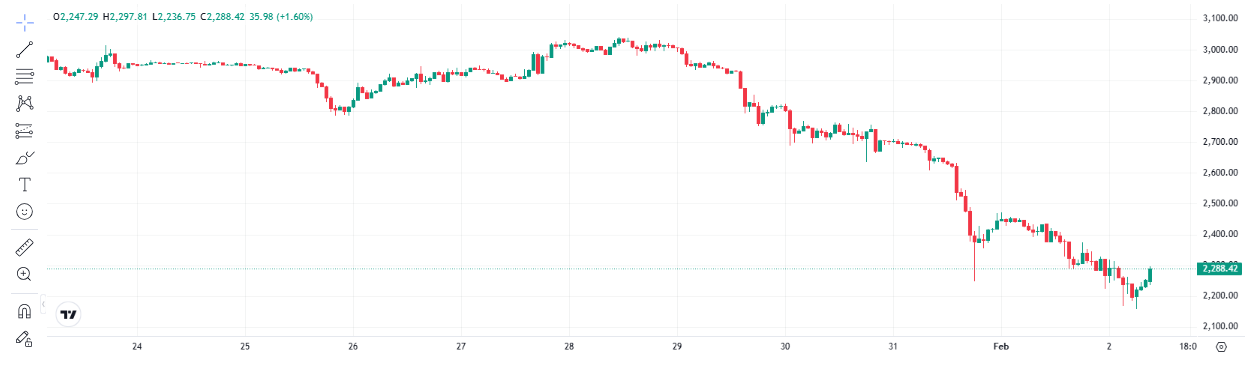
This collapse below $2,400 places ETH in a clear bearish zone, especially with resistance forming at $2,415 and $2,500.
Analysts highlight the significance of a descending trend line and bearish divergence below the 23.6% Fibonacci retracement. Unless the Ethereum price prediction recovers and holds above $2,500, downside risk remains dominant.
What’s Driving Ethereum’s Price Right Now?
The current Ethereum crash is tied to multiple high-impact developments. The largest is the $2 billion crypto liquidation event that swept across the market, pushing Bitcoin below $40,000 and Ethereum below $2,200.
According to Coinglass data, Ethereum saw $150 million in liquidations, with a heavy concentration in long positions. These sudden liquidations triggered cascading stop-loss orders, deepening the selloff across centralized exchanges.
On the tech side, the Ethereum Foundation has prioritized quantum security, announcing a renewed focus on LeanVM and post-quantum cryptography. While important in the long term, this signals that Ethereum’s dev team is more focused on core protocol safety than immediate scaling, even for the best altcoins now.
Another key factor is regulatory optimism surrounding a Uniswap ETF, filed by Bitwise in Delaware. Although unrelated to ETH directly, it reflects growing institutional appetite for Ethereum-adjacent DeFi assets. This could affect sentiment longer-term but hasn’t slowed the current correction.
Critical Support Levels: $2,475 and $1,881 Identified
According to Glassnode data shared by Ali Martinez, the UTXO Realized Price Distribution (URPD) model places Ethereum’s next key support zones at $2,623, $2,475, and $1,881. These levels reflect the cost bases of large ETH holders.
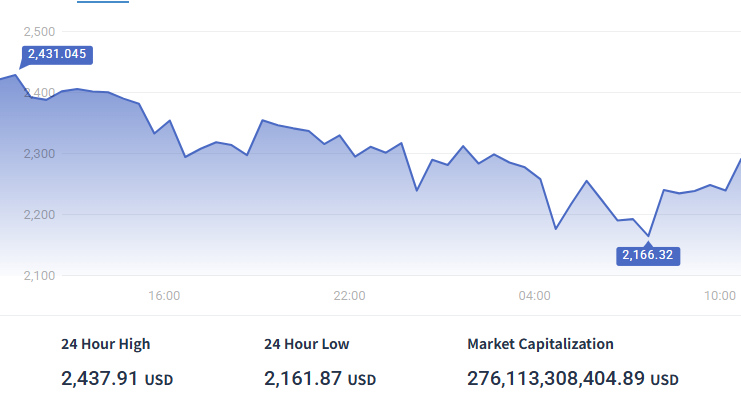
When prices near these zones, investors often double down, offering natural support through increased buying activity.
However, Ethereum recently breached both $2,623 and $2,475, leaving $1,881 as the next major line of defense. A decline to that level would represent a 25% drop from today’s price and over 60% from the last cycle high. It’s a critical zone that could define whether ETH rebounds or slips into deeper losses.
Resistance Zones and Short-Term Reversal Scenarios
Despite the pessimism, Ethereum could still find near-term support. The immediate bounce zone is around $2,350, with the $2,420 resistance forming alongside a descending trend line.
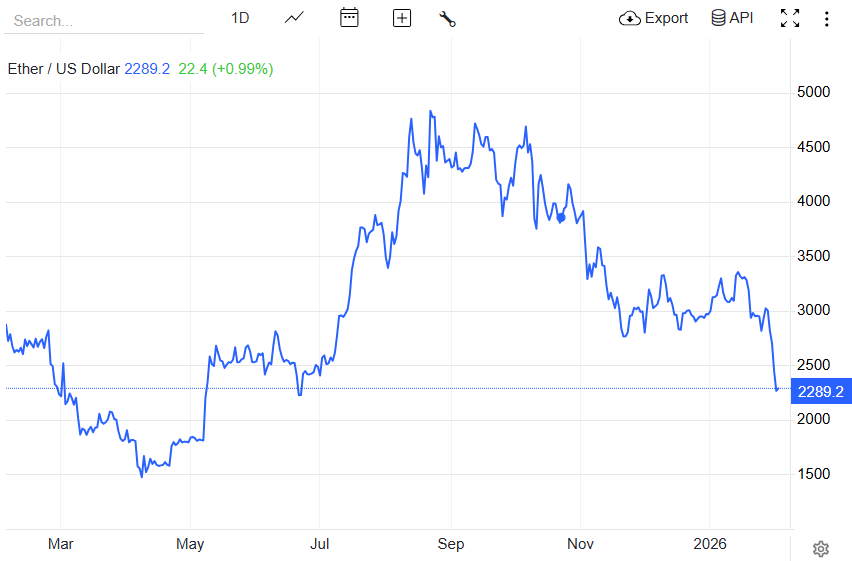
If buyers regain confidence, a move above $2,500 would be the first sign of strength. Beyond that, $2,620 represents the 50% Fib retracement level, followed by $2,800, a zone that aligns with earlier consolidation before the January drop.
Technical traders are also watching the hourly 100-SMA, which ETH is struggling to reclaim. Without a decisive break, the asset may continue to face headwinds as sellers dominate.
Long-Term Ethereum Price Forecast: 2026–2038 Outlook
Long-term projections remain cautiously optimistic. According to year-by-year estimates, Ethereum’s price could reach $2,439.75 by 2026 and $2,965.53 by 2030, assuming continued Layer 2 scaling and gradual institutional adoption.
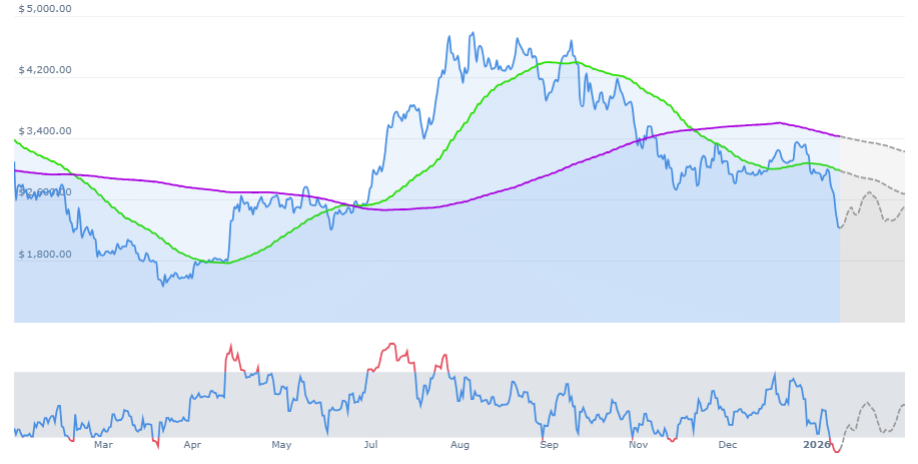
By 2038, forecasts rise above $4,300, reflecting compound network growth and market recovery.
AI models give wider predictions. ChatGPT’s macro-weighted model projects a range of $3,000 to $9,000. Gemini sees a bull case of $7,000 to $18,000 tied to scaling upgrades and ETF approvals.
Copilot offers a conservative band of $8,200 to $10,200, while Grok suggests $4,000 to $12,000, weighted toward staking demand. The most aggressive target, $18,000, represents a 480% upside from current levels.


