

Every cryptocurrency you own – Bitcoin, Ethereum, stablecoins, altcoins – relies on a single cryptographic assumption: that nobody can reverse-engineer your private key from your public key. That assumption has held for decades. But quantum computing is about to break it, and most of the crypto industry isn’t ready.
This isn’t science fiction. It’s a countdown. Governments, intelligence agencies, and the world’s largest tech companies are all preparing for what cryptographers call Q-Day: the moment a quantum computer becomes powerful enough to crack the algorithms that protect blockchain transactions. Understanding what Q-Day means – and how far along the timeline we are – is essential for anyone holding digital assets in 2026.
The Technical Problem in Plain English
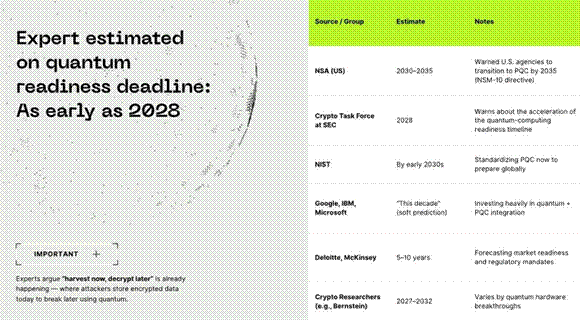
Quantum readiness deadlines: NIST finalized post-quantum standards in 2024. Government mandates target 2028–2030. Source: qLABS
Blockchains use an algorithm called ECDSA (Elliptic Curve Digital Signature Algorithm) to sign transactions. When you send crypto, your wallet uses your private key to create a signature. The network verifies that signature using your public key. The security of this system depends on a mathematical problem – the elliptic curve discrete logarithm problem – that classical computers can’t solve in any reasonable timeframe.
Quantum computers change the equation. In 1994, mathematician Peter Shor proved that a sufficiently powerful quantum computer could solve this problem exponentially faster than any classical machine. That means a quantum computer could derive your private key from your public key, forge your signature, and drain your wallet. Every blockchain using ECDSA – which is essentially all of them – shares this vulnerability.
The question isn’t whether this is theoretically possible. It’s when the hardware catches up. And the timeline is tightening faster than most people realize.
The Timeline Is Closer Than You Think
In 2024, NIST finalized its first post-quantum cryptographic standards, signaling that the threat has moved from theoretical to operational planning. Google, Apple, and Microsoft have already deployed quantum-resistant protocols in their products. Tether’s CEO Paolo Ardoino publicly stated that Bitcoin holders will need quantum-resistant addresses. Ethereum’s Vitalik Buterin has warned the community about quantum risks. NVIDIA’s Jensen Huang has called quantum computing an inflection point.
Meanwhile, a less discussed but equally concerning threat is already underway: “harvest now, decrypt later” attacks. Adversaries are collecting encrypted blockchain data today, storing it, and waiting for quantum computers to mature so they can decrypt it retroactively. This means assets and transactions that feel secure right now could be compromised in the future without the owner ever knowing they were targeted.
Why Blockchain Is Uniquely Vulnerable
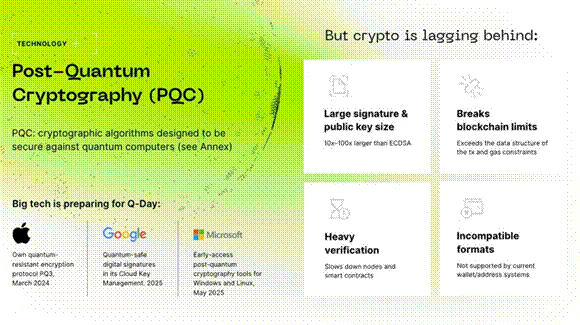
Apple, Google, and Microsoft adopted post-quantum cryptography. Blockchain infrastructure lags behind. Source: qLABS
Traditional internet infrastructure can upgrade its encryption relatively quickly. When TLS standards change, servers update their certificates. When messaging apps adopt new protocols, users get a software update. The transition is centralized and fast.
Blockchain is different. Cryptography is baked into the consensus layer. Changing the signature scheme on Ethereum or Bitcoin requires coordinating millions of nodes, migrating billions of dollars in assets, and maintaining backward compatibility – all without breaking anything. It’s an enormous technical and governance challenge, and no major chain has a concrete plan to complete the transition before Q-Day.
That gap – between the speed of the quantum threat and the speed of blockchain adaptation – is where the risk lives. Over $4 trillion in crypto assets sit on chains that haven’t begun the migration to post-quantum cryptography. The clock is running, and the industry is behind.
How Post-Quantum Cryptography Works
Post-quantum cryptography (PQC) uses mathematical problems that are resistant to both classical and quantum attacks. The most widely adopted approach is lattice-based cryptography, specifically algorithms like CRYSTALS-Dilithium, which NIST selected as a primary standard. These algorithms create digital signatures that a quantum computer cannot forge, even with Shor’s algorithm.
The challenge for blockchain is size. Post-quantum signatures are significantly larger than ECDSA signatures, which creates problems for chains with strict block size limits. Fitting quantum-safe security into existing blockchain architecture requires creative engineering – typically involving zero-knowledge proofs that can compress quantum-safe verification into proofs small enough to fit on-chain.
What’s Being Built to Solve This
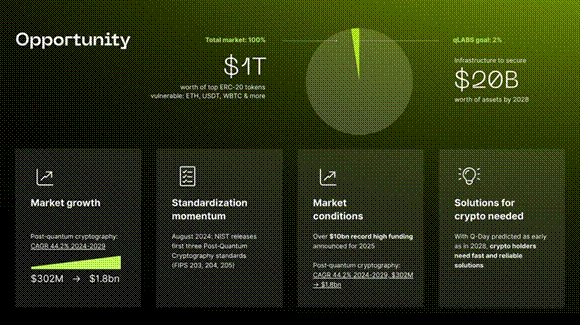
The post-quantum cryptography market is projected to grow from $302M to $1.8B by 2029 (44.2% CAGR). Source: qLABS
Several approaches are emerging. Some projects propose building entirely new quantum-resistant Layer 1 blockchains from scratch. Others focus on migration toolkits that allow existing chains to adopt PQC without rebuilding. The most practical solutions wrap quantum-safe signatures around existing wallets and transactions, adding a second layer of protection without requiring users to migrate assets or change chains.
qLABS, the team behind the $qONE token that recently sold out its presale in under 24 hours, has taken this wrapper approach. Their qONE Security Protocol combines NIST-approved post-quantum cryptography with zero-knowledge proofs to verify quantum-resistant transactions on existing blockchains. The underlying IronCAP™ engine, developed by publicly traded 01 Quantum Inc. (TSXV: ONE), holds two U.S. patents and is already used in production by enterprises including Hitachi, PwC, and Thales.
The $qONE token, now approaching its Token Generation Event on Hyperliquid, serves as the utility layer for this infrastructure – powering transaction fees, staking access, and governance within the protocol. Whether $qONE specifically succeeds as an investment is for the market to decide, but the underlying problem it addresses is not going away. If anything, it’s accelerating.
For investors and builders in the crypto space, understanding the quantum timeline isn’t optional anymore. Q-Day isn’t a question of if. The only question is whether the industry will be ready when it arrives.


