

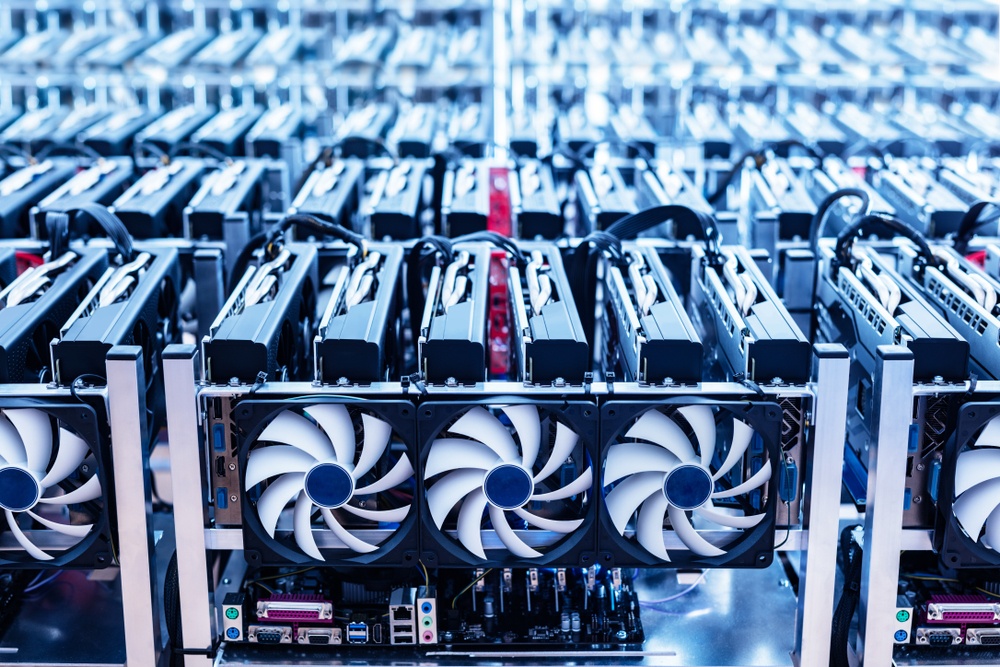
Bitcoin mining is no longer just about hashing power. After the April 2024 halving cut block rewards in half, a growing number of publicly traded miners began rewriting their business models.
Key Takeaways
Miners are shifting into AI after the 2024 halving cut rewards and squeezed margins.
TeraWulf is leading the move, backed by Google and multibillion-dollar AI contracts.
Firms are selling BTC to fund GPU upgrades and data center expansion.
AI hosting offers steadier, higher-margin revenue than traditional mining.
Power access has become the most valuable asset in the race for AI infrastructure.
By late 2024 and into 2025, many shifted aggressively toward Artificial Intelligence and High-Performance Computing, turning their massive energy footprints into platforms for AI workloads.
The logic is simple: mining revenue became less predictable, while demand for AI infrastructure exploded. Instead of relying solely on Bitcoin production, companies started monetizing their electrical capacity by hosting GPU-heavy AI clusters. In many cases, that meant selling portions of their BTC treasuries to finance expensive hardware upgrades and data center retrofits.
TeraWulf Leads The AI Pivot
Among the most aggressive movers is TeraWulf, which has rapidly repositioned itself as a hybrid energy and AI infrastructure provider. As of early 2025, the company has emerged as one of the clearest examples of how miners are transforming into large-scale data center operators.
A major catalyst has been its partnership with Google. The tech giant increased its equity stake in TeraWulf to 14% and committed a $3.2 billion backstop to support expansion at the Lake Mariner facility, which is being upgraded to handle AI workloads.
To fund this transition, TeraWulf has steadily liquidated much of its Bitcoin holdings. Unlike pure-play miners that continue to accumulate BTC, the company is prioritizing infrastructure expansion. It also secured long-term AI hosting contracts, including a 10-year agreement with Fluidstack, with potential revenue reaching $8.7 billion if lease extensions are exercised.
Recent site acquisitions in Kentucky and Maryland have pushed TeraWulf’s total power capacity to roughly 2.8 gigawatts, placing it among the most energy-rich operators in the sector.
A Broader Industry Migration
TeraWulf is far from alone. At least eight other major miners have announced strategic pivots toward AI or HPC.
Cango sold 4,451 BTC, worth roughly $305 million, to repay debt and fund its expansion into distributed AI computing. Core Scientific secured a 12-year agreement with CoreWeave projected to generate $4.7 billion in revenue. Bitdeer reduced its BTC treasury in early 2026 to finance AI infrastructure growth.
Meanwhile, Hut 8 attracted a $150 million investment to build AI-ready facilities and has reportedly collaborated with Anthropic. IREN, formerly Iris Energy, is leaning into AI hosting contracts that can offer operating margins between 80% and 90%. Bit Digital reported that more than half of its gross margin was already coming from AI operations as early as 2024.
Why Miners Are Chasing AI
The transition reflects a powerful economic trade-off. AI hosting typically provides stable, long-term revenue streams under multi-year contracts. Bitcoin mining, by contrast, remains highly sensitive to price swings, network difficulty, and halving cycles.
There is also clear infrastructure synergy. Miners already control high-capacity substations, industrial-scale cooling systems, and large physical footprints – precisely the “hard assets” hyperscalers need. Companies like Amazon, Google, and Microsoft are racing to secure limited electricity supplies, making existing power permits increasingly valuable.
On a per-megawatt basis, AI contracts can generate up to three times the revenue of traditional Bitcoin mining. For firms under pressure after the 2024 halving, the math has become difficult to ignore.
The result is a structural transformation: what began as digital gold extraction is evolving into energy-backed AI infrastructure. If current trends persist, many former “miners” may soon resemble power-focused data center operators more than crypto-native companies.


