

Foundry Digital, a subsidiary of Digital Currency Group (DCG) and operator of the largest Bitcoin mining pool in the world, announced it will launch an institutional-grade Zcash (ZEC) mining pool in April 2026.
Key Takeaways
Foundry Digital is launching an institutional-grade Zcash mining pool in April 2026 – its first expansion beyond Bitcoin.
Former Electric Coin Company developers raised $25M to build a new Zcash wallet under a newly formed entity, ZODL.
Global regulators are intensifying crackdowns on privacy coins, with the EU set to ban them outright by July 2027.
ZEC is down roughly 72% from its late-2025 peak, currently trading around $211.
This important launch marks the company’s first expansion beyond Bitcoin infrastructure.
ZEC is currently trading around $211, down approximately 72% from its peak of roughly $750 in November 2025 – a price environment that makes institutional infrastructure announcements like this one particularly consequential for the network’s longer-term trajectory.
The pool is built on the same SOC 1 Type 2 and SOC 2 Type 2 compliant framework that underpins Foundry USA Pool, which currently controls approximately 30% of global Bitcoin hashrate. No minimum hashrate is required to join, and payouts will follow a Pay Per Last N Shares (PPLNS) model with full auditability and 24/7 support. The pitch is straightforward: U.S.-based, compliance-focused infrastructure for institutional and publicly traded miners who have had nowhere regulated to go – until now.
Zcash mining is currently dominated by ViaBTC at roughly 31.7% of hashrate and F2Pool at around 15.8%. Both are non-U.S. entities. Foundry’s entry doesn’t just add another pool – it introduces a heavily regulated, audited operator into a network that has, until now, lacked that layer of institutional credibility. Zooko Wilcox, the founder of Zcash, acknowledged the significance directly, noting the move will help “spread out” mining hashpower and reduce concentration risk. CEO Mike Colyer went further, describing Zcash as having matured into an “institutional-grade asset” – the kind of statement that tends to matter when public companies are deciding where to allocate mining resources.
The broader case Foundry is making cuts to the heart of the privacy coin debate: that financial privacy and regulatory compliance are not mutually exclusive. Whether the market buys that argument is another question, particularly given the regulatory pressure building around ZEC globally.
A Development Team in Turmoil
The Foundry announcement comes during a turbulent period for Zcash’s core development ecosystem. In January 2026, the entire staff of the Electric Coin Company – the organization historically responsible for Zcash’s protocol development – resigned en masse. The fallout stemmed from a governance dispute with Bootstrap, ECC’s parent nonprofit, over the direction of the Zashi wallet, questions about potential privatization for external investment, and changes to employee terms.
The departing team, led by Josh Swihart, didn’t sit idle. They regrouped under a new entity called Zcash Open Development Lab, or ZODL. On March 9, 2026, ZODL closed a $25 million seed round backed by Paradigm, a16z crypto, Winklevoss Capital, and Coinbase Ventures – a fundraise that signals serious institutional conviction in the protocol’s future, internal chaos notwithstanding. The funding is earmarked for a new Zcash wallet. Whether ZODL can effectively take over development continuity remains to be seen, but the investor roster alone suggests this isn’t being treated as a dead-end project.
Regulators Are Closing In
The political and regulatory environment for privacy coins has shifted considerably, and not in ZEC’s favor. Jurisdictions across the globe are moving to restrict or outright ban privacy-enhancing cryptocurrencies – with Zcash consistently named alongside Monero and Dash as a primary target.
The European Union finalized its Anti-Money Laundering Regulation, which takes effect July 10, 2027. Under the new rules, all crypto-asset service providers operating in the EU — including major exchanges like Binance and Kraken – will be prohibited from listing or handling privacy-focused tokens. Peer-to-peer transactions remain technically legal, but the regulated infrastructure supporting them will be removed.
India moved faster. In January 2026, the country’s Financial Intelligence Unit directed domestic exchanges to immediately halt trading, deposits, and withdrawals for Monero, Zcash, and Dash, citing money laundering and terrorist financing risks. Dubai followed a similar path, with VARA and the DFSA categorically banning the issuance, listing, and trading of anonymity-enhanced cryptocurrencies as of January 12, 2026 – violations carry penalties including license revocation and fines running into tens of millions of dirhams. Japan and South Korea have maintained effective bans on privacy coin listings for years, with no sign of softening. Australia has consistently pressured exchanges to delist these assets to maintain AML/KYC compliance.
The cumulative picture is one of shrinking access – fewer exchanges, fewer jurisdictions, and fewer on-ramps for retail and institutional participants alike. That’s a structural headwind that no single mining pool launch can fully offset.
ZEC Technical Analysis
Zcash’s price chart reflects both the momentum it generated in 2025 and the severity of what followed. ZEC surged nearly 600% through the year, reaching approximately $750 in November 2025 before the broader market correction pulled the floor out. From that peak to the current price of around $211, ZEC has shed roughly 72% of its value.
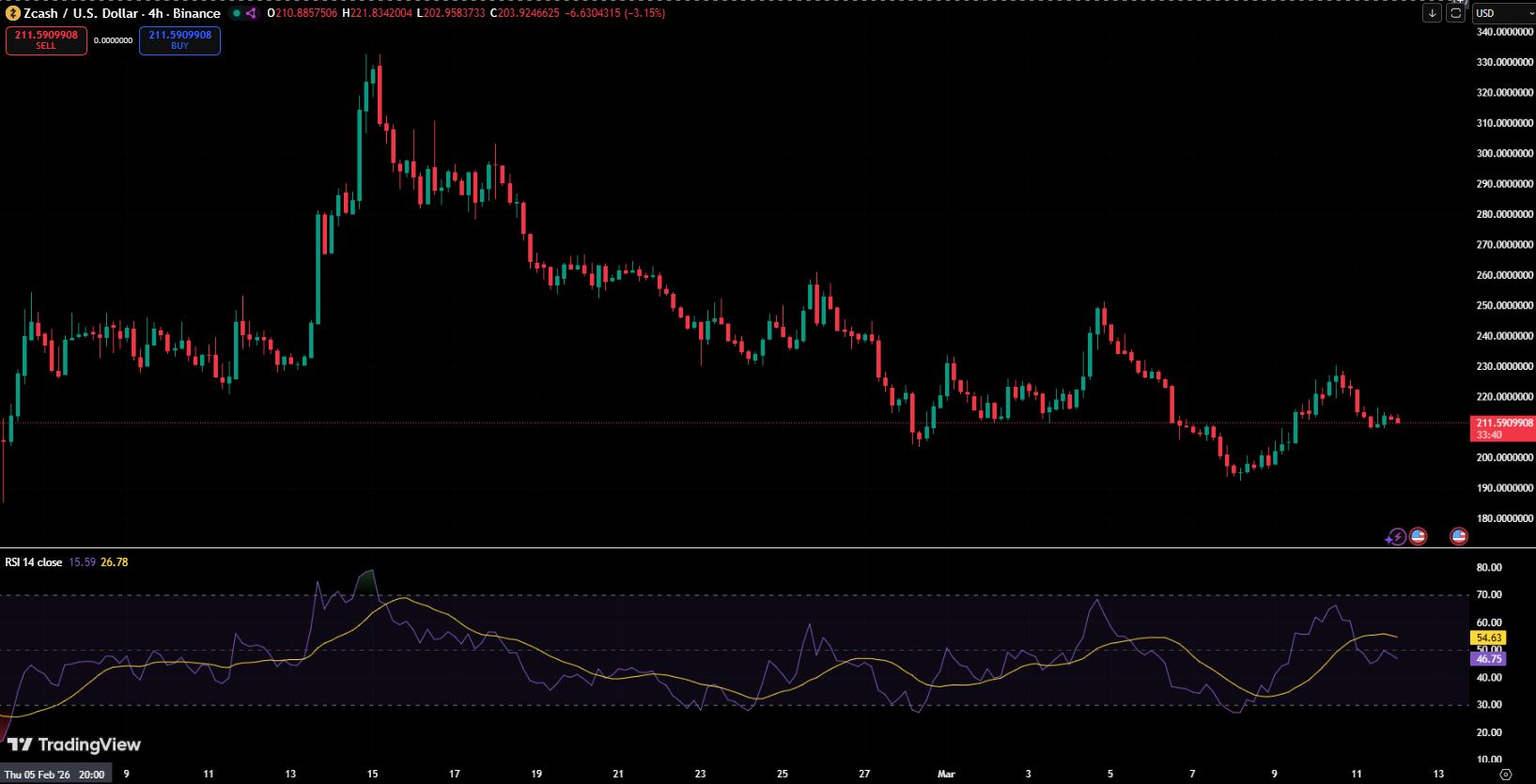
On the 4-hour chart, price is sitting in a range between $200 and $220 – an area that also acted as support back in early February. The RSI is hovering around 46–54, which is essentially neutral: no strong oversold signal, no clear momentum building. The previous bounce from the $190 area in early March managed to push price back above $210, but the recovery lost steam before reaching $250, suggesting sellers are still active at higher levels.
The dotted support line visible across the chart at the $210 zone has been tested multiple times now. A clean hold above $220 would be the first indication of any short-term recovery. Until that happens, the bias remains cautious – the structure is that of a market that bounced, not one that reversed.
The Bottom Line
Foundry’s Zcash pool launch is the most significant institutional development the ZEC ecosystem has seen in some time. It doesn’t erase the governance disruption at ECC, and it doesn’t change the regulatory trajectory in the EU, India, or Dubai. What it does do is put a major, compliant, U.S.-based operator into the network – exactly the kind of infrastructure that institutional miners and public companies require before they’ll touch an asset.
ZEC is sitting 72% below its peak. The internal development situation is being rebuilt from scratch under ZODL. Regulatory pressure is structurally intensifying. None of that is trivial. But if broader market conditions stabilize and risk appetite returns, Foundry’s entry could prove to be the kind of catalyst that moves the needle – assuming the protocol survives the turbulence long enough to benefit from it.


