


Senators Bill Cassidy and Cynthia Lummis introduced the Mined in America Act on March 30, 2026, a bill that would establish a voluntary federal certification program for domestic Bitcoin mining facilities, codify the Strategic Bitcoin Reserve into statute, and create a direct Treasury procurement channel through which certified miners sell newly mined BTC to the federal government in exchange for a capital gains tax exemption.
The legislation, which carries no new fiscal authorizations, designates the Department of Commerce as the administering certifying body and directs the National Institute of Standards and Technology and the Manufacturing Extension Partnership to support domestic mining hardware development – a mandate that implicitly acknowledges what the bill’s sponsors describe as an untenable dependence on hardware manufactured by foreign adversaries.
The bill now awaits committee referral, with the Senate Commerce, Science, and Transportation Committee the most likely venue for initial review. It arrives as a companion to the broader reserve architecture that Senator Lummis has advanced since her introduction of the BITCOIN Act of 2025, which first proposed Treasury-managed custody of federal Bitcoin holdings.
We suspect the more consequential provision is not the certification label itself but the Treasury procurement mechanism – a structure that, if enacted, would make the federal government a recurring, price-insensitive buyer of domestically mined BTC, introducing a demand floor with no clear precedent in sovereign commodity acquisition.
Mined in America Act: Legislative Mechanics and Operative Provisions
The mechanism functions as follows: a mining facility or pool applying for “Mined in America” certification must demonstrate to the Department of Commerce that it operates no equipment manufactured by entities domiciled in, or controlled by, countries designated as foreign adversaries under existing U.S. trade law – a category that presently encompasses China, Russia, Iran, North Korea, Cuba, and Venezuela.
Full hardware phase-out is required by the end of the decade, giving operators a defined transition runway but imposing a hard deadline on continued use of equipment from manufacturers such as Bitmain Technologies and MicroBT, which together account for the overwhelming majority of the approximately 97% of mining rigs currently sourced from Chinese-domiciled companies.
Senators Cynthia Lummis and Bill Cassidy just introduced the "Mined in America Act." This one is worth paying attention to.
The problem it addresses is straightforward. The United States controls roughly 38% of the global Bitcoin hash rate, but the vast majority of the hardware… pic.twitter.com/7LF4kO6rO0
— TFTC (@TFTC21) March 30, 2026
Certified operators gain access to pre-existing Department of Energy and U.S. Department of Agriculture program benefits – including grid stabilization contracts, renewable energy absorption arrangements, and methane capture initiatives at landfill and oil field sites – without triggering new appropriations. That framing is notable because it allows sponsors to characterize the bill as fiscally neutral while still delivering material economic incentives to compliant miners.
The reserve codification provision links certification directly to Treasury acquisition: miners holding the “Mined in America” designation may sell newly mined Bitcoin to the Treasury at market rates in exchange for exemption from capital gains tax on the transaction. Revenue from staking rewards and airdrop income on the government’s existing seized-asset holdings – estimated between 198,000 and 328,000 BTC following Trump’s 2025 executive order – would fund further open-market purchases, creating a self-reinforcing accumulation structure that requires no direct congressional appropriation beyond the initial statutory authorization.
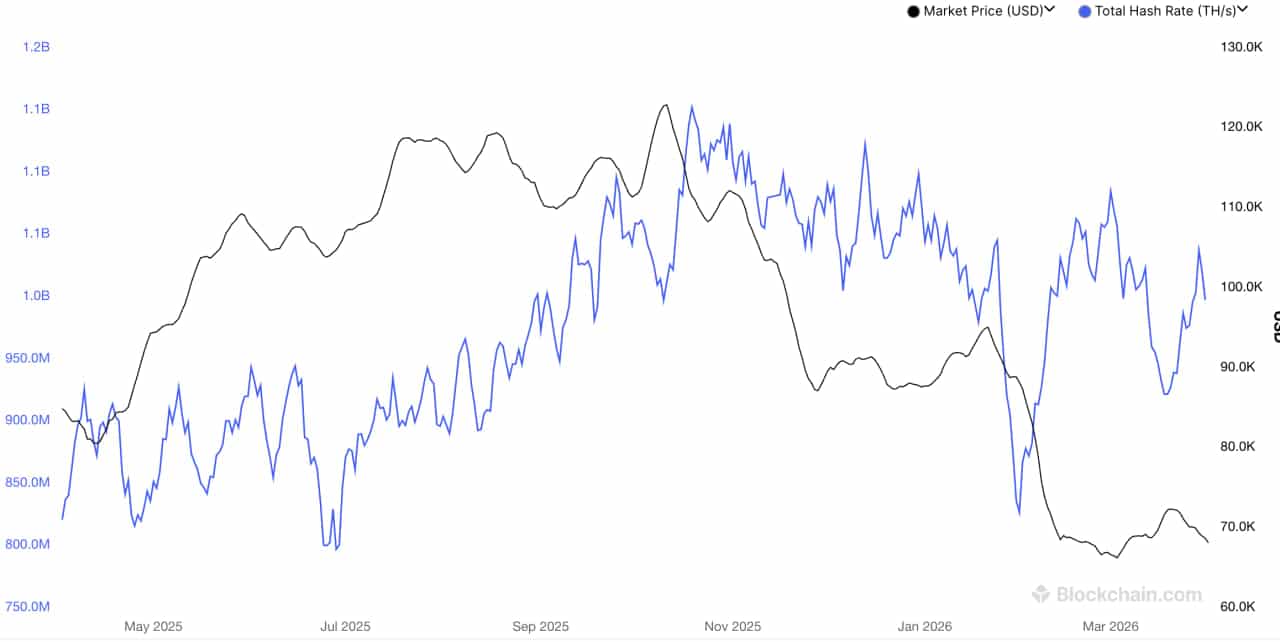
Bitcoin Mining Nationalization: Hash Rate Distribution and BTC Supply Implications
The transmission chain operates as follows: the certification regime, combined with the tax exemption incentive, creates a structural tilt toward domestic hardware procurement that – if adopted at scale – would concentrate an increasing share of U.S. hash rate among operators whose capital expenditure cycles are now tied to a nascent domestic ASIC manufacturing base rather than the established Bitmain and MicroBT supply chains.
Source: Blockchain
The United States currently controls approximately 38% of global Bitcoin hash rate, a figure that makes it the dominant single-jurisdiction contributor to network security, yet one achieved almost entirely on imported hardware whose firmware integrity has already been called into question by late 2024 U.S. Customs inspections that identified remote-access vulnerabilities in imported Chinese mining rigs.
We anticipate that the near-term hardware transition cost – sourcing certified equipment from a domestic manufacturing base that does not yet exist at commercial scale – will compress margins for mid-tier miners who lack the capital to absorb dual procurement cycles, potentially accelerating consolidation toward larger, better-capitalized operators who can participate in the Treasury sales program. The parallel to the post-2021 China mining ban is instructive but imperfect: that episode redistributed hash rate geographically without altering the hardware supply chain; the Mined in America Act, if enacted, targets the supply chain itself.
On the supply side, the Treasury procurement channel introduces a buyer whose acquisition behavior is not governed by profit motive – a structural novelty in Bitcoin’s market history. We suspect the effective float of newly mined BTC available to secondary markets would narrow if a meaningful share of certified mining output is routed directly to the reserve, a dynamic with directional implications for spot supply that analysts have not yet fully priced into hash-rate-adjusted valuation models.


