


Bitcoin broke above $80,000 for the first time since February, backed by $1.98B in taker volume, but on-chain structure signals the move is not yet complete.
Key Takeaways
Bitcoin at $80,300, first return to $80K since February 2026.
Binance taker buy volume: $1.98B across two consecutive hours.
Two hourly spikes: $1.19B and $792M at the breakout.
ETF buyer cost basis acted as support before the move.
6-12M realized cap share risen to 27.5%.
RSI at 74.77 on 1H: overbought on shorter timeframe.
All three MAs below price.
Holding $80,000 on daily close is the confirmation signal.
$1.98 Billion in Two Hours Is Not a Normal Breakout
Bitcoin trades at $80,300 on May 4, its first print above $80,000 since February 2026. The price did not drift there. It was pushed by two consecutive hourly taker buy volume spikes on Binance: $1.19 billion in the first hour and $792 million in the second, combining to $1.98 billion in a two-hour window, per CryptoQuant data.
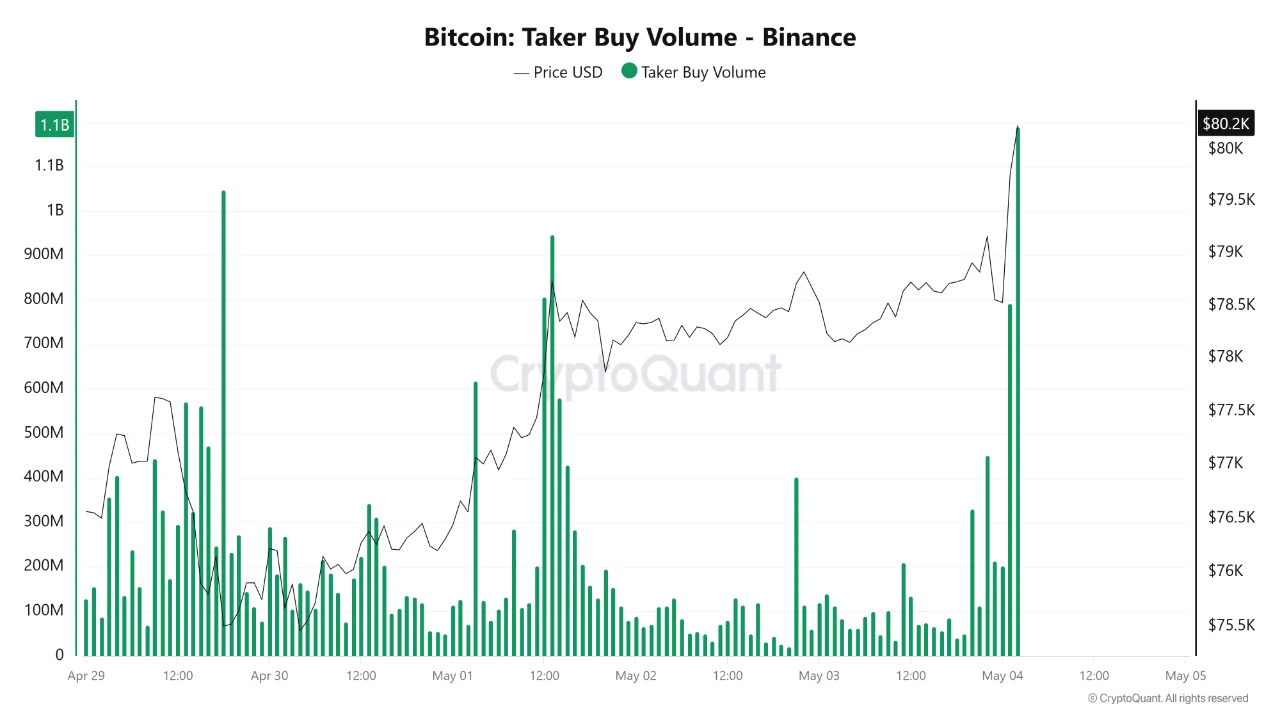
Taker buy volume at that magnitude means buyers were not placing limit orders and waiting. They were hitting asks, paying whatever price sellers demanded, to get filled immediately. That behavior at a major psychological level does not describe patience. It describes urgency.
The prior volume spikes visible in the same CryptoQuant window, from April 29 through May 3, ranged between $500 million and $1 billion. The May 4 spike is the outlier by a factor that makes every prior session look quiet. The breakout was not gradual accumulation finally tipping into price. It was a concentrated burst of aggressive demand hitting the market at the exact moment price tested $80,000.
The Floor That Made the Breakout Possible
Volume explains the urgency. The ETF cost basis explains why $80,000 was reachable at all.
CryptoQuant’s UTXO Age Bands analysis shows Bitcoin rebounding from the average cost basis of institutional investors who entered the market following the approval of spot Bitcoin ETFs. That cohort, the first wave of institutional capital to access Bitcoin through regulated products, held their positions as price tested their entry level. They did not sell. That absorption created the floor the May 4 breakout launched from.
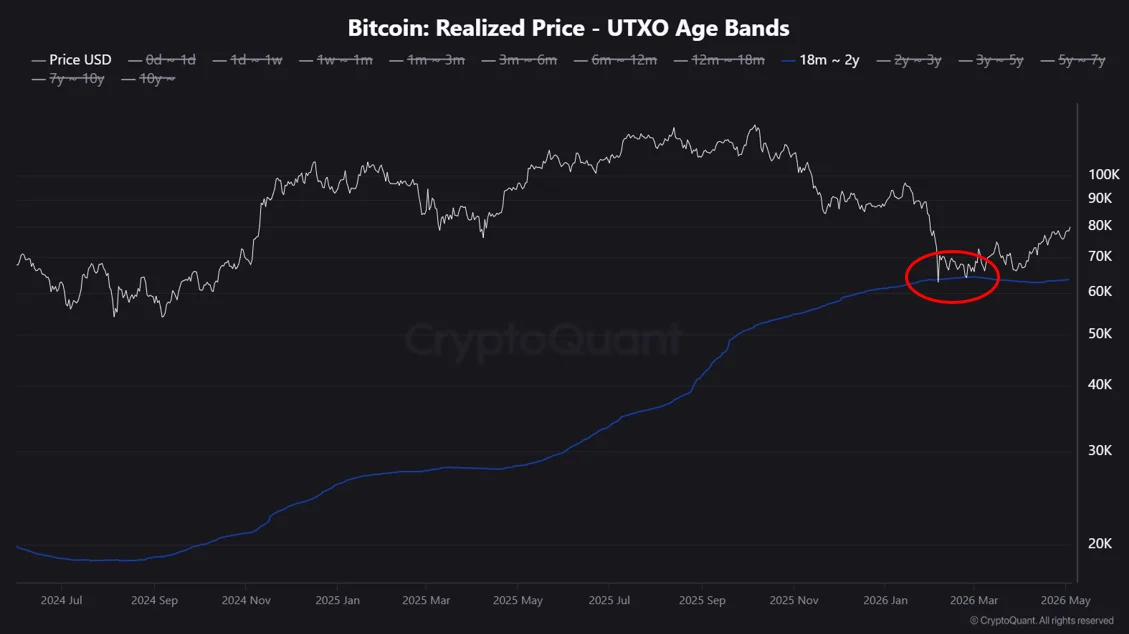
This is the structural variable that did not exist in prior cycles. In 2021, in 2018, in every prior Bitcoin correction, there was no institutional cohort with a defined, measurable cost basis acting as a demand wall. The ETF approval created that cohort. Their cost basis is now a support level visible in on-chain data. When price tested it and held, it was not retail sentiment driving the bounce. It was institutional holders not blinking.
A bounce from retail sentiment is fragile. A bounce from institutional cost basis is structural. Those holders have compliance frameworks, investment mandates, and longer time horizons than traders chasing momentum. They did not buy to sell at the first $80,000 print.
What the 27.5% Realized Cap Reading Actually Means
The ETF cost basis signal is bullish. The 6-12M realized cap reading is not bearish. It is incomplete.
The 6-12 month realized cap share has risen to approximately 27.5%. This measures the proportion of Bitcoin’s realized value represented by coins that last moved between six and twelve months ago. A rising reading in this cohort means supply is sitting in hands that have held for six to twelve months, long enough to suggest conviction, not long enough to confirm mature long-term holder status.
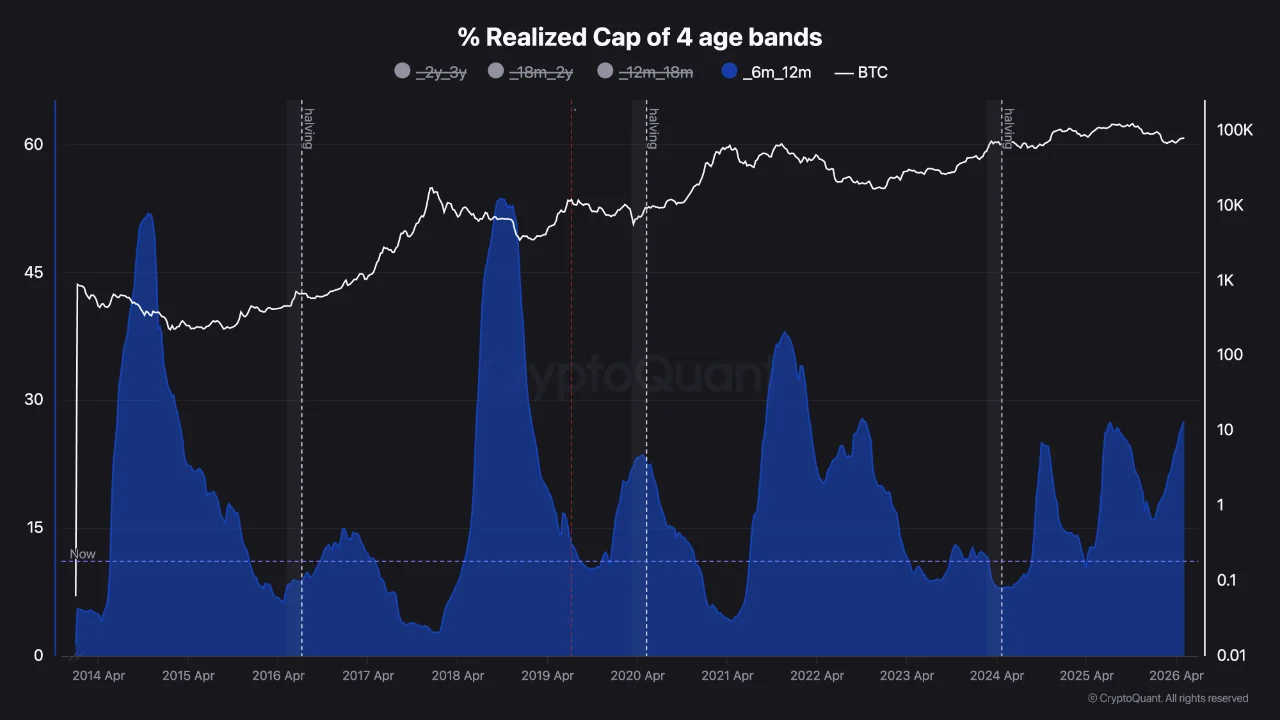
In prior cycles, CryptoQuant notes, expansions in this cohort appeared before broader accumulation phases and then declined as supply either redistributed or continued aging into the long-term holder band. The current structure is therefore intermediate. It is not the completed accumulation setup that preceded the sustained bull phases of 2020-2021 or 2016-2017. It is the transition layer, supply moving from shorter-term hands into medium-term ones, with the question of whether it continues aging or gets redistributed at higher prices still open.
The 27.5% reading does not deny the $80,000 breakout. It contextualizes it. The move is real. The structural completion that would confirm a new sustained phase is not yet in place.
Why the RSI and Supply Structure Warn Against Assuming It Holds
The counter-argument is written in the RSI. At 74.77 on the 1H chart, Bitcoin is in overbought territory on the shorter timeframe. The $1.98B taker buy surge that drove the breakout is exactly the kind of aggressive, urgency-driven volume that precedes short-term pullbacks when it cannot be sustained. Buyers who chased confirmation at $80,000 are now the most exposed participants in the market. They paid the highest prices and have no buffer if price reverts.
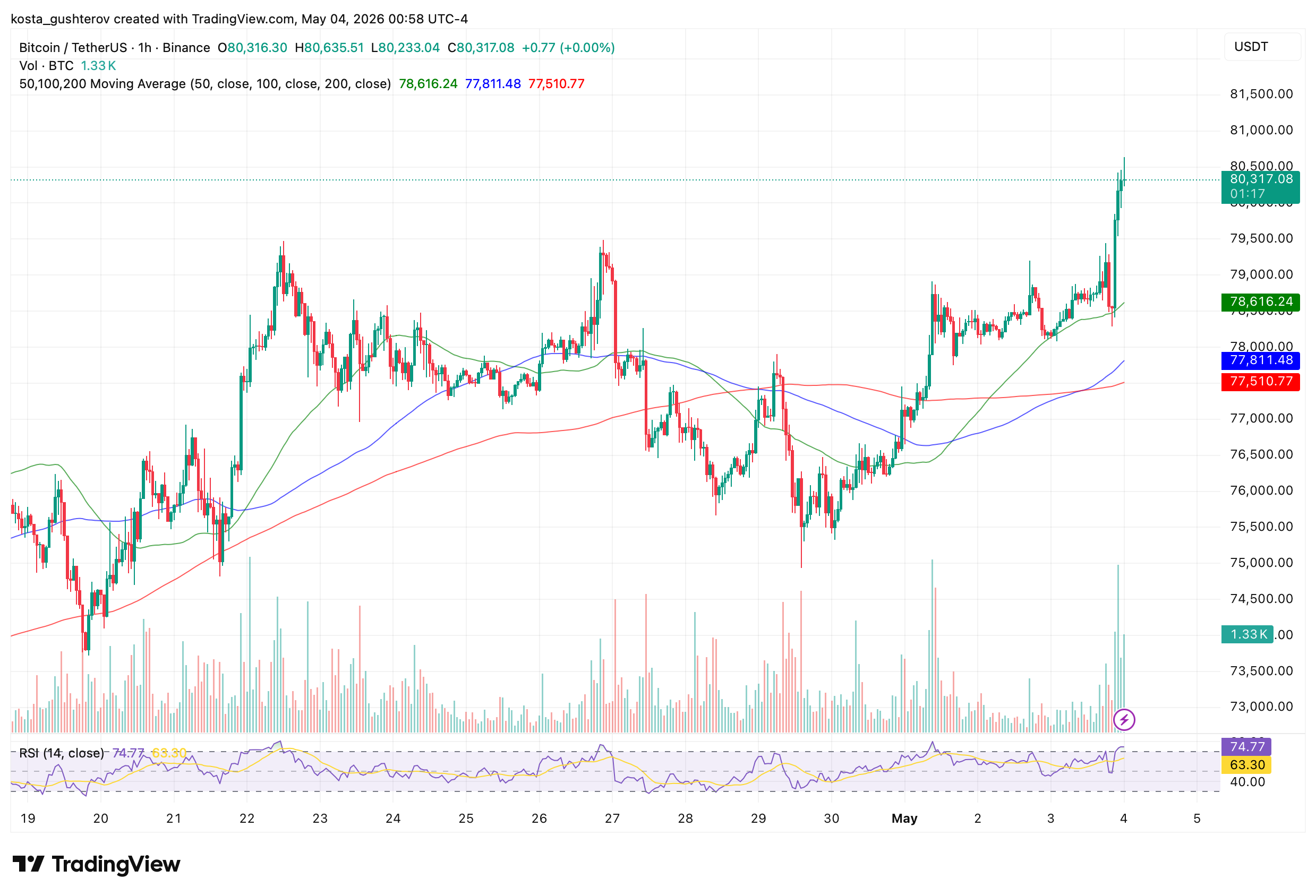
CryptoQuant frames this directly: if price fails to sustain the breakout, aggressive buyers entered late and are vulnerable to a short-term pullback. The $80,000 level now functions as both the target that was just achieved and the support that must hold. Those are two very different conditions.
The 6-12M realized cap at 27.5% adds a second caution. Supply in transition is supply that can move. If the breakout stalls, medium-term holders who bought six to twelve months ago, many of whom are now in profit, have both the motive and the ability to redistribute at current prices.
What limits the bear case: all three moving averages are below price and stacked in bullish order. The 50-MA at $78,616, 100-MA at $77,811, and 200-MA at $77,510 form a support cluster $1,700 to $2,800 below current price. A pullback has structure to land on. A reversal would have to break through three converging averages. That is a different and more difficult outcome than a retest.
The Daily Close That Converts Event Into Phase
The confirmation signal is Bitcoin closing the daily candle above $80,000 today, May 4. A daily close above $80,000 converts the intraday print from a breakout attempt into a confirmed level reclaim. Combined with the ETF cost basis holding as structural support and $1.98B in taker volume confirming demand urgency, a daily close above $80,000 would be the clearest signal that the move has follow-through.
The denial signal is Bitcoin closing the daily candle below $78,616, the 50-MA. That outcome would confirm the taker buy surge was a late-entry momentum chase that failed to sustain, placing the May 4 move in the category of a failed breakout rather than a reclaim.
The ETF cost basis held. $1.98B showed up at the right level. The 6-12M realized cap says the structure is not finished. The daily close answers which of those three facts matters most right now.


