

Circle stock closed +19.9% higher on May 4 after lawmakers reached a weekend compromise on the CLARITY Act news that preserves usage-driven crypto yield programs for stablecoin issuers, a provision that directly alters how USDC can compete for user deposits against bank-issued alternatives and offshore rivals like Tether.
The key update, finalized in bill language on Friday, draws a legal line between passive savings-account-style interest, reserved for traditional banks, and activity-based rewards tied to trading, transactions, or staking, which regulated issuers like Circle can now offer.
The compromise ends months of legislative gridlock that had weighed directly on Circle’s valuation. Coinbase withdrew support for the bill in January over disputes around yield restrictions, stalling Senate markup indefinitely and generating the kind of policy overhang that depressed the stock, including a -20% single-session drop earlier in the cycle amid concerns over Tether’s US expansion.
Senators Thom Tillis (R-N.C.) and Angela Alsobrooks (D-Md.) finalized the compromise text, threading a needle that satisfied traditional banking interests while preserving the product functionality crypto platforms need to compete.
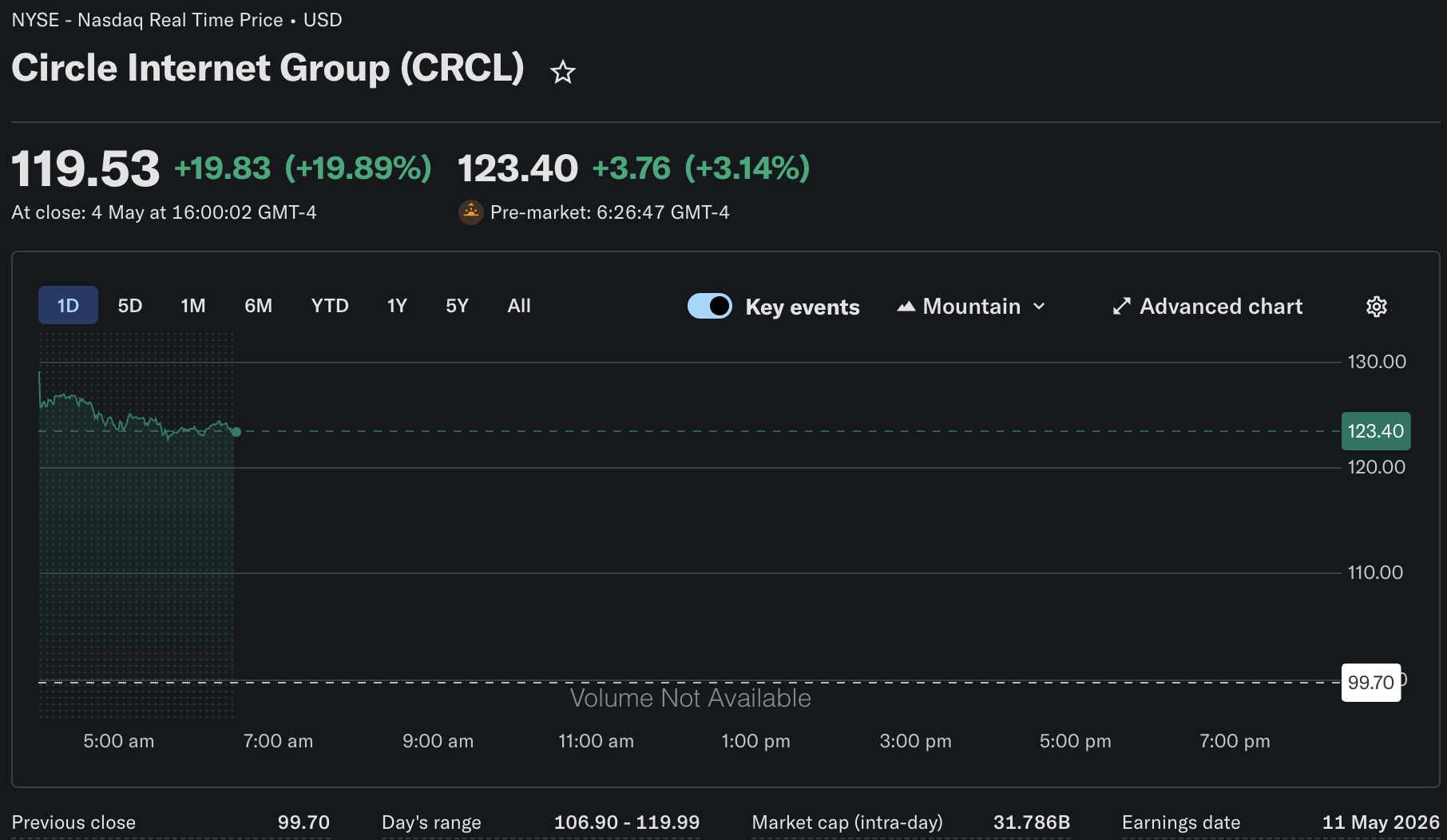
(SOURCE: Yahoo Finance)
What the Rewards Clause Actually Changes for Circle and USDC
The previous legislative framework threatened to completely ban third-party rewards on stablecoins, alarming investors reliant on yield from USDC.
The compromise creates a legal category for activity-based rewards that Circle and its partners can offer without SEC classification as securities.
However, Circle cannot pay a blanket yield on USDC; that role remains with chartered banks. Instead, rewards can be linked to verifiable activities like trading volume and staking participation.
USDC’s growth, from a $30Bn market cap to an $80Bn market cap, is driven more by trading and payments than by yield. Circle generated $2.64Bn in reserve income in FY2025 from Treasury-backed reserves, not from yield distribution.
Analysts labeled the compromise a “scaling setback” but not detrimental to USDC’s growth potential. The changes affect distribution partners more, requiring adjustments to products like Coinbase’s 3.5% USDC yield, which is identified as a distributor-level issue.
$CRCL 持续走强的核心逻辑:
合规稳定币龙头 USDC(≈790B 流通)+ AI Agent 支付基础设施叙事 + 美国稳定币法案落地 + 业绩兑现预期
从周期股到 Web3+AI 基建龙头,估值重估才刚开始 pic.twitter.com/Kup3Bk1kls
— Young (@Young852560) May 5, 2026
CLARITY Act News: Why a Regulatory Clause Triggered a 19.9% Sentiment Surge
The market reaction centered on the removal of regulatory uncertainty that had constrained Circle’s valuation. Quiver Quant linked the rally to reduced regulatory concerns, prompting investors to reassess Circle’s risk profile.
Analyst consensus currently holds a Hold rating on Circle (CRCL) with an average price target of $127.24, indicating the market is pricing in a base case rather than a bullish outlook.
Bank of America’s Ebrahim H. Poonawala noted that the Clarity Act’s resolution of the stablecoin yield debate is a net positive for banks, alleviating concerns about deposit flight and enabling better engagement with digital assets.
Additionally, Meta’s USDC-based creator compensation and Visa’s blockchain expansion positioned institutional adoption favorably ahead of this legislative clarity.
Where the Clarity Act Stands After the Compromise
CLARITY ACT COMPROMISE BANS STABLECOIN REWARDS FROM LOOKING LIKE BANK INTEREST
Senators Thom Tillis (R-NC) and Angela Alsobrooks (D-MD) have issued a joint statement confirming a bipartisan compromise on Section 404 of the CLARITY Act, signaling the deal is effectively locked… pic.twitter.com/dKb675dPg9
— BSCN (@BSCNews) May 5, 2026
The rewards clause is resolved, but the Clarity Act is still in progress. The Senate committee markup is set for May 11, aligned with Circle’s Q1 2026 earnings release.
Regulators need to propose new stablecoin disclosure rules and define reward structures, which will add implementation delays even after the bill passes.
Jurisdictional issues concerning DeFi and the SEC/CFTC boundary remain unresolved. Coinbase’s Faryar Shirzad noted banks secured more restrictions on rewards, but emphasized the importance of allowing Americans to earn rewards from cryptocurrency use.
CEO Brian Armstrong supported the outcome with a simple “Mark it up.” The legislative dynamics around the Clarity Act highlight current Senate support.


