


Whale realized prices held as support during the recent correction, exchange reserves fell to 2023 lows across three platforms, and institutional flows have structurally changed Bitcoin's market behavior.
Key Takeaways
Whale realized price support: $66K-$70.6K range held during correction.
Above this range: local bottom may be established.
Binance reserves: 670K to 620K BTC since Feb 21, $4B+ removed.
OKX reserves: 132K to 102K BTC since March 2, $2.4B removed.
Gemini reserves: 114.8K to 95K BTC since Feb 4, $1.6B removed.
Total: 100,000 BTC removed from three exchanges, worth $8B+.
Weekend inflow gap now visible: institutional flows follow TradFi calendar.
Structural shift began 2018, accelerated through 2020.
Three Signals, One Story
Three independent Bitcoin datasets and none of them references the others. Individually, each signal is significant. Together they describe the same market transformation from three different measurement angles.
The retail-dominated, 24/7 Bitcoin market of 2016 no longer exists. The institutional-dominated, weekday-concentrated market of 2026 has replaced it. The three datasets are measuring different aspects of that same transformation.
Signal One: The Whale Floor That Held
During the recent Bitcoin correction, spot price dropped toward the realized prices of two key whale cohorts. Whales active in the last one to seven days held a realized price of approximately $66,000. Whales active in the last seven to thirty days held a realized price of approximately $70,600 according to report by CryptoQuant.
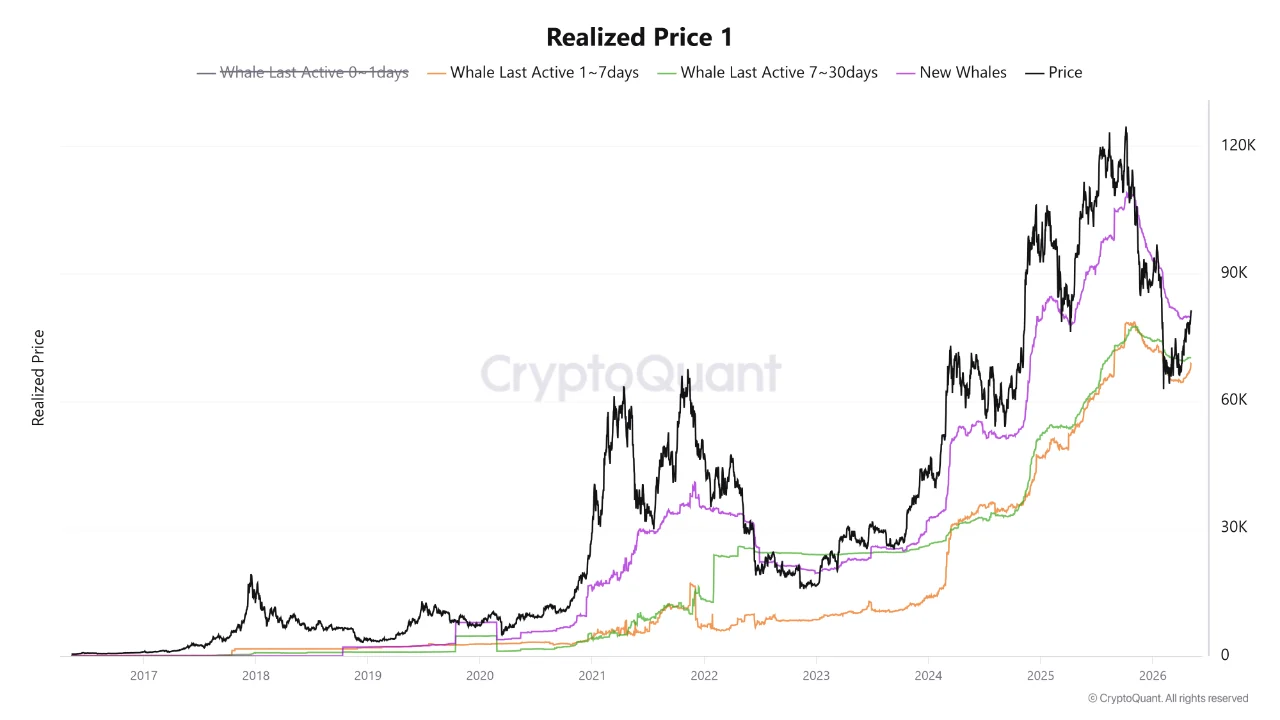
The $66,000 to $70,600 range functions as a break-even zone for these recent whale cohorts. When price approaches a large holder’s cost basis, selling pressure typically decreases: holders who bought near that level are reluctant to realize losses. The same zone simultaneously becomes an attractive re-accumulation area for new buyers who see large holders defending their positions.
Per CryptoOnchain’s analysis, the positive price rebound from this range confirms that short-term whale holders provided meaningful demand support during the correction. The structural implication is specific: as long as Bitcoin holds above $70,600, the recent correction has the character of a local bottom. Bitcoin losing the $66,000 whale support level would invalidate that reading and signal a more serious structural breakdown.
The whale realized price is not a technical level drawn on a chart. It is the actual average cost basis of identifiable large holders calculated from on-chain data. When price bounces off that level, it is not a coincidence. It is the market responding to where real money is anchored.
Signal Two: $8 Billion Leaves Three Exchanges
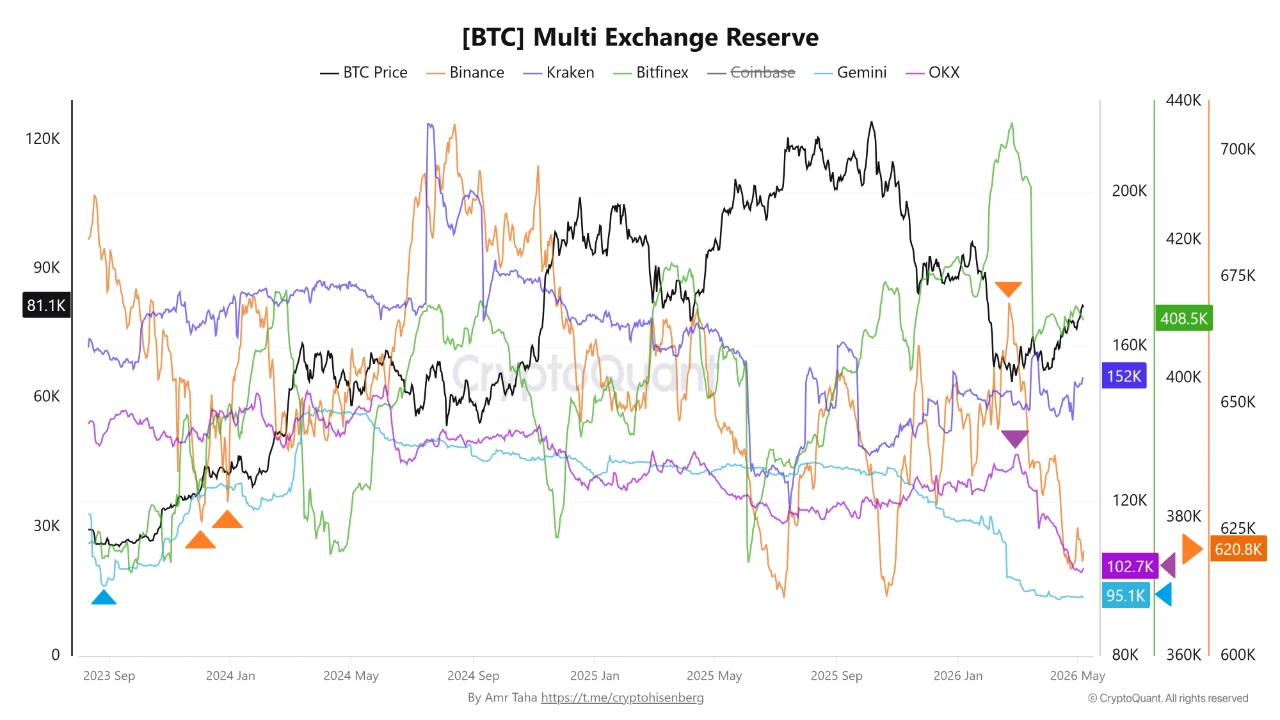
Nearly 100,000 BTC has left Binance, OKX, and Gemini since February 2026, worth more than $8 billion at Bitcoin’s current price near $81,100. All three exchanges are now at their lowest reserve levels since 2023.
The breakdown by exchange:
Binance: fell from approximately 670,000 BTC on February 21 to around 620,000 BTC on May 7, a decline of 50,000 BTC worth more than $4 billion
OKX: fell from nearly 132,000 BTC on March 2 to around 102,000 BTC on May 7, a decline of 30,000 BTC worth approximately $2.4 billion
Gemini: fell from around 114,800 BTC on February 4 to nearly 95,000 BTC on May 7, a decline of 19,800 BTC worth roughly $1.6 billion
The significance is not the individual exchange movements but their synchronization. Three major exchanges declining simultaneously to multi-year lows describes a coordinated withdrawal from sell-side liquidity pools. Exchange reserves represent Bitcoin that is readily available for trading or selling. When reserves fall across multiple platforms at the same time, the sell-side supply tightens.
The supply tightening argument is structural: fewer coins sitting on exchanges means less immediately available selling pressure. When demand recovers in a lower-supply environment, the price impact of each unit of new demand is amplified. The $8 billion exit from three exchanges since February has been building that amplification effect quietly while price consolidated.
Signal Three: Bitcoin No Longer Trades Like It Did in 2016
Darkfost’s analysis of Bitcoin exchange inflows from spent UTXOs reveals a structural change in how Bitcoin is traded that most market participants have not fully internalized.
In 2016, Bitcoin exchange inflows were continuous and relatively constant, fluctuating between 20,000 and 60,000 BTC per day, seven days a week. The pattern was flat across the full week. There was no meaningful difference between Monday and Saturday in terms of how much Bitcoin entered exchanges.
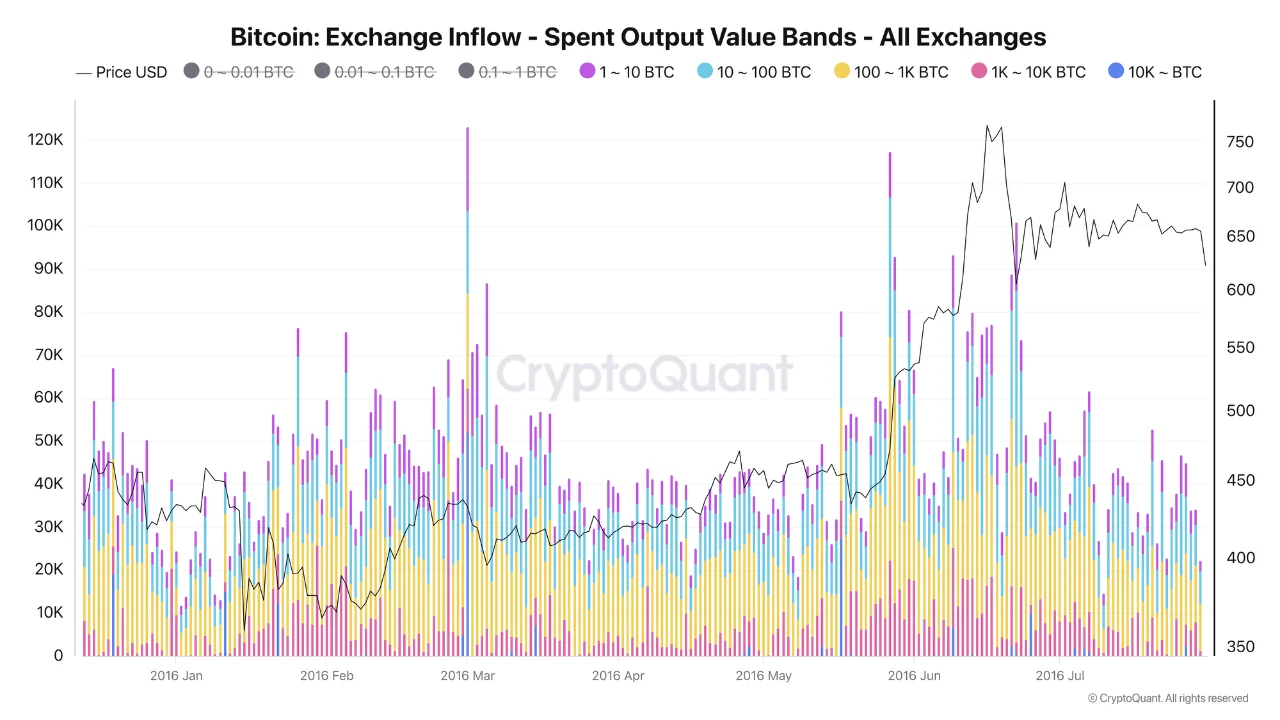
Today the pattern looks completely different. Total weekly inflow volumes are broadly comparable to 2016 but the distribution across the week has changed fundamentally. A clear two-day gap now appears every week: weekend inflows drop sharply while weekday inflows remain active.
The explanation is institutional dominance. Institutional investors operate on traditional financial market schedules. They manage portfolios, execute trades, and make allocation decisions on weekday calendars tied to equity market hours. When Bitcoin’s dominant participants operate on a Monday-to-Friday schedule, Bitcoin’s on-chain activity mirrors that schedule.
The transition started around 2018 and accelerated through 2019 and 2020 as a sequence of institutional infrastructure milestones were reached: CME and CBOE futures launched in December 2017, Fidelity introduced crypto custody in 2018, Bakkt entered with physically settled BTC futures in 2019, and Grayscale’s Bitcoin Trust alongside MicroStrategy’s accumulation began in 2020. Each milestone brought a new category of institutional participant into the Bitcoin market. Each category operated on a traditional financial calendar.
The consequence is a Bitcoin market that increasingly correlates with equity markets and follows weekday patterns. Darkfost frames this as a structural transformation that may change Bitcoin’s historical cyclicality: the four-year halving cycles and predictable boom-bust patterns that characterized the retail-dominated era may no longer apply in the same form.
Supply Tighter, Floor Held, Structure Changed: What All Three Say Simultaneously
The whale support data, the exchange reserve data, and the institutional flow data are measuring the same market from three different angles.
Exchange reserves declining to 2023 lows describes the supply side: less Bitcoin is sitting ready to be sold. Whale realized prices holding as support describes the demand side: identifiable large holders are defending their cost basis and not selling into weakness. Institutional dominance of flows describes the structural reality: the participants who now control Bitcoin’s market are not the same participants who drove its 2016 behavior, and they operate on different schedules with different risk frameworks.
The counter-argument is that exchange outflows do not automatically mean accumulation. Bitcoin can leave exchanges for custody purposes, OTC settlement, or collateral management without representing bullish conviction. The synchronized decline across three exchanges is a supply signal, not a demand signal. Supply tightening only produces price appreciation when demand is present.
The whale support data is the bridge between the supply and demand sides. Active buyers are defending the $66,000 to $70,600 range on-chain while exchange supply tightens. That combination, tightening supply and active demand defense, describes the structural setup for a more responsive market when new demand enters.
The confirmation signal is Bitcoin holding above the whale realized price support of $70,600 while exchange reserves continue declining. That combination would confirm the supply tightening is meeting sustained demand rather than distributing into weak hands.
The denial signal is Bitcoin losing the $66,000 whale support level while exchange reserves stabilize or increase. Reserve stabilization at current levels combined with whale support breakdown would confirm that the $8 billion outflow was repositioning rather than accumulation, and that the demand floor the whale data identified has been breached.
Three signals. One market. The structure has changed. The floor held. The supply is tighter. What happens when demand returns to a market with all three of those conditions simultaneously is what the data is pointing toward.


