

In Solana news today, at Consensus Miami 2026, Lily Liu, president of the Solana Foundation, made a structural argument that goes well beyond payment speed: Solana is positioning itself as the operating layer for the Machine Economy, the emerging infrastructure where AI agents transact autonomously, in real time, at volumes and velocities that no traditional financial rail can accommodate.
The evidence of corporate adoption is accumulating rapidly, with Meta, Western Union, and Visa all building on Solana’s rails.
The central tension is whether a network optimized for throughput and cost efficiency can also serve as a trustless, decentralized infrastructure, and whether that tension even matters if the AI economy’s demand for permissionless, high-frequency settlement proves dominant enough to define the outcome.
It comes as SOL USD trades at $90, up a modest +0.5% on the day, while the broader market has experienced an overnight pullback, signaling strength in Solana.
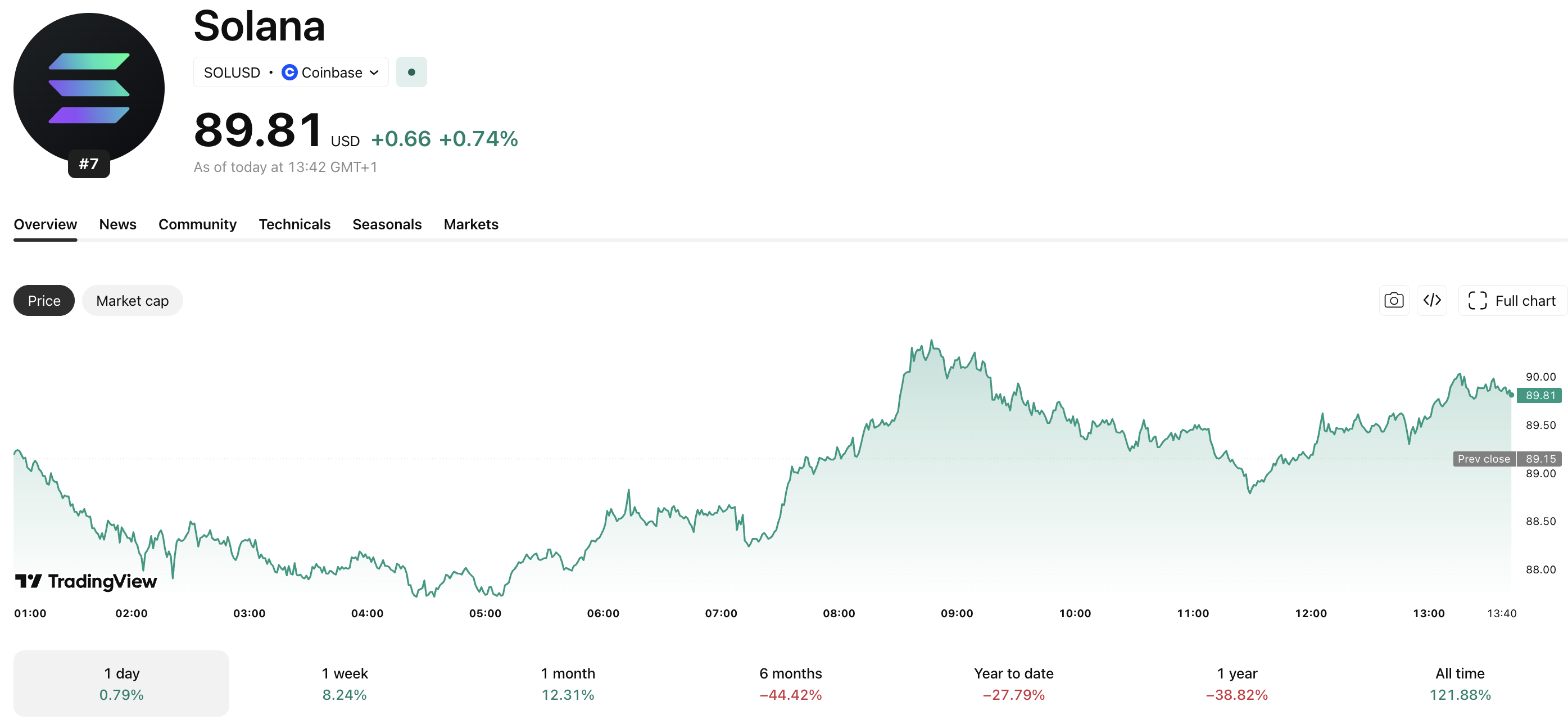
(SOURCE: TradingView)
Solana News and the AI Agent Economy: Why Micro-Transactions Are the Bottleneck
Liu’s infrastructure issue highlights the need for AI agents, autonomous software that can handle real-time payments of thousands of sub-cent transactions without human intervention.
Traditional card networks make this unfeasible due to high interchange fees, which result in losses for transactions under $0.30. As Liu noted at Consensus Miami, most online transactions fall into the microtransaction category, making credit card processing impractical.
Solana’s architecture solves this problem with its Proof of History consensus and Sealevel transaction engine, achieving over 65,000 transactions per second at costs under $0.001.
This makes sub-cent payments viable at scale, unlike on Ethereum or complex L2 solutions, where bridging adds friction. The Machine Economy concept emphasizes that Solana’s scalability is essential for high-frequency AI agent commerce.
Lily Liu’s Permissionless Rails Vision and What It Means for Autonomous Commerce
Tech, capital and policy converged in Miami to showcase the future of Solana and America at the biggest Accelerate ever ?? pic.twitter.com/gdq9i1rymS
— Solana (@solana) May 6, 2026
Liu’s comments at Consensus Miami highlight Solana’s role as a permissionless financial layer designed for entities, including AI agents, that lack access to traditional banking. Unlike banks, which require KYC and AML processes, Solana wallets can be created instantly, enabling autonomous commerce at scale.
The corporate adoption of Solana reinforces this direction. Visa’s extensive review led to the development of stablecoin settlement capabilities on Solana, signaling strong confidence in the infrastructure. Western Union’s integration, once seen as a major hurdle for crypto, signifies the successful conversion of traditional institutions.
Similarly, Meta’s stablecoin integration adds consumer volume, further supporting Solana’s ecosystem and its ability to deliver the liquidity, developer density, and application breadth required for enterprise payment solutions.
The Solana Foundation’s defense of ecosystem interventions amid security issues reveals a pragmatic approach. In striving for institutional-grade infrastructure for AI, reliability takes precedence over ideological purity.
The Efficiency-Decentralization Trade-Off: What Solana Concedes in the Machine Economy Race
The bull case for Solana news as the AI OS is valid, but there are significant counterarguments. Solana’s validator set is more concentrated than Ethereum’s, raising concerns about censorship resistance.
The network has faced several major outages since 2021, and for infrastructure serving AI commerce, reliability is crucial. An outage in a high-frequency machine-to-machine payment network can have far more severe consequences than a retail DeFi outage.
Competitive pressure is increasing, with Ethereum’s EIP-4844 reducing L2 transaction costs to fractions of a cent on networks like Arbitrum and Optimism, diminishing Solana’s cost advantage.
Additionally, decentralized GPU networks like Aethir, capable of 500,000 TPS, indicate that AI workloads may shift to specialized networks rather than rely on a single chain. While Solana’s efficiency is noteworthy, its long-term durability remains uncertain.


