


a16z crypto reports tokenized RWAs have surged 10x in two years to top $30B, with nearly half in U.S. Treasury debt, but the chart behind that number shows the steepest growth is happening right now, not in the past.
Key Takeaways
Tokenized RWA market topped $30B.
Nearly half, approximately $15B, held in U.S. Treasury debt.
Steepest growth visible: January to May 2026.
Near-zero in July 2023 – entire $30B accumulated in under three years
Source: rwa.xyz, data as of May 7, 2026, via a16z crypto (@a16zcrypto)
A16z crypto reported that tokenized real-world assets have “surged 10x in two years, now topping $30B.” The headline figure is accurate and significant. The chart behind, generated by RWA.xyz data, shows something the headline number does not: the growth is accelerating, not plateauing. The steepest growth in the RWA chart is the most recent growth, which means the market is not normalizing after a spike: it is accelerating into a larger structure.
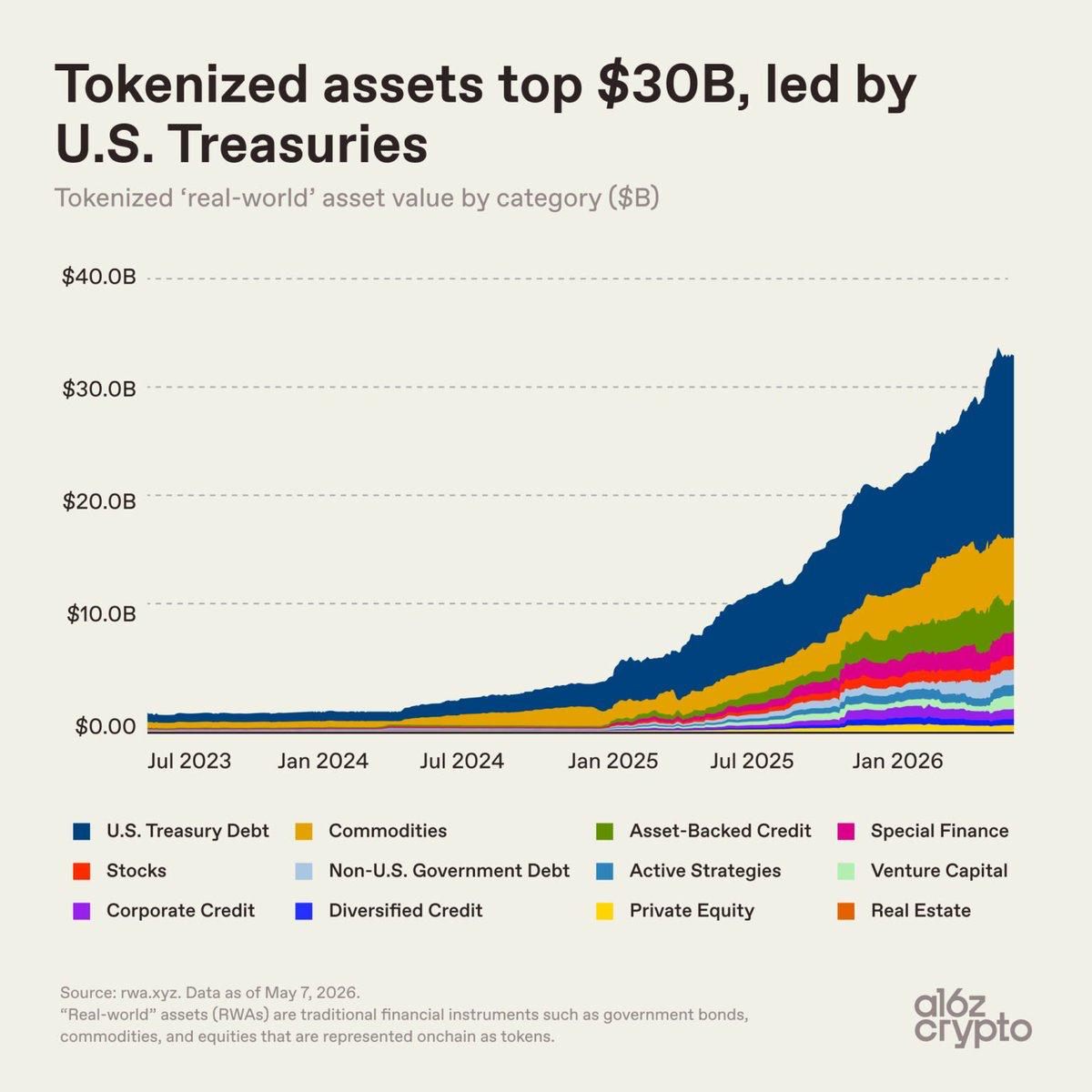
From July 2023 through the end of 2024, growth was gradual and largely confined to U.S. Treasury debt. From January 2025 onward, the curve began steepening. From January 2026 to May 2026, the chart shows a near-vertical ascent from approximately $20B to $30B. The 10x growth took roughly two and a half years in total, but the last $10B of it took approximately five months.
That compression reframes what the $30B figure means. A market that grows 10x linearly is expanding at a steady pace. A market that grows 10x with the steepest growth at the end is entering an exponential phase. The $30B figure is not the ceiling of a completed cycle: it is the steepest point on a curve that is still rising.
Why Treasuries Dominated First and What Their Decline in Share Means
U.S. Treasury debt accounts for nearly half of the $30B total, approximately $15B. That dominance is not accidental. Treasuries are the simplest asset to tokenize: fixed income instruments with clear legal ownership, deep secondary market liquidity, standardized documentation, and no valuation ambiguity. When blockchain infrastructure for RWAs was nascent, institutions chose the asset class with the lowest tokenization complexity. Treasuries were the path of least resistance into on-chain finance, and they remain the dominant category today.
Approximately $15 billion of U.S. government debt now sits on blockchain rails, which means the instrument that defines the global risk-free rate is being used to bootstrap the on-chain financial system. A government’s own debt instrument being used to bootstrap the on-chain financial system is not a crypto milestone: it is a monetary infrastructure event. U.S. Treasuries on blockchain rails means the yield curve, the benchmark against which every other financial asset is priced, is now partially accessible and settable on-chain. That is not a crypto product. It is a structural change in how government debt distributes.
Twelve Categories and What the Progression Reveals
The chart’s legend lists twelve distinct categories: U.S. Treasury Debt, Commodities, Asset-Backed Credit, Special Finance, Stocks, Non-U.S. Government Debt, Active Strategies, Corporate Credit, Diversified Credit, Venture Capital, Private Equity, and Real Estate. Through mid-2024, the chart shows almost exclusively Treasury debt. From late 2024, commodities and asset-backed credit begin appearing. From 2025 onward, private equity, real estate, venture capital, and stocks all start registering visible scale.
The category progression from Treasuries to commodities to private equity is not diversification for its own sake: it is a map of how complex an asset must be before blockchain infrastructure can handle it, and that map shows the infrastructure is maturing faster than most expected. Each new category requires its own legal framework, valuation methodology, custody solution, and regulatory approval. The fact that all twelve are now present and growing simultaneously indicates that the infrastructure buildout is no longer sequential: it is parallel. The counter-argument is that most non-Treasury categories remain small relative to the total. Private equity, real estate, and venture capital combined likely represent less than 5% of the $30B. The category breadth is real.
The category depth, outside Treasuries and commodities, has not yet arrived at scale. The confirmation signal is the non-Treasury share of total RWA value exceeding 60% within 12 months, which would indicate that the market has genuinely diversified beyond its bootstrapping asset. The denial signal is Treasury debt share increasing rather than declining in the next two quarterly readings, which would indicate that the new categories are growing in absolute terms but not gaining structural share against the dominant incumbent.


