


Exchange reserves reached a multi-week high as inflows landed during every dip, yet $2,250 held, and that combination defines what happens next.
Key Takeaways
Three inflow spikes totaled 439,850 ETH in three days.
Combined value: approximately $1,023,000,000.
All three events occurred during corrective price phases.
Binance ETH reserve rose from 3.3M to 3.62M ETH.
Reserve now 24.6% of total ETH held across exchanges.
4H MAs compressed in $29 range around current price.
RSI neutral at 51.93, no directional commitment.
Over $1 billion in ETH moved to Binance across three discrete events in the first days of May, each among the largest inflow spikes recorded since March. On May 6, 216,152 ETH worth approximately $511,000,000 moved to the exchange.
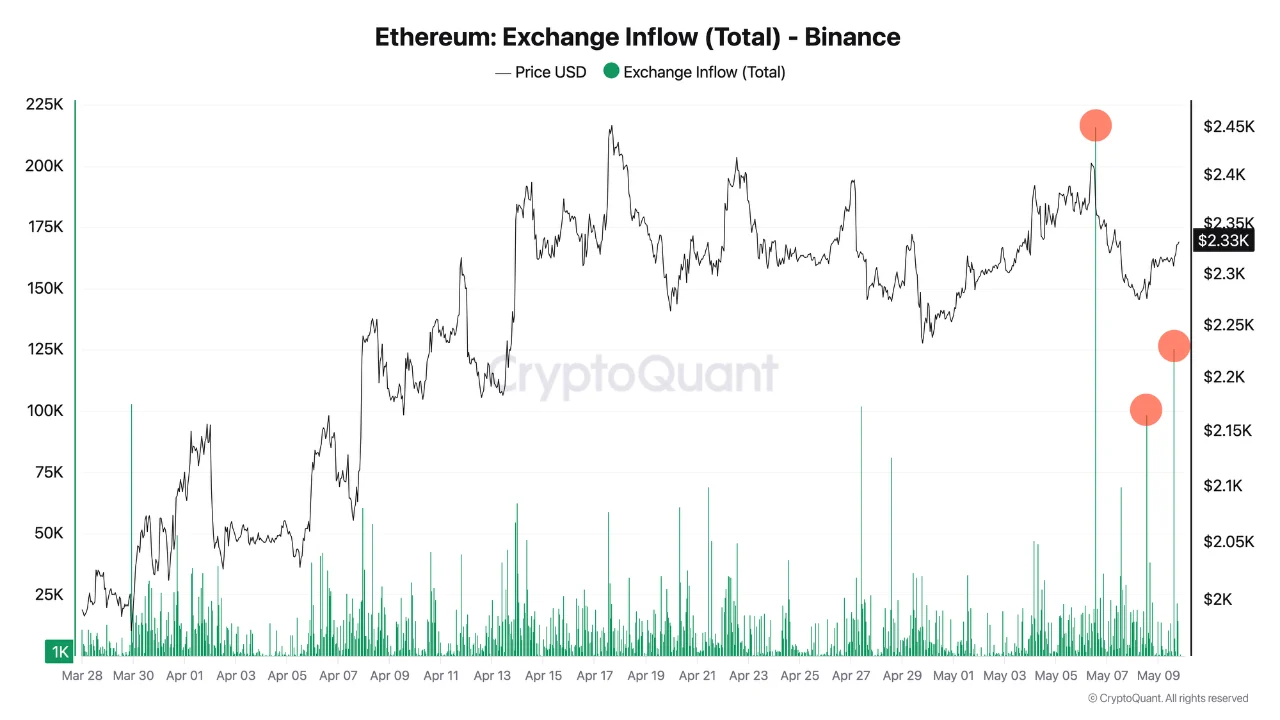
On May 8, 98,552 ETH worth approximately $224,000,000 followed. On May 9, 125,146 ETH worth approximately $288,000,000 arrived. CryptoQuant analyst Darkfost identified a specific pattern across all three: every transfer occurred while price was entering a corrective phase, suggesting emotional reactions from large holders rather than systematic profit taking at predetermined levels.
The distinction matters. Calculated profit taking happens at resistance, at price targets, at cycle highs. Emotional selling happens at the first sign of weakness, regardless of where price sits relative to structure. Every one of these three spikes landed while ETH remained inside the $2,250 to $2,450 consolidation range, well above the 4H 200 MA at $2,302.93.
320,000 ETH Arrived and Did Not Leave
Binance ETH reserves bottomed near 3.3M ETH in early April and have risen to 3.622M ETH as of May 10, an increase of 320,000 ETH in roughly five weeks. That reserve now represents 24.6% of all ETH held across centralized exchanges. Rising exchange reserves mean more ETH is available to be sold. The direction of reserves is unambiguous: supply on the exchange is increasing.
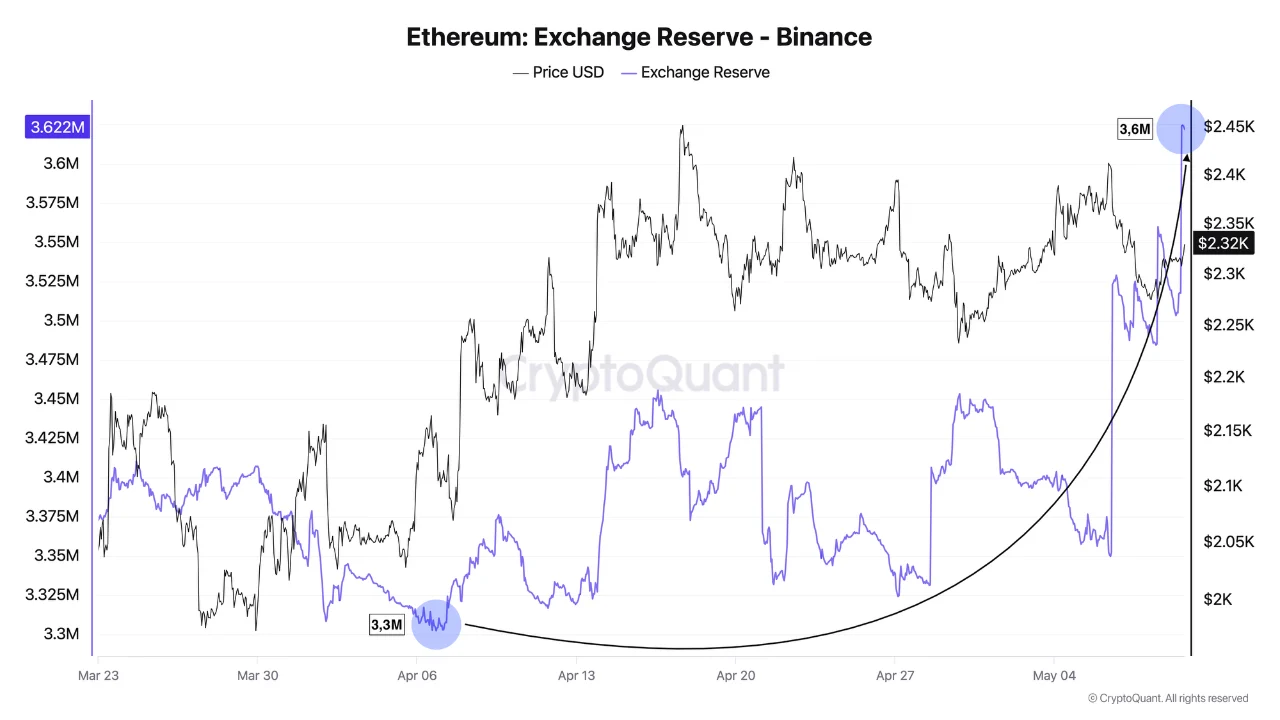
What the reserve chart does not show is whether that supply is being held for sale or parked temporarily by holders who moved during volatility and have not yet acted. The behavioral pattern Darkfost identified, inflows during dips rather than at highs, suggests at least a portion of this supply arrived reactively. Reactive sellers who moved during a correction but did not sell at the correction low often withdraw again once price stabilizes. The reserve figure at 3.62M is the ceiling of available pressure. Whether it becomes active selling pressure depends on what price does next.
Three Moving Averages, Twenty-Nine Dollars Apart
The 4H chart shows three moving averages within $29 of each other: the 200 MA at $2,302.93, the 100 MA at $2,317.67, and the 50 MA at $2,332.05. Current price at $2,327.42 sits below the 50 MA and above the 100 and 200 MAs, compressed inside the cluster. The RSI at 51.93 with the signal line at 46.64 shows slight positive momentum but no directional commitment. Volume has declined since the May 6 peak.
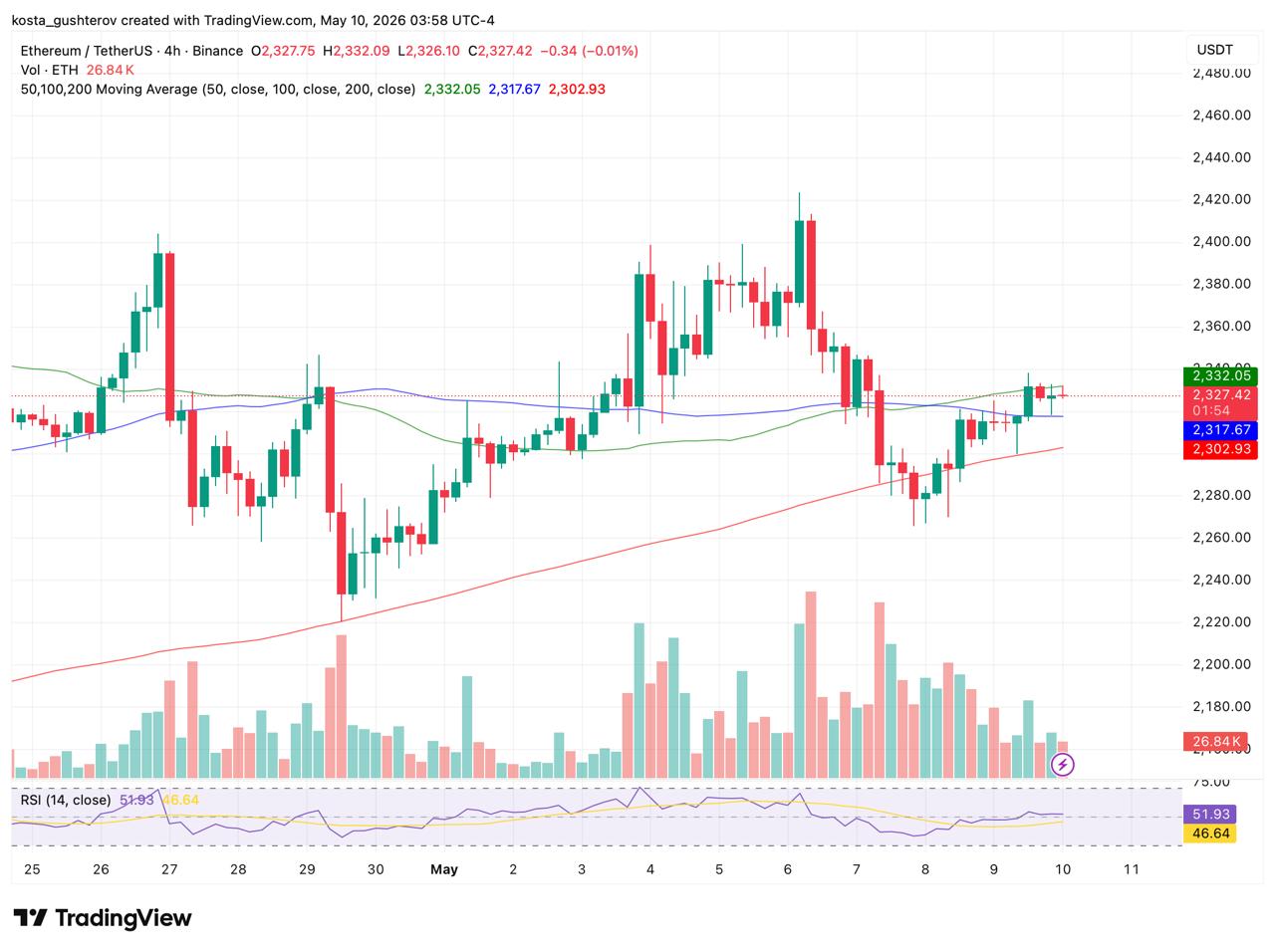
A coiling price structure inside a tight MA cluster does not stay coiled. It resolves. The question is which side. With 3.62M ETH now sitting on Binance, supply that arrived predominantly during dips, a downside resolution through the 200 MA at $2,302.93 would bring that reactive supply into active selling territory. An upside resolution through the 50 MA at $2,332.05 toward the $2,420 range high would test whether holders who moved during corrections take profit at strength or withdraw their ETH back to custody.
Why a Billion Dollars of Inflows Did Not Break the Floor
The counter-argument to the demand-absorption reading is direct. Over $1,000,000,000 in Ethereum moving to exchanges in three days is not a small number, and the reserve rising from 3.3M to 3.62M represents a 9.7% increase in available Binance supply in five weeks. If the buyers absorbing that supply are short-term traders rather than strategic accumulators, the demand is not structural, it is positional, and it rotates out at the first sign of broader market weakness. ETH remaining inside the $2,250 to $2,450 range for several weeks while reserves rise is not evidence of strong demand. It is evidence of demand sufficient to prevent breakdown, which is a lower standard. Insufficient to drive breakout and insufficient to break down is exactly the condition that produces prolonged consolidation, not resolution.
What Happens at $2,302 and $2,332 Decides the Trade
A 4H close above $2,332.05, the 50 MA, sustained for two consecutive candles, with Binance ETH reserves declining from the 3.62M level over the following five days, confirms the supply that arrived during corrections is being withdrawn rather than sold, and the MA compression resolved to the upside.
A 4H close below $2,302.93, the 200 MA, on above-average volume within the next seven days activates the reactive supply sitting at 3.62M and opens the lower end of the consolidation range near $2,250, with no MA support between those two levels.
The $1,000,000,000 that moved to Binance in three days did not break the floor. That is the most important fact in this data set. It means demand exists at current levels. It does not mean demand is strong enough to push price higher. The MA cluster at $2,302 to $2,332 will provide the answer within days.


