


Ethereum is printing higher lows from April above its MA 50 and MA 100, building toward the $2,460 resistance, while 154,911 ETH arrived on Binance in a single day last week, the largest exchange inflow of the year, and ten years of quarterly data show ETH has never closed three consecutive quarters in the red.
Key Takeaways
ETH at $2,329.10, above MA 50 ($2,240.44) and MA 100 ($2,145.43).
Higher lows from April: ~$2,050 → ~$2,150 → ~$2,250.
Key resistance: $2,460 – 5.6% above current price, stopped prior rally.
May 6: 154,911 ETH netflow to Binance – highest single-day inflow of 2026.
ETH has never closed three consecutive quarters in the red – Q2 2026 currently +10.92%.
Q2 average return: +59.00% – gone negative only once in ten years (2022: -67.34%).
From the February low near $1,800, Ethereum recovered steadily through March and April. The daily chart shows a clear sequence of higher lows since early April: price bottomed near $2,050 in early April, held approximately $2,150 in mid-April, and found support near $2,200-$2,250 in late April before pushing back toward current levels.
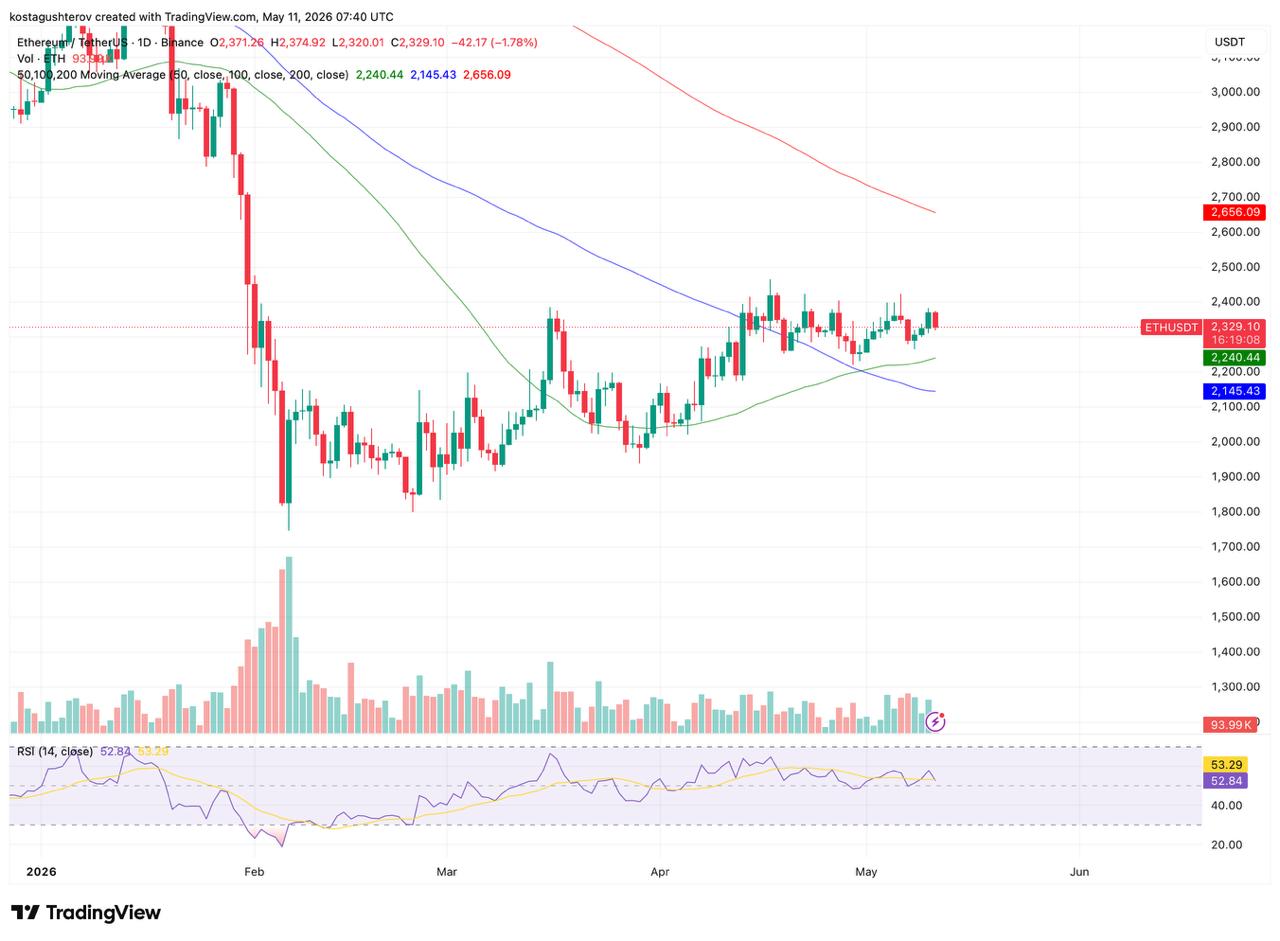
Each successive low was higher than the one before it, a structure that reflects buyers stepping in at progressively higher prices rather than waiting for deeper discounts. Both the MA 50 at $2,240 and MA 100 at $2,145 sit below current price and are rising, providing a layered dynamic support base that strengthens with each session. The MA 200 at $2,656 remains well above, declining: a reminder that the broader downtrend from the 2025-2026 highs has not yet been repaired.
The RSI at 52.84 against a signal of 53.29, a spread of just 0.45 points with the signal barely above RSI, reflects a market with no directional momentum in either direction. Neutral RSI in the middle of a higher-lows structure is consistent with accumulation: price is rising but not accelerating, which reduces the probability of a sharp reversal while also limiting the probability of a sharp breakout without a catalyst. The $2,460 level is where the structure will be tested. That is the resistance that stopped the March-April rally and sits 5.6% above current price. Every technical element on the chart is constructive below it. The chart alone cannot tell what happens at it.
154,911 ETH Arrived on Binance in One Day
The higher lows ETH has printed since April are technically constructive, but 154,911 ETH arriving on Binance in a single day is the largest exchange inflow of 2026, and that supply does not disappear because the chart looks healthy.
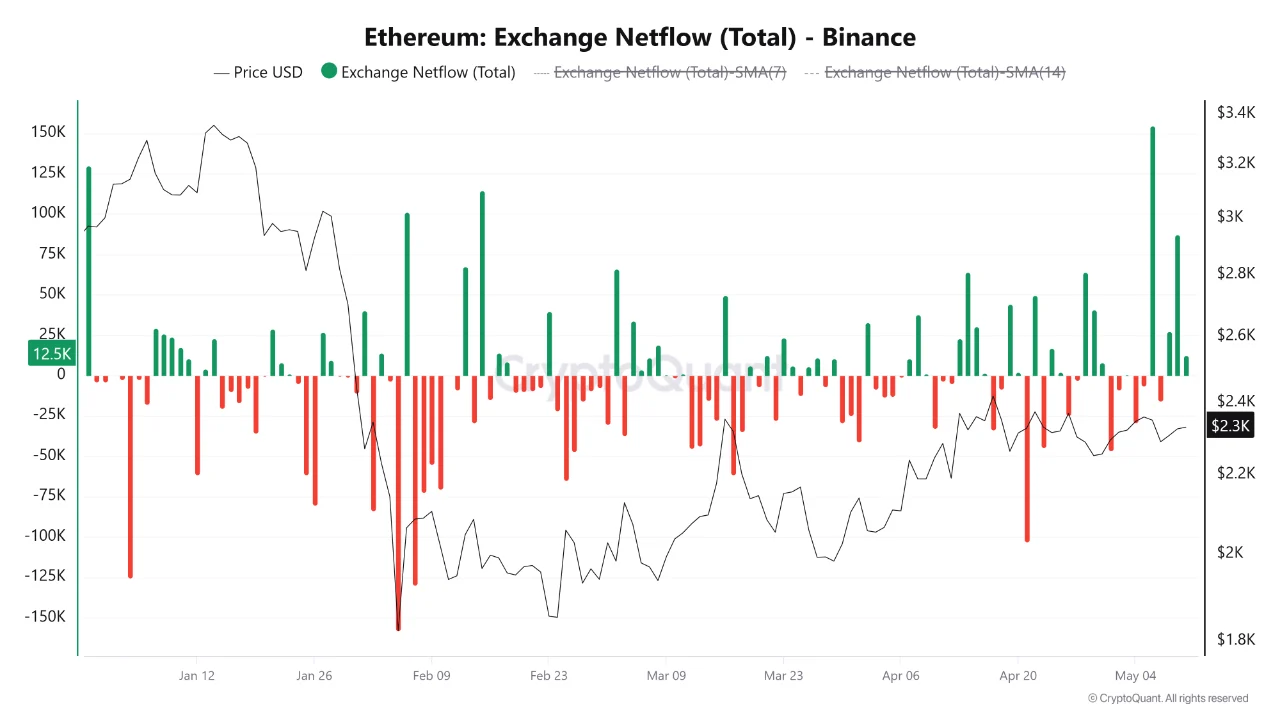
On May 6, as ETH was trading near $2,350, the daily exchange netflow total on Binance reached 154,911 ETH, the highest recorded since the start of the year. As of May 10, the 14-day SMA for that metric had risen to 20,519 ETH, confirming the spike was not isolated but part of a sustained increase in exchange supply.
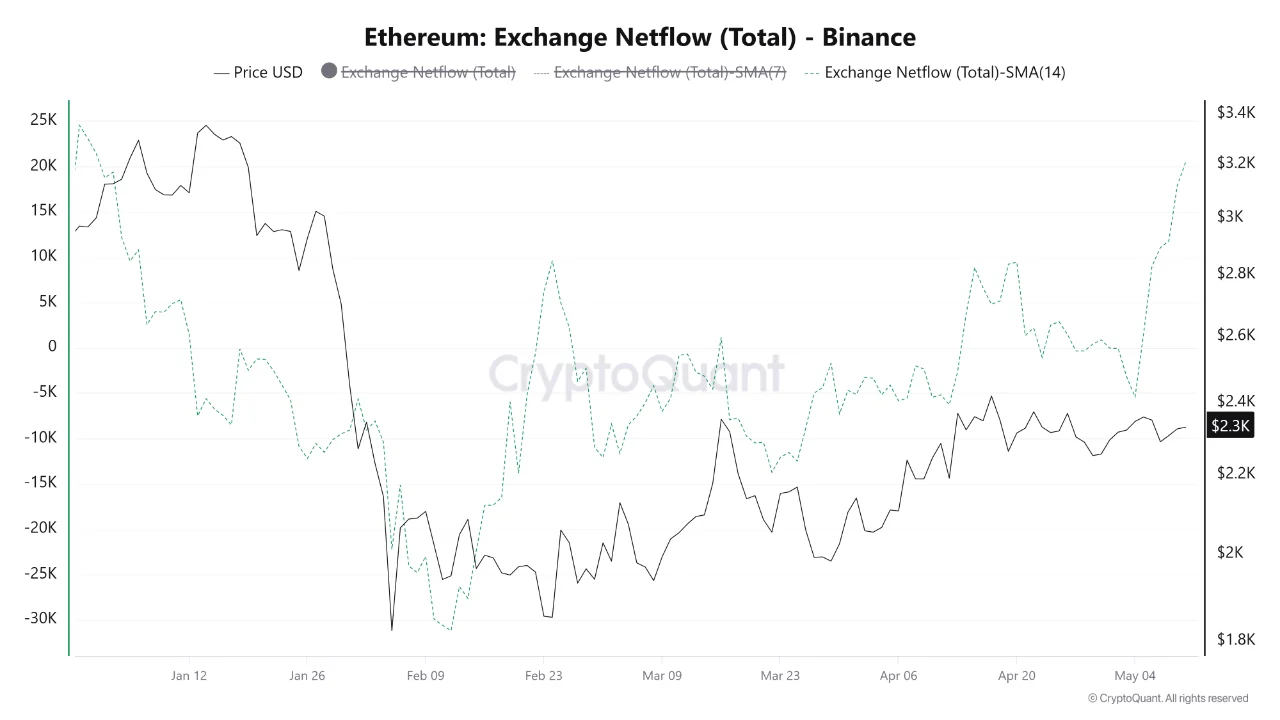
Large positive netflows historically indicate holders moving Ethereum from cold storage to exchange wallets: preparation for selling, not holding. When this follows a rally, as it does here with ETH having climbed from $1,800 to $2,350, it signals profit-taking intent. The supply does not have to sell immediately but it is staged and sitting in exchange order books. Every approach toward $2,460 will encounter it. The $2,460 resistance is not just a technical ceiling: it is the price at which holders who moved ETH to exchanges during the rally will decide whether to sell into strength or hold for more, and the CVD at -1,580 suggests that decision is already being made.
Three Separate On-Chain Signals, One Message
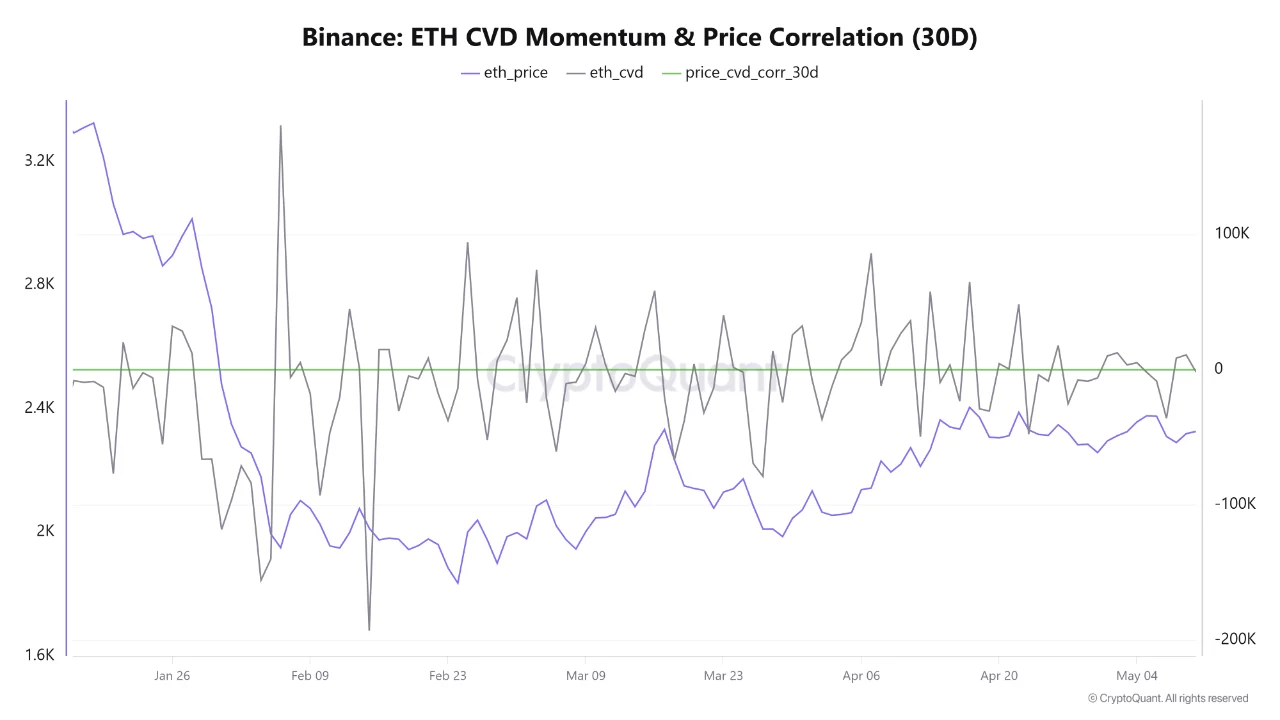
Arab Chain’s CVD analysis shows the ETH CVD index at -1,580 on Binance, with a 30-day price/CVD correlation of 0.788. A negative CVD means accumulated sell orders have exceeded buy orders in recent trading activity. The high correlation of 0.788 means price direction is increasingly being driven by this order flow imbalance, making CVD a leading rather than lagging indicator for ETH’s short-term direction. Price has held above $2,300 despite the negative CVD, reflecting demand absorbing the selling. That absorption has a limit, and the exchange inflow data suggests it is approaching.
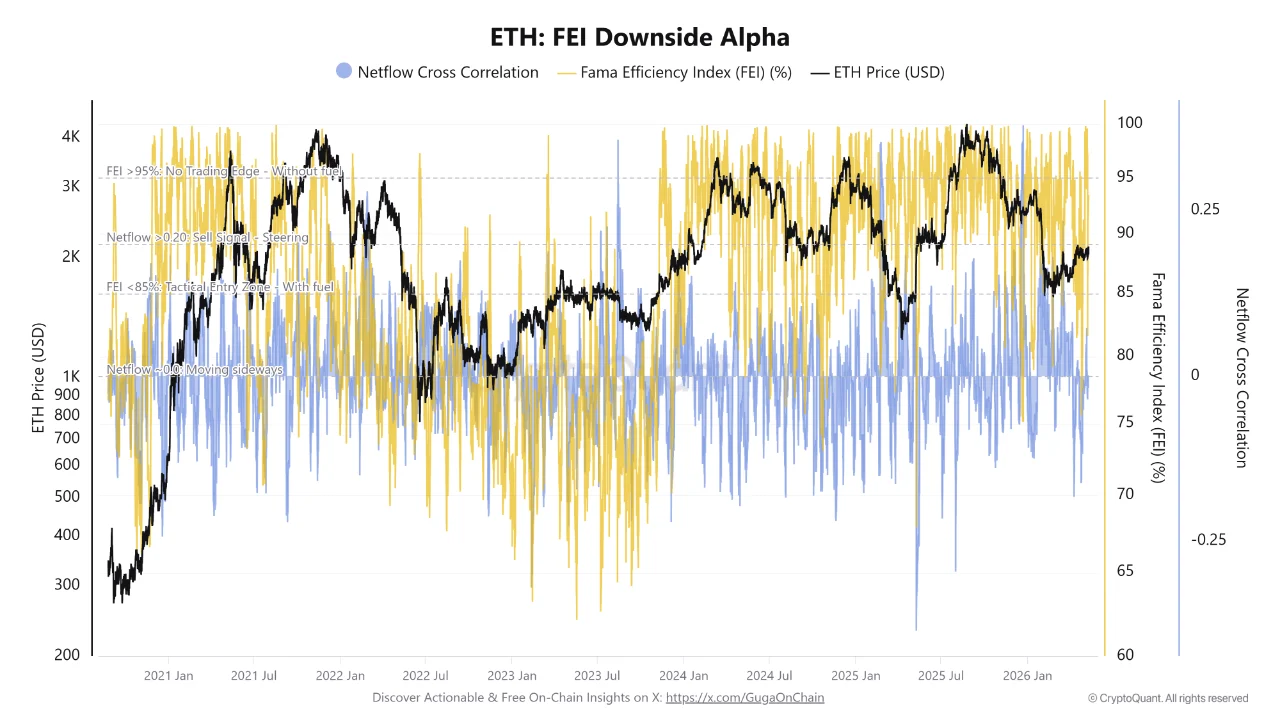
GugaOnChain’s FEI Downside Alpha framework adds the efficiency dimension. The Fama Efficiency Index at 93.43% places ETH just below the 95% threshold that signals no trading edge and pure sideways movement. Open interest on Binance fell 2.98% in 24 hours and stagnated at $5.4718 billion: speculative capital is exiting rather than building new positions. A FEI reading of 93.43% combined with near-zero RSI momentum and open interest stagnating at $5.47 billion is three separate data points saying the same thing: the market has no directional conviction at current prices, and the move to $2,460 or below $2,240 will come from an external catalyst rather than internal momentum building.
Ten Years of Quarterly Data and What They Say About Q2
Ethereum has never closed three consecutive quarters in the red, and Q2 2026’s current +10.92% gain is already following the only pattern the historical data consistently shows: a positive quarter following every two-quarter negative streak. Q4 2025 closed at -28.28%. Q1 2026 closed at -29.26%. ETH has never experienced two consecutive losing quarters without the third recovering. Q2 2026 at +10.92% is tracking that recovery. The table does not predict price: it records what has always happened when ETH enters Q2 after two losing quarters, and the answer every time is the same.
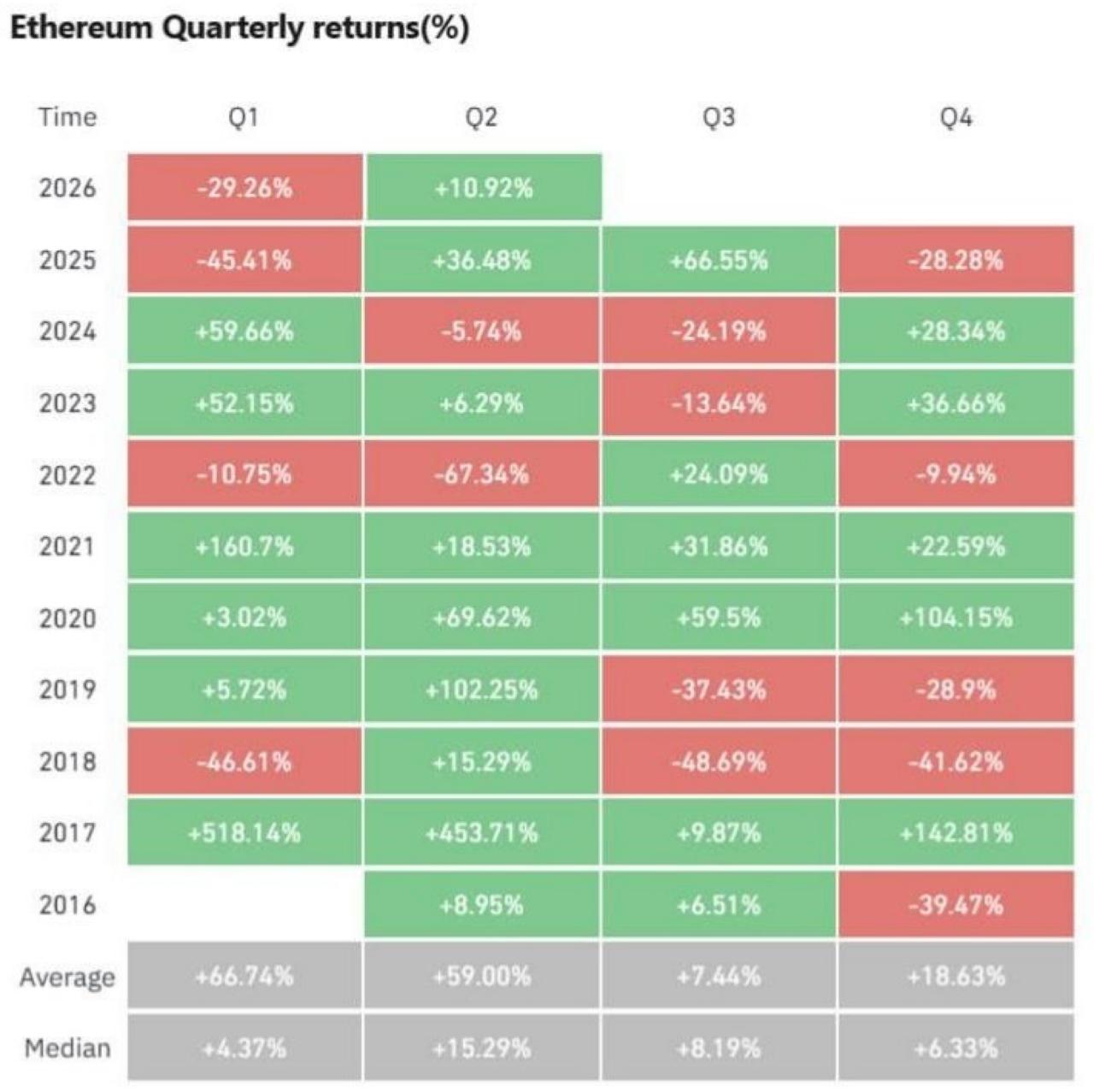
Q2 is the most reliably positive quarter in ETH history, having gone negative exactly once in ten years of data, in 2022, the worst crypto year on record, which means the current Q2 recovery is not seasonal optimism but the continuation of a pattern that has broken only under catastrophic conditions. The full Q2 record: +453.71% (2017), +15.29% (2018), +102.25% (2019), +69.62% (2020), +18.53% (2021), -67.34% (2022), +6.29% (2023), -5.74% (2024), +36.48% (2025), +10.92% (2026 in progress). Average: +59.00%. Median: +15.29%. Current 2026 reading at +10.92% is below median but tracking positive, and well above the only negative precedent which required a -67% year to produce.
The counter-argument is Q3. Historically it is ETH’s weakest quarter by average return: +7.44% average, +8.19% median, and negative in both 2023 (-13.64%) and 2024 (-24.19%). A positive Q2 does not guarantee Q3 continuation: the data shows Q3 has given back Q2 gains in two of the last three years, which means the seasonal case for ETH strengthens through Q2 and weakens entering Q3 regardless of what happens at $2,460. The confirmation signal is ETH closing above $2,460 on a daily basis with exchange netflow turning negative, indicating that the staged exchange supply has been absorbed by buyers rather than driving a rejection. The denial signal is a daily close below the MA 50 at $2,240 within seven days, which would break the higher-lows structure and indicate that exchange supply overhang has overwhelmed the technical support built since April.


