

In Ripple XRP ETF news today, the Senate Banking Committee is advancing revised language under the Clarity Act framework, the most concrete legislative step toward commodity classification for XRP since Ripple’s $125 million SEC settlement closed in August 2025.
That classification, if codified into statute, is not simply a regulatory label; it is the removal of the compliance barrier that has kept institutional allocators structurally sidelined from XRP exposure for the better part of three years.
The open question is how quickly that removal translates into filed ETF products, approved instruments, and measurable inflows, and Standard Chartered has already put a number on the answer: $4 billion to $8 billion by year-end under a favorable regulatory scenario.
XRP trades near $1.45, having recovered from its post-settlement consolidation range as legislative momentum builds into the committee markup window.
Spot XRP ETFs launched in November 2025 across seven providers, accumulating $1.37 billion in total inflows by April 2026, with $119.6 million in net inflows for the week ending April 11 alone, the highest weekly figure since December 2025.
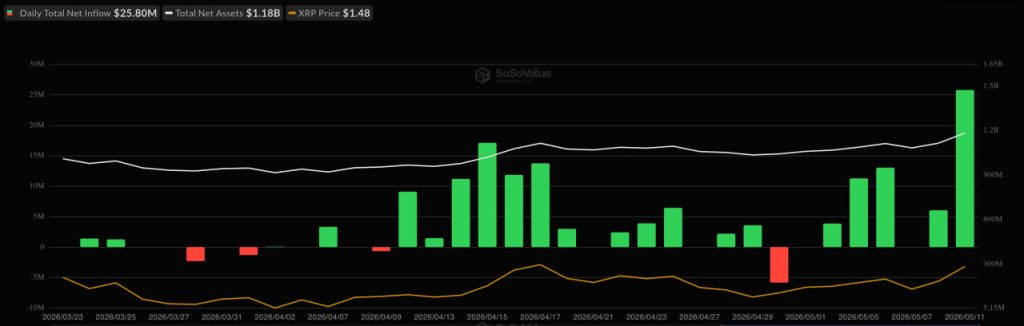
XRP just recorded a daily inflow. XRP spot ETFs saw a $25.80 million single-day net inflow, the largest in over four months.
Flows were positive on multiple days (e.g., ~$9.23M on May 6, ~$8.11M on May 5, ~$4.36M on May 8), led by issuers like Bitwise, Canary, and Franklin.
XRP has carried a persistent regulatory risk discount relative to its market position – a discount that tightened meaningfully after the Torres ruling in 2023 but never fully dissolved because court decisions, unlike statutes, remain subject to appeal and reinterpretation.
The Clarity Act is the instrument designed to close that gap permanently by embedding XRP’s commodity status in federal law rather than leaving it dependent on judicial precedent.
Clarity Act News: What the Commodity Classification Framework Actually Resolves for Ripple XRP
The Clarity Act, formally introduced as a bipartisan bill by Senators Cynthia Lummis and Kirsten Gillibrand in March 2025, establishes a decentralization test to determine whether a digital asset falls under SEC jurisdiction as a security or CFTC jurisdiction as a commodity.
For XRP, the practical consequence is a statutory pathway to commodity status that goes beyond the Torres ruling, which held that programmatic XRP sales did not constitute securities offerings but left the broader classification question legally contestable.
Commodity classification under the Clarity Act framework directly unblocks three categories of institutional actors currently operating under compliance restrictions. Asset managers at firms like BlackRock and Fidelity face internal eligibility screens that require a clear, durable regulatory classification before an XRP ETF filing can be approved at the product committee level.
JUST IN: ?? US Senate Banking Committee releases crypto Clarity Act draft bill. pic.twitter.com/M9dqecVonb
— Watcher.Guru (@WatcherGuru) May 12, 2026
Custody banks require commodity-designated assets to clear specific legal review thresholds before they can serve as ETF custodians. Compliance teams at broker-dealers need statutory clarity, not judicial interpretation, to approve Ripple XRP as a permissible product for distribution across advisory channels.
The SEC’s March 2026 joint classification of XRP as a digital commodity, alongside the CFTC, provided an administrative foundation; the Clarity Act converts that foundation into durable statutory law.
The pipeline implications are already visible. Multiple XRP ETF applications are active or in preparation, and the $1.37 billion in accumulated spot product volume since November 2025 reflects early-mover institutional demand ahead of full compliance clearance.
Analyst Chad Steingraber has noted that Clarity Act passage would enable direct in-kind XRP-to-ETF share swaps without cash intermediaries, effectively turning ETFs into regulated custody instruments with minimal tax friction, analogous to how Treasury money market funds function as regulated cash parking for institutional capital.


