

The US spot Bitcoin ETF market experienced around $1.26Bn in net outflows over six consecutive trading days, including a single-day redemption of $649M, one of the largest since their launch in January 2024.
Bitcoin is trading at approximately $77,300 after falling below critical support levels at $79,250 and $78,500.
The broader economic context includes elevated oil prices driven by geopolitical tensions, uncertainty around Federal Reserve policy, and a strong dollar, creating a challenging environment for speculative investments.
The market must determine whether the outflow represents a temporary technical correction or a lasting decline in institutional interest in Bitcoin at current prices. This distinction is crucial, as a tactical unwind resolves itself, while a structural demand shift does not.
Bitcoin ETF Outflow Data: What the Six-Day Streak Actually Reveals
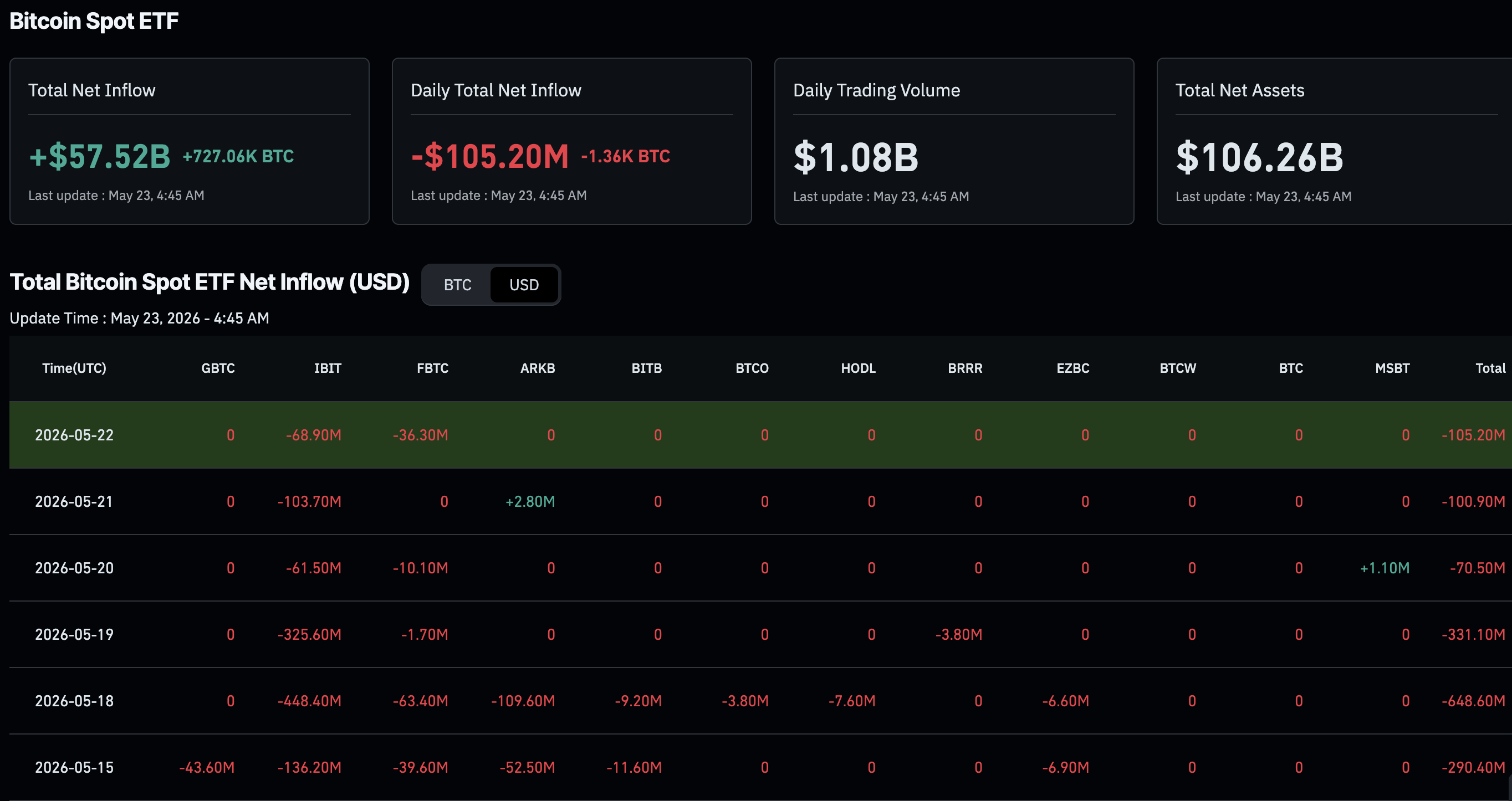
(SOURCE: CoinGlass)
The $1.26Bn total outflow over six days is notable, particularly the $649M single-day exit, which suggests a specific triggering event rather than routine portfolio rebalancing. K33 Research identifies $83,000 as the breakeven level for many ETF holders from the 2024 and 2025 inflow waves.
With Bitcoin currently around $6,000 below that level, selling behavior is predictable as holders experience widening unrealized losses, particularly given risk management thresholds.
Cumulative net inflows into spot Bitcoin ETFs since launch are close to $60Bn, according to Bloomberg’s James Seyffart, and the recent $1.26Bn outflow is viewed as a minor disruption in a larger trend rather than a structural change.
Spot Bitcoin ETFs hold nearly $99Bn in assets, with BlackRock’s IBIT managing over $61Bn, indicating resilience against short-term redemptions.
The market has weathered significant outflows before, such as the $4.2Bn departure from Bitcoin and Ethereum ETFs in early 2026. The current concerns hinge on whether the less favorable macro environment affects this stability.
Why Basis-Trade Mechanics Explain the Selling Without Confirming a Trend Change
The mechanism behind basis trades in Bitcoin ETFs involves buying the spot ETF while shorting Bitcoin futures to profit from the spread between them. When the futures premium over the spot widens, the trade is profitable irrespective of Bitcoin’s price direction.
However, if the premium compresses or if the spot price struggles to break resistance, the trade becomes less attractive, leading institutions to sell the Bitcoin ETF and close their futures shorts.
This strategy is market-neutral, not a bet against Bitcoin. When Bitcoin nears $75,000 and fails to surpass $80,000, the conditions for unwinding basis trades emerge: resistance hinders spot price increases, funding rates drop as leveraged longs exit, and the spread narrows.
This makes the position expensive to hold. Historical patterns support this: previous outflow spikes during FOMC-driven risk-off sessions have exhibited similar characteristics and have been followed by stabilization.
Bitcoin Price Structure: The Levels That Define the Next Move
$BTC 4H Update
Bitcoin is still moving inside this big consolidation range on the 4H timeframe.
We’ve respected the structure so far — bouncing between the marked zones. Currently sitting in the middle of the range.Next important areas to watch:
Upper resistance around 79,300… https://t.co/QoXHYwxwzx pic.twitter.com/EvPw23GBOk— Xixx (@xixx_1120) May 25, 2026
Bitcoin is currently priced at around $74,720, hovering between key resistance levels at $75,000 and $76,000. Reclaiming $76,000 with positive Bitcoin ETF flows is essential for suggesting that recent selling pressure has eased.
Below this, the $71,000 to $73,000 range serves as the next significant support but could trigger further selling from ETF holders near their cost basis.
The $83,000 level identified by K33 Research would need to be cleared for ETF holders to shift from net sellers to net holders. Meanwhile, external macro factors such as inflation, Fed policy, and geopolitical developments also affect Bitcoin’s price movements.
Without favorable signals from the Federal Reserve regarding easing or pausing rates, continued outflows may pressure the $71,000 to $73,000 support zone, shaping the outcome between wash-out and waning demand.


