

Nathan Allman, founder and CEO of Ondo Finance, unexpectedly died on May 25, 2026, leading to significant volatility in the ONDO token and a reevaluation of key-person risk in the tokenized real-world asset sector.
Ondo Finance announced his passing on X, expressing condolences but not disclosing the cause. Ian De Bode, the company’s longtime president, will take over as CEO with full support from the leadership team.
It is with profound sadness that we announce the unexpected passing of Nathan Allman, Ondo's founder. Our hearts are with his family and loved ones.
Nate’s brilliance, humility, and drive shaped every part of what Ondo is today. His belief in the power of technology to create a…
— Ondo Finance (@OndoFinance) May 25, 2026
Ondo Finance is a major player in the RWA space, with $3.5Bn in total value locked across products like OUSG, a tokenized US Treasury fund, and USDY, a yield-bearing stablecoin.
Allman had built the infrastructure since the 2021 founding, leveraging his experience from Goldman Sachs. The market now questions whether Ondo’s structure can withstand the loss of Allman or whether it will affect its institutional credibility.
Ondo Finance and Nathan Allman: What the Founder’s Role Actually Reveals About Protocol Vulnerability
? $ONDO HOLDS KEY LEVELS AFTER CEO SHOCK
Despite heavy uncertainty following Ondo founder Nathan Allman’s passing, $ONDO continues trading near the $0.42 zone after a sharp volatility spike.
The chart shows buyers still defending support but market sentiment remains fragile.… pic.twitter.com/3l6AjjC3hf
— Coin Edition: Your Crypto News Edge ️ (@CoinEdition) May 26, 2026
Allman’s departure is significant, as he was crucial to establishing Ondo’s credibility with institutional investors.
A Brown University graduate with a background in Goldman Sachs’ digital assets division, he founded Ondo in 2021 and grew it to $3.5Bn in TVL in just four years.
Ondo’s product lines include OUSG, a tokenized wrapper for short-duration US Treasuries; USDY, a stablecoin offering higher dollar-denominated yields; and Ondo Global Markets, which expands into equities.
These offerings reflect a strategic focus on institutional investment, emphasizing the importance of who will now lead this vision.
Allman’s statement highlighted a commitment to technology for a more accessible financial system, but for institutional investors, his personal connection to the vision remains a key consideration in their decision-making.
ONDO Token Reaction: What the Double-Digit Sell-Off Actually Signals About Key-Person Risk Pricing
ONDO experienced significant double-digit declines after the announcement of CEO Allman’s death, followed by a partial recovery.
This price action differs from standard equity market reactions, where stabilized discounts usually follow confirmed succession plans.
In token markets, governance token holders lack the same information rights as equity shareholders, raising broader concerns about off-chain institutional relationships and whether those relationships can transfer to new management.
The sell-off reflects institutional allocators’ questioning of Ondo’s ability to maintain the pace of institutional business development.
Recovery timing after similar events in crypto history hinges on executive continuity, particularly on whether the new leadership can quickly secure major partnerships.
Stabilization of total value locked (TVL) in the weeks following the announcement will be a key indicator of ongoing counterparty relationships.
Why Key-Person Risk in RWA Protocols Functions Differently Than in Traditional Finance
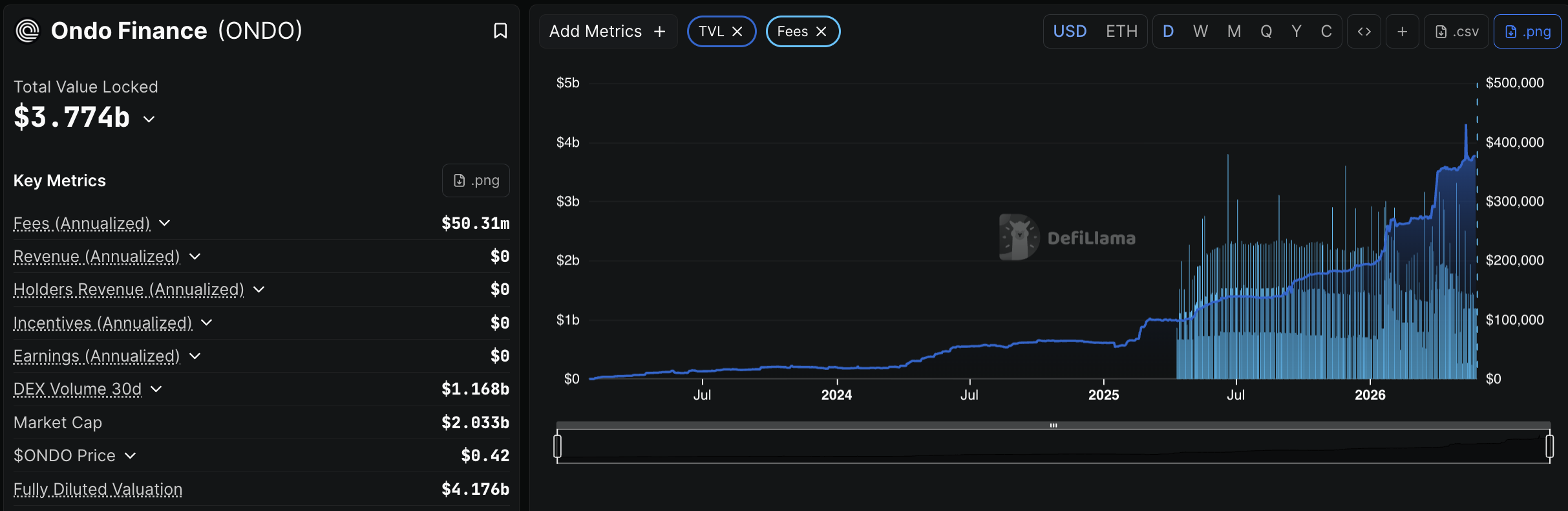
(SOURCE: DefiLlama)
The mechanism is crucial here. In a purely decentralized protocol with on-chain governance, a founder’s death affects operations but does not compromise the protocol’s functionality, since smart contracts execute independently.
In contrast, Ondo relies on off-chain institutional trust tied to personal relationships, which differs from pure DeFi governance. While DeFi governance can set parameters, it cannot replicate the credibility a founder with a strong institutional background brings to conversations with allocators.
This isn’t a failure of decentralization but a structural characteristic of the RWA category. Tokenized Treasury products like OUSG compete with established investment vehicles and require trusted counterparts who understand compliance.
Allman provided this credibility, and now competing firms like BlackRock and Circle have similar founding relationships, creating direct pressure on Ondo’s successors.
While the smart contracts and legal protections for OUSG and USDY remain intact, the key asset at risk during a sudden leadership change is the institutional pipeline, the ongoing conversations, evaluations, and regulatory dialogues essential to product design and capital commitment.


