


Early June 2026 Ethereum data from CryptoQuant reveals a synchronized 475,000 ETH exchange reserve drain alongside a conflicting automated model signal.
Key Takeaways
Four exchanges lost 475,000 ETH combined in early June.
Coordinated venue drawdowns suggest non-random institutional custody migration.
An automated trading model bought based purely on one metric.
ETH remains stuck 11.7% under its active Death Cross.
Total stablecoin reserves are shrinking despite temporary inflow spikes.
Multi-Exchange ETH Reserve Drawdown (CryptoQuant Data)
According to exchange reserve metrics provided by blockchain analytics platform CryptoQuant, four major digital asset trading venues experienced a combined reduction of 475,000 ETH from liquid holdings between late May and June 7, 2026. The simultaneous nature of these outflows indicates a broader structural shift toward self-custody or over-the-counter (OTC) accumulation.
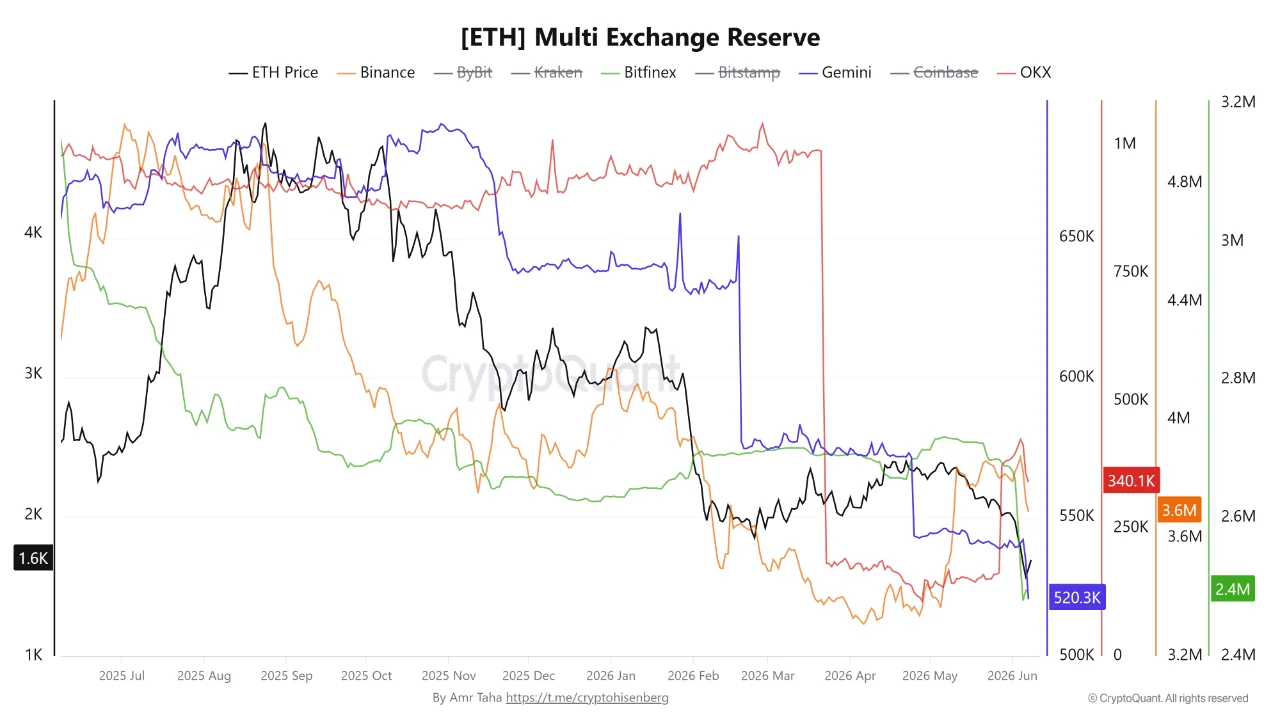
A synchronized outflow across completely unrelated platforms rules out exchange-specific anomalies. However, CryptoQuant’s historical data reminds us that a thinner exchange-supply environment only accelerates price appreciation if spot demand simultaneously scales up. Absent a corresponding surge in buying pressure, a supply drop simply creates a more illiquid, volatile environment rather than a sustainable upward trend.
Unpacking the Automated Buying Signal
On May 14, 2026, an automated math-based trading system flipped to 100% bullish on Ethereum.
To understand why, think of a quantitative model as a strict, rules-based computer program used by large funds. Instead of relying on human judgment or news headlines, it tracks hard data. It is programmed with a clear rule: if Market Condition X happens, automatically execute Action Y.
In this case, the program looked at a single on-chain metric: stablecoins moving onto Binance.
The Trigger: The mathematical score for stablecoin deposits (Z-Score) spiked to +1.21σ – meaning an unusually large wave of dollar-pegged stablecoins entered the exchange in a short window.
The Logic: Large funds use stablecoins as reserve capital to purchase crypto. The program is designed to read a spike in stablecoin inflows as immediate buying power entering the market, so it automatically switched to a buy position.
Macro Structural Headwinds and Divergences
The core flaw with the automated model’s bullish move is that it isolated one data point while the broader picture pointed in the opposite direction. Rules-based systems can produce misleading signals when their triggers are too narrow. Right now, the rest of the market data tells a different story:
The Downtrend is Heavy: ETH is currently trading 31% below its 200-day Simple Moving Average (SMA200), which is at $2,445 according to TradingVew data.
Temporary Liquidity: While one large wave of stablecoins entered Binance and tripped the model’s trigger, CryptoQuant’s macro indicators show total stablecoin reserves on the platform are actually shrinking overall (-0.68σ). The reserve capital isn’t accumulating, it was a one-time inflow.
No Support from Bitcoin: The broader market structure led by Bitcoin remains fundamentally weak. Out of seven core trend indicators tracked by analysts, only two are currently flashing green.
The exchange reserve drain tells us that large holders are moving funds off centralized platforms into longer-term storage. However, the automated model’s buy signal shouldn’t be followed without caution, it responded to a temporary stablecoin flash while the underlying technical trend remains heavily downward. This looks more like a short-term bounce attempt than a confirmed market reversal, and discretionary risk management should take priority until ETH breaks above its key macro moving averages.


