

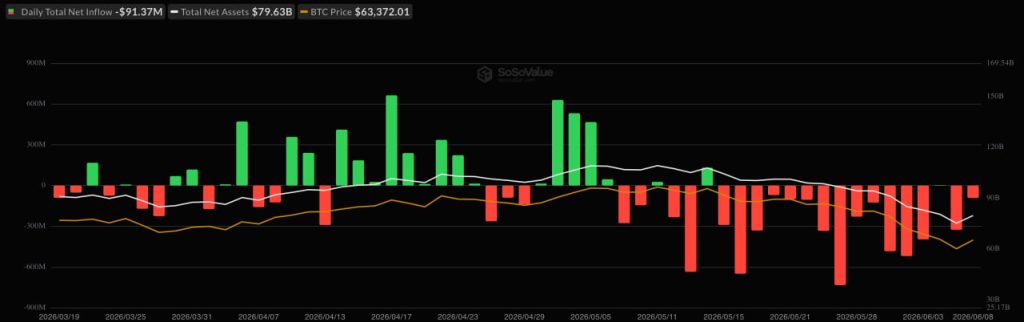
Bitcoin ETF News: US spot Bitcoin ETF products have shed a net $2.6 billion year-to-date in 2026, a headline figure that has prompted alarm across financial media and renewed debates about whether institutional conviction in BTC is structurally unwinding.
Wall Street research firm Bernstein, in a client note authored by lead analyst Gautam Chhugani, pushes back directly: the outflows reflect cyclical capital rotation, not a collapse in Bitcoin’s store-of-value thesis, and the underlying market structure remains intact.
The scale of the deceleration is real. Total combined ETF inflows into Bitcoin in 2026 stand at approximately $12 billion, against roughly $60 billion across the same complex in 2025, an ~80% reduction in gross capital intake.
Bernstein characterizes the current environment as a ‘boring cycle,’ arguing that muted price action and weaker flow dynamics are features of a consolidation phase, not evidence of structural demand erosion.
The open question the market must now resolve is whether the $2.6 billion in Bitcoin ETF outflows represent the early stages of an institutional exit – or a transient rotation that leaves the store-of-value case fully intact once the liquidity cycle turns.
Bitcoin ETF News: What the $2.6Bn Bleed Actually Reveals About Institutional Positioning
Context significantly enhances the raw outflow figures. When authorized participants redeem ETF shares, the issuer is required to sell underlying bitcoin on spot markets to satisfy the redemption, meaning each dollar of net outflow translates directly into spot-side selling pressure. By that mechanism, $2.6 billion in net Bitcoin ETF outflows represents real incremental supply hitting the market.
But the $2.6 billion figure is net, and the gross flow picture is materially more complex.
On the demand side, corporate treasury accumulation is absorbing a substantial share of the selling. Strategy, formerly MicroStrategy, raised $7.5 billion through preferred instruments in 2026 alone and deployed that capital into approximately 100,000 BTC, bringing its total managed position to over 818,000 BTC. That single buyer absorbed more than the entire ETF net outflow figure in fresh BTC demand.
Bernstein analyst Gautam Chhugani explicitly identifies this corporate treasury Bitcoin bid as the key structural counter to the ETF redemption dynamic, calling the ‘boring cycle’ label a characterization of price behavior, not a verdict on the underlying demand thesis.
On-chain data from Glassnode adds a supply-side dimension: 61% of Bitcoin’s circulating supply has remained inactive for over a year, indicating that a substantial majority of holders are not responding to the current volatility with selling activity. The ETF flows data captures marginal institutional repositioning; it does not capture the behavior of the long-term holder cohort that constitutes the structural floor of BTC demand.
EXPLORE: Next Crypto to Explode in 2026
Why Bernstein Calls This a Boring Cycle, And Why That Framing Matters
Bernstein’s interpretive framework rests on a specific diagnosis of the source of the outflows. Gautam Chhugani attributes the weakness in ETF flows primarily to retail investor capital rotating into AI-sector equities, not to declining conviction in Bitcoin’s long-term properties.
In that framing, BTC and AI stocks are competing for the same incremental risk capital, with AI narratives currently winning the allocation battle among discretionary participants.
That diagnosis matters because it reframes the outflow data entirely. If ETF redemptions are being driven by opportunity-cost rotation rather than loss of faith in Bitcoin as a store of value, the selling pressure is by definition transient, it ends when AI capital rotation peaks or when macro liquidity conditions improve.

The single-week $1.72 billion ETF exodus that drove much of the YTD figure came during a period of acute risk-off sentiment and peak AI equity momentum, which is consistent with that rotation thesis rather than a structural reassessment of Bitcoin 2026 demand.
The bearish counterargument is not without force. ETF inflows in 2026 are running at roughly one-fifth of 2025’s pace, and the flow regime has inverted from persistent net buying to intermittent net selling, a regime shift that, if sustained, transforms the ETF complex from a structural demand source into a systematic source of marginal supply.
Bernstein does not dismiss this reading; it rebuts it by pointing to corporate treasury Bitcoin accumulation as the demand replacement that prevents the flow inversion from becoming a price dislocation.


