

Total net assets across the 11 US-listed spot Bitcoin ETF products stood at $77.58Bn as of June 9, 2026, identical to the level recorded immediately after Donald Trump’s November 2024 election victory, erasing every dollar of post-election appreciation in roughly 19 months.
Cumulative net inflows since inception, which peaked at $62.77Bn in October 2025 when BTC price touched its all-time high near $126,000, have since declined by nearly $9Bn to $53.77Bn, the lowest reading since August 2025.
According to SoSoValue, U.S. spot Bitcoin ETFs recorded $77.44 million in net outflows on June 9, extending their net outflow streak to three consecutive trading days. U.S. spot Ethereum ETFs recorded $40.85 million in net outflows, with Grayscale Ethereum Trust ETF (ETHE)… pic.twitter.com/VHsi0xLT6w
— Wu Blockchain (@WuBlockchain) June 10, 2026
Bitcoin is currently trading at approximately $61,400, and the twin forces driving institutional exit are unambiguous: sticky inflation keeping the Fed hawkish and a ferocious AI investment frenzy siphoning incremental risk capital from crypto markets.
The open question the market must now resolve is whether this represents structural demand erosion, a permanent rerating of Bitcoin’s role in diversified portfolios, or a cyclical rotation that reverses sharply the moment AI momentum peaks and macro liquidity conditions ease.
$BTC/usdt DAILY
Price retests the $60k low, as it is extremely commonplace for markets to retest the lows
Bears, 4 year cyclers and now basically 90% of CT thinks we're headed to $45k
I'm sure everyone is correct ? pic.twitter.com/Nu0k9sQBBT
— Satoshi Flipper (@SatoshiFlipper) June 10, 2026
Bitcoin ETF Redemption Mechanics: What the $53.77Bn Cumulative Inflows Figure Actually Reveals About Institutional Positioning
Context significantly impacts outflow figures for Bitcoin ETFs. When participants redeem shares in a spot Bitcoin ETF, the issuer must sell BTC on the spot market, creating selling pressure that exceeds what AUM would suggest.
Recently, 11 ETFs reported over $5Bn in net outflows, with total Bitcoin AUM dropping from a peak of $169.54Bn in October 2025 to $77.58Bn today, a decline of $91.96Bn due to price depreciation and redemptions.
BlackRock’s IBIT is the leading ETF, with AUM of around $51.9Bn to $54Bn, a level that affects overall market dynamics. Fidelity’s FBTC saw its BTC holdings fall from 213,000 to 186,000, reflecting a broader institutional exit rather than just a shift between products. A record $3.4Bn in weekly outflows highlights this trend.
Importantly, long-term holder behavior isn’t captured in these flow figures. Data show that Bitcoin held by long-term addresses remains stable, suggesting that the recent selling comes from short-term traders, which is crucial for understanding potential recovery dynamics. If the selling is tactical, a rebound could happen quickly.
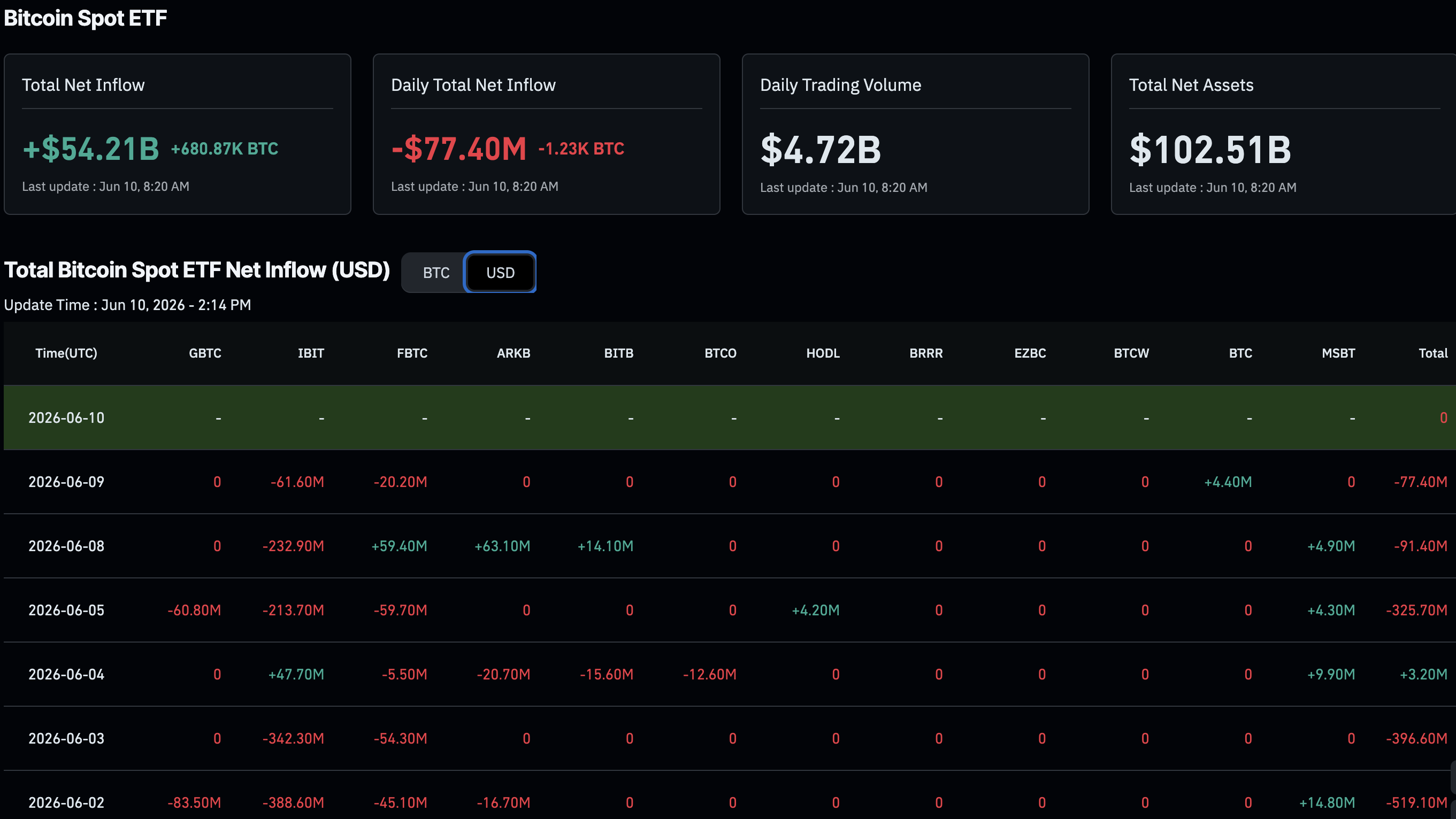
(SOURCE: CoinGlass)
EXPLORE: Next Crypto to Explode in 2026
Why Sticky Inflation Keeps the Fed’s Foot on the Brake and Bitcoin ETF in the Crossfire
Binance Research highlighted that Bitcoin ETF outflows are driven by short-term pressures from inflation and a hawkish Fed, despite ongoing on-chain supply tightening.
Elevated Treasury yields increase the opportunity cost of holding non-yielding assets like Bitcoin, while a strong dollar inversely affects BTC prices.
Currently, core inflation remains stubborn, leading Goldman Sachs to push its first anticipated Fed rate cut to June 2027, creating a ‘higher for longer’ environment that disadvantages speculative assets.
This revised rate outlook contributes to a decline in ETF flows as institutional investors pull back from underperforming assets amid high real yields.
Ironically, while the US regulatory environment for crypto has improved, with fewer enforcement actions and progress on the Digital Asset Market Clarity Act, macro headwinds are causing investors to exit regardless.
BREAKING: May CPI inflation rises to 4.2%, the highest level since April 2023.
Core CPI inflation also rises to 2.9%, the highest since September 2025.
Inflation in the US is officially back above 4% and more than double the Fed's target.
Odds of Fed rate hikes are rising.
— The Kobeissi Letter (@KobeissiLetter) June 10, 2026
The AI Capital Siphon: How Tech Narratives Are Outcompeting Bitcoin for Incremental Risk Allocation
Ophelia Snyder, a market analyst and former co-founder of 21Shares, notes that ETF outflows are driven by competition from narratives such as AI and SpaceX, amid ongoing geopolitical and economic uncertainty.
This scenario represents offensive capital rotation rather than a fearful exit, affecting the speed of any reversal. Bitcoin and AI equities vie for the same investment budget.
When AI-related stories capture attention with major deals and earnings beats, funds that might have gone to Bitcoin spot ETFs are redirected.
If AI offerings falter, capital is likely to shift back quickly to Bitcoin infrastructure, resulting in a swift reversal similar to the anticipated 2024–2025 ETF surge.
DISCOVER: Best Meme Coins to Buy Right Now
Bitcoin Price Structure: The Levels That Define What Happens Next
$BTC Most liquidity below has been taken.
Biggest clusters on the chart are sitting at ~$68K & $75K.
Obviously no guarantee price goes and visits those as BTC is in a down trend. But regardless, it can be good to watch these going forward if price does start grinding up close… pic.twitter.com/CCBmiEYcND
— Daan Crypto Trades (@DaanCrypto) June 10, 2026
BTC is trading around $61,400, within a support zone of $60,000 to $62,000, but struggles to recover. Resistance lies between $72,000 and $76,000, where ETF investors may sell at break-even.
Bull case: If core inflation decelerates and Bitcoin ETF inflows rise to $500M–$1B weekly, BTC could reclaim $72,000. Timeline: Q3 2026 FOMC and CPI data.
Base case: BTC consolidates between $59,000 and $66,000 for 6–10 weeks amid macro uncertainty, with ETF outflows slowing but not reversing.
Bear case: A sustained break below $58,000, accompanied by high volume, especially alongside $1B+ ETF outflows, could push BTC down to $52,000–$54,000.


