


XRP News: On-chain analytics firm Glassnode has recorded XRP’s 90-day realized profit-to-loss ratio at 0.38, meaning that for every $1 of profit realized on-chain, investors are booking $2.63 in losses, and has classified the current market phase as one of “intense capitulation.”
The reading sits at less than half the 1.0 equilibrium threshold that separates net-profit from net-loss regimes, and represents a near-total reversal from the ratio’s peak of approximately 50 during XRP’s 2025 euphoria phase, when realized gains dwarfed losses by an almost incomprehensible margin.
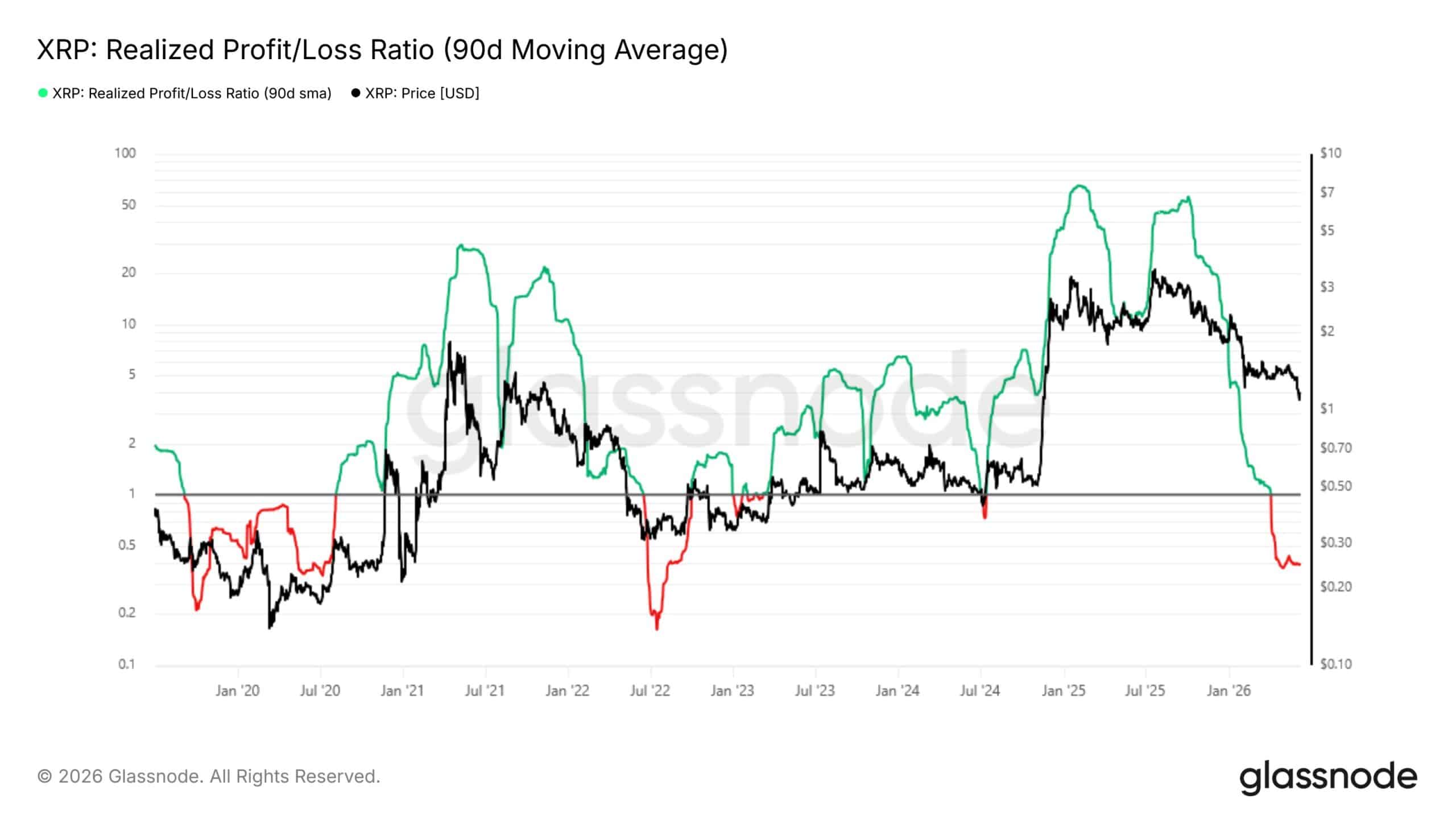
Source: Glassnode on X
XRP was trading near $1.10 at the time of the analysis, below its aggregate realized price of approximately $1.48, meaning the average holder is currently underwater on a cost-basis basis.
Glassnode stated directly that “this ratio so far from the equilibrium threshold of 1 shows a market where most investors moving their tokens do so at a loss, a typical characteristic of intense capitulation,” and added that “this dynamic has completely reversed” relative to the prior bull phase.
The speed of the reversal, from 50 to 0.38 across a single cycle, has drawn comparisons to the structural deterioration Glassnode documented for XRP in early 2022, the last time the asset entered a comparably loss-dominated on-chain regime.
XRP News: Compounding Signals, XRPL Fees, SOPR, and Supply Underwater
The realized profit loss ratio does not stand alone. XRPL fees, measured on a 90-day moving average, collapsed from approximately 5,900 XRP per day in February 2025 to just 500 XRP, a 91.5% reduction that Glassnode attributes to a sharp decline in transactional demand associated with the prior speculative phase.
The fee metric is a direct proxy for block-space demand: when developers, payment processors, and active users transact on the XRP Ledger, fees rise; when they withdraw, fees fall, and a 91.5% decline is not fee optimization, it is user exodus.
As XRP price falls below their acquisition levels, they enter the underwater cohort and face a binary choice: hold and wait, or sell and crystallize losses. When organic network demand, measured by XRPL fees, simultaneously collapses, there is no fundamental use-case catalyst to interrupt that selling calculus.
The result is the self-reinforcing loop that characterizes late-cycle capitulation: more sellers, fewer buyers, declining fees, declining prices. It is necessary to flag the epistemic status of this data: what the realized profit loss ratio at 0.38 proves is that capitulation is occurring with intensity. What it does not prove is that capitulation is complete, or that current price levels represent a durable floor.


