

Jupiter Exchange’s $70 million buyback campaign in 2025 failed to stop the relentless downward pressure on its JUP token, which continues to face $1.2 billion in upcoming unlocks.
The token has fallen 89% from its peak, highlighting the limitations of conventional buyback strategies in a market characterized by significant emissions, ongoing unlocks, and structural selling pressure.
Jupiter Faces Backlash as $70 Million Buybacks Fail Against $1.2 Billion Token Unlocks
Founder Siong sparked community debate when he suggested pausing the JUP buybacks to redirect funds toward growth incentives.
“We spent more than $70 million on buybacks last year, and the price obviously didn’t move much,” he wrote on X. “We can use the $70 million to give out for growth incentives for existing and new users. Should we do it?”
His proposal aimed to fund rewards for active users and subsidies for newcomers, shifting the focus from defensive market support to ecosystem expansion.
Community reactions were divided. Some argued that buybacks are ineffective under heavy unlock pressure, while others warned that halting them could exacerbate price declines.
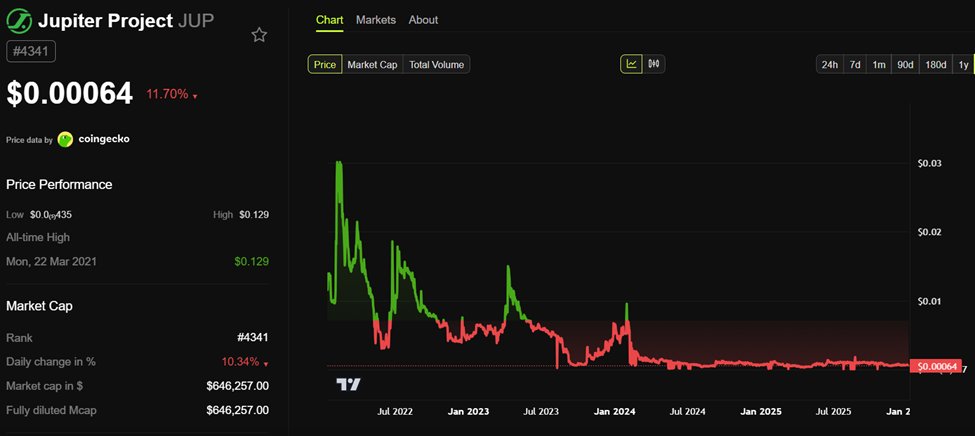
Jupiter (JUP) Price Performance. Source: BeInCrypto
The limited impact of Jupiter’s buybacks, covering only about 6% of unlocked tokens, highlights the challenge. With monthly unlocks of 53 million JUP scheduled through June 2026, the token’s circulating supply has increased by roughly 150% since launch. This is despite three-year lockups of 100 million tokens.
Solana co-founder Anatoly Yakovenko offered a potential path forward. He suggested storing profits as future claimable assets and offering one-year staking rewards to long-term holders
According to the Solana executive, this approach would align token prices during unlocks with the anticipated post-buyback value.
“Let people lockup and stake for a year to get a token yield. So as the balance sheet grows those who stake net a bigger claim,” he added.
His model emphasizes capital formation over short-term buybacks, aiming to extend the utility cycle of funds and strengthen token value anchoring.
Helium and Jupiter Highlight the Limits of Conventional Buybacks
The debate over buybacks extends beyond Jupiter DEX. Helium recently suspended its HNT repurchase program after the market showed minimal response. Instead, the network chose to allocate resources toward user growth, including expanding Helium Mobile subscribers and network hotspots.
Critics of buybacks argue that in ecosystems where tokens are viewed as utility vouchers rather than equity, repurchases create only short-term optical effects and fail when structural selling pressure dominates.
Solana’s internalized ecosystem further complicates matters. Frequent team unlocks, insider prioritization, and high emissions continually offset repurchase efforts.
Community members have pointed out that these structural issues, rather than the mechanism of buybacks itself, are the main reason defensive strategies often fail. Others argue that dynamic approaches, including staking-based rewards or valuation-driven buybacks, may offer a more effective solution.
The challenge for Jupiter remains balancing short-term price support with long-term ecosystem growth. While $70 million in buybacks was insufficient to stabilize the token, Yakovenko’s proposals point to a future where long-term capital formation and staking incentives may better align user incentives with sustainable token value.


