

As global interest in digital asset trading continues to rise, a fundamental limitation has become increasingly apparent: traditional blockchains still struggle to scale efficiently enough to meet growing trading demand. This gap has pushed many users toward opaque, custodial platforms, undermining the transparency and trust that decentralized systems aim to provide.
Lighter was built to address this challenge. The Lighter Protocol offers a scalable, secure, transparent, and non-custodial trading infrastructure designed to support fair and efficient market price discovery. By combining advanced cryptographic techniques, novel data structures, and blockchain technology, Lighter reduces reliance on centralized operators and mitigates the risks associated with opaque execution — laying the foundation for a new generation of high-performance and verifiable digital trading platforms.
Lighter’s token, LIT, is now available on the XT Pre-Market LIT section, allowing users to trade and gain early exposure to the Lighter ecosystem.
Press enter or click to view image in full size
TL; DR for Busy Readers
Lighter (LIT) is a zk-rollup–based perpetual trading protocol bringing high-performance, non-custodial order book trading to Ethereum.
It combines millisecond-level latency with cryptographically verifiable matching and liquidations, ensuring transparent and fair execution.
Lighter uses a modular architecture (Sequencer, Prover, smart contracts) to balance speed, security, and onchain verification.
LIT underpins Lighter’s long-term vision as a core execution and settlement layer for next-generation onchain financial markets.
What is Lighter (LIT)?
Lighter is a perpetual trading protocol that introduces a scalable, secure, transparent, non-custodial, and verifiable order book trading infrastructure within the Ethereum ecosystem. As an application-specific zk-rollup, it employs advanced cryptographic techniques and data structures. Lighter significantly improves the security and fairness of order book trading with its verifiable matching engine, ensuring scalable and efficient market price discovery. Thus, Lighter lays the groundwork for creating new, high-performance, and secure digital trading platforms.
Lighter’s features include:
Scalable: Engineered for scale, processing tens of thousands of orders and cancels per second with millisecond latency.
Efficient: Infrastructure for matching orders and proving the correctness of the matching is highly optimized for low costs, allowing zero fees for retail traders and very competitive fees for high frequency traders.
Verificable: Lighter strictly adheres to a publicly predefined set of rules. All operations including matching and liquidations are proven cryptographically and verified publicly on Ethereum.
Secure: Lighter uses Ethereum as the base layer for proofs and system state changes. Users can deposit or withdraw securely through Ethereum, with all proofs verified publicly.
How Lighter (LIT) Works: Core Mechanisms Explained
The protocol comprises several main components: the Sequencer, the Prover, the Indexer, the API Servers, and the Smart Contracts.
The Sequencer serves as the low-latency execution engine. It consumes user transactions from the mempool and executes them sequentially, structuring them into blocks. It then broadcasts transaction receipts and state changes through multiple data feeds — to the Indexer and Prover services.
The Indexer digests the Sequencer’s data feed and reformats it into a user-friendly structure. The API Servers consume this indexed data to provide users with real-time information and serve as the primary interface for protocol interaction. Through the API Servers, users can submit transaction requests or query the current state of the protocol.
The Prover consumes the Sequencer’s execution feed and generates succinct execution proofs for all exchange operations, including price-time-priority order matching and liquidations. It takes the previous state and a batch of user transactions as inputs to produce proofs that verify the correctness of the resulting state transition.
Finally, the smart contracts on Ethereum hold deposited assets and the canonical Lighter state root, which encapsulates user assets and positions, public pools, order books, and other critical system components. The Lighter Protocol periodically publishes state update proposals to Ethereum, each representing a batch of processed transactions. Every proposal is accompanied by data blobs containing detailed state transition data (e.g., per-account updates), enabling users to independently reconstruct and verify their own state. Once the proof for a state update proposal is generated by the Provers and verified on Ethereum, the contracts update the canonical exchange state. These proofs attest to both the correctness of the state update proposals and the validity and completeness of the accompanying on-chain data — demonstrating that the information within Ethereum’s data blobs is sufficient to fully reconstruct all user states using only censorship-resistant on-chain data.
LIT TGE: Expectations and the Points System
Although detailed tokenomics have not been fully published as the token is pre-launch, the protocol currently operates on a points system, where users earn “Lighter Points” based on trading activity, liquidity provision, and referrals.
Lighter’s Season 1 Points Program ended with the final Private Beta distribution on September 30, 2025. Season 2 points will be distributed every Friday. The Lighter team may adjust distributions at its discretion.
Earn points by running organic trading strategies via UI and API. Sybil, self-trading, and similar activities will not earn points.
Points may convert to $LIT upon the Token Generation Event (TGE).
How to Buy $LIT|Ways to Participate
Lighter’s token, LIT, is now available on the XT Pre-Market LIT section, allowing users to trade and gain early exposure to the Lighter ecosystem.
To get started, create or log in to your XT.com account, navigate to the “Pre-Market” area, search for $LIT, and place your buy or sell orders.
Press enter or click to view image in full size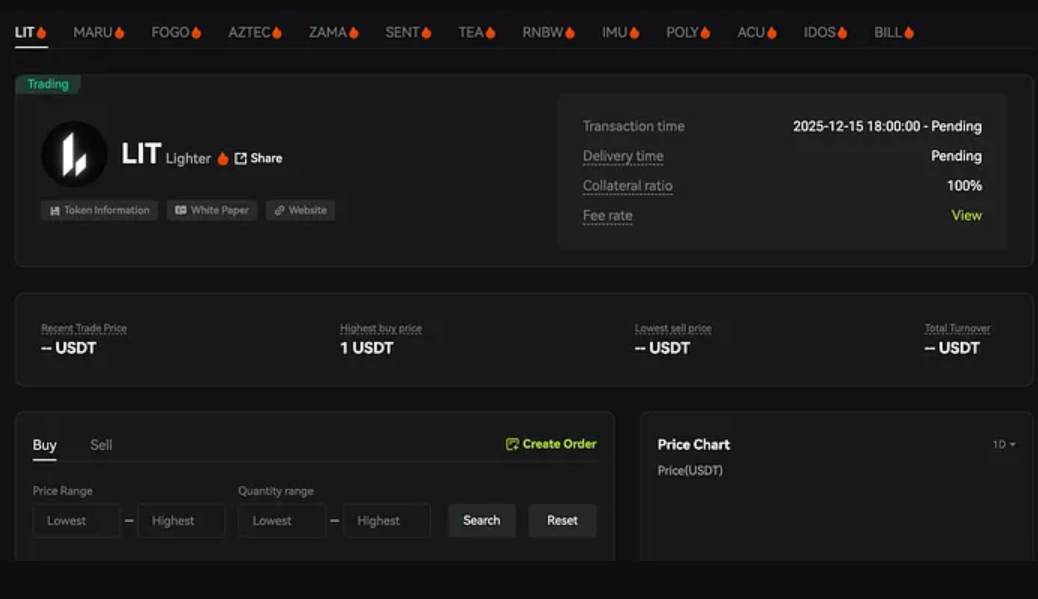
Future Listings and TGE: The $LIT Token Generation Event is expected imminently, with community speculation pointing toward a possible launch by the end of 2025. Stay updated through official channels for announcements regarding the exact TGE date, airdrops, and subsequent spot listings on major exchanges.
LIT Token’s Competitive Edge
From a market positioning perspective, LIT is closely tied to Lighter’s role as an infrastructure-layer protocol rather than a single trading application. Its competitive edge primarily comes from the protocol’s architectural choices and execution guarantees.
First, Lighter focuses on verifiable order book trading, a segment where most onchain solutions still struggle to balance performance and trust. Unlike AMM-based models or opaque offchain matching systems, Lighter’s zk-based matching and liquidation proofs provide transparent, cryptographically verifiable execution while maintaining low latency. This positions LIT exposure closer to “onchain market infrastructure” than to a typical DeFi application token.
Second, the application-specific zk-rollup design allows Lighter to optimize specifically for trading workloads. High throughput, millisecond latency, and efficient proof generation give the protocol a structural advantage in attracting professional traders, algorithmic strategies, and API-driven participants — user segments that are often underserved by existing DeFi platforms.
Finally, LIT’s early-stage distribution via points and pre-market trading creates a gradual price discovery process ahead of spot listings. This may help smooth volatility around TGE while allowing early participants to price in expectations around future utility, incentives, and protocol growth.
Key Risks and Challenges of the LIT Token
Despite its technical strengths, LIT also faces several important risks that investors and users should consider carefully.
One key uncertainty lies in token utility and value capture. The long-term demand for LIT will depend heavily on how it is integrated into protocol fees, governance, staking, or incentive mechanisms after TGE. Without clear alignment between protocol usage and token demand, value accrual could remain speculative.
Another challenge is competition within the onchain derivatives landscape. While Lighter differentiates itself through verifiable order books, it competes with both AMM-based perpetuals and emerging high-performance DEXs that also target professional traders. Sustaining liquidity and trader retention will be critical as the broader Perp DEX sector continues to evolve.
Finally, there are execution and decentralization risks. Lighter’s roadmap includes further decentralization of sequencing and MEV mitigation. Delays, technical complexity, or unforeseen trade-offs in achieving these goals could impact user trust and adoption, particularly among institutions and high-frequency participants who demand reliability.
Lighter (LIT): Outlook & Future Direction
Lighter’s long-term outlook is defined by its ambition to become a foundational, high-performance order book infrastructure for onchain finance rather than a single-purpose trading venue. By supporting a broad range of financial instruments — including spot, perpetuals, options, and potentially lending — Lighter positions itself as a modular trading engine capable of scaling alongside the evolving needs of decentralized markets. Its application-specific zk-rollup design, combined with verifiable matching and liquidations, addresses long-standing trade-offs between performance, transparency, and security, making it well suited for professional and high-frequency trading use cases onchain.
Looking ahead, Lighter’s roadmap emphasizes full decentralization and aggressive MEV mitigation through fair sequencing and encryption techniques, while preserving millisecond-level latency. As demand grows for trust-minimized, order-book-based DeFi infrastructure, Lighter is well positioned to capture value as a core settlement and execution layer. If complemented by a clearly defined LIT token and incentive framework, the protocol could further align users, liquidity providers, and builders — strengthening its role as a critical building block for the next generation of decentralized financial markets.


