


Jakarta, Pintu News – In a digital age filled with concerns about data privacy and security, decentralized and user-friendly identity solutions are becoming increasingly important. One project that is attracting attention in this area is Humanity Protocol, a layer-2 blockchain platform designed to verify human identity in a secure, private, and non-invasive way.
With a unique approach based on palm biometrics and supported by zero-knowledge proofs (ZK proofs) technology, Humanity Protocol introduces a new digital identity model known as Human ID. This protocol allows users to prove that they are real human beings without having to share personal information.
How Humanity Protocol Works: Proof-of-Humanity and Palm Technology
Humanity Protocol relies on a consensus mechanism called Proof-of-Humanity (PoH) to ensure that every identity created on the network comes from a unique human being. Different from traditional identification methods such as document or facial recognition, this protocol uses palm recognition due to the unique nature of blood vessel patterns that are difficult to forge.
Once the biometric scan is complete, the data is not shared with anyone. Instead, the system uses ZK proofs to verify the authenticity of the identity without exposing the user’s raw information. With this method, users can prove their “authenticity” in the digital world without sacrificing privacy.
Human ID: Independent and Secure Digital Identity
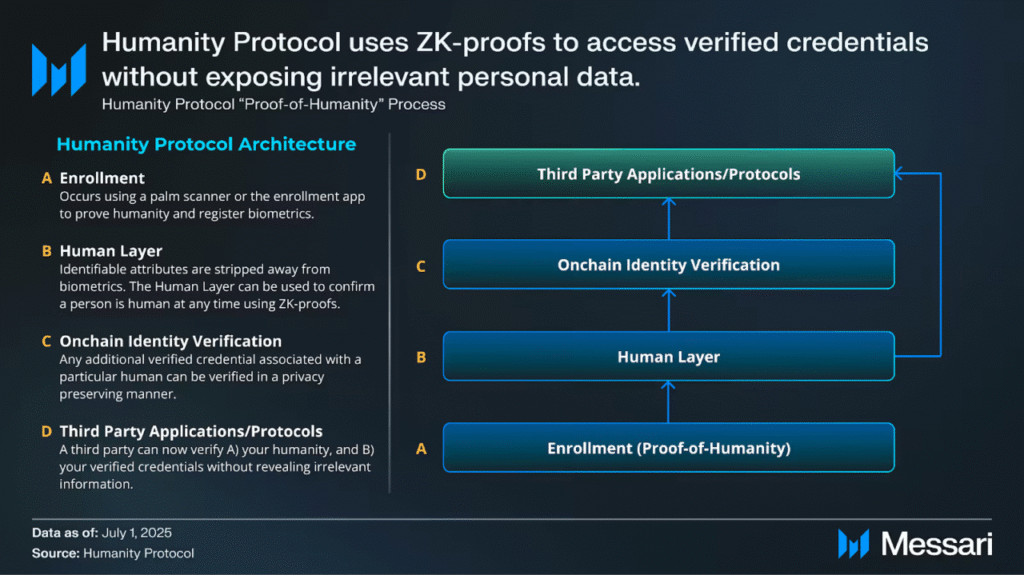
Each verified individual will receive a Human ID, a self-sovereign digital identity that can be used across any Web3 application or Web2 compatible service. The Human ID is immutable and serves as proof of the user’s uniqueness in the blockchain ecosystem.
This model is suitable for a variety of needs, from registration to applications, access to healthcare, to participation in DAOs and voting governance. In addition, Human ID creation is also accompanied by a token-based incentive system, so that users can get rewards after completing the verification process.
Humanity Protocol Use Cases: From Web3 to the Real World
According to the official documentation, Humanity Protocol is not only used in the blockchain ecosystem, but also has great potential in real-world use. For example, users can get into fitness centers, pay for public services, or access financial facilities by simply scanning their palms – without an ID card or email.
With privacy still protected, this protocol promises ease of access that could previously only be achieved through a centralized identity system. In addition, the ability to store Human ID history in an encrypted manner makes it suitable for integration with medical, educational, and financial applications.
Tokenomics & Status on CoinMarketCap
To date, Humanity Protocol has not released full details regarding tokenomics, including token allocation, incentive distribution, or their token ticker. However, the protocol is expected to use a token model that supports user incentives, governance participation, and payment of transaction fees.
While not yet publicly available on platforms like CoinMarketCap or CoinGecko, the project is starting to be widely discussed in the Web3 community, including as a competitor to Worldcoin in the decentralized identity verification category. While Worldcoin uses irises, Humanity opts for a more privacy-friendly approach with palms and ZK proof.
Conclusion: A More Private Future of Digital Identity
Humanity Protocol addresses a key challenge of the digital world: how to verify that a person is a real human being without compromising personal data. With a combination of cutting-edge biometric and cryptographic technologies, the protocol offers a more ethical, secure, and efficient alternative to traditional identity solutions.
With over 2 million Human IDs already created (data as of Q3 2025), Humanity Protocol has the potential to become a key infrastructure in the future of digital identity – especially amidst the rampant adoption of artificial intelligence and the need for authentic human verification.


