

Cross-chain interoperability and security have become a challenge for blockchain technology. ZK startup Lagrange Labs has provided its solution. Maven11, as an investing institution, has elaborated on the importance of Lagrange in an article. This article details the core concepts of the Lagrange protocol, the verification process, and how to use zero-knowledge proof technology to achieve trustless cross-chain operations.
Cross-chain state proof is crucial for applications in a multi-chain world. It enables applications to use verifiable chain state declarations submitted by untrusted users. Use cases include multi-chain DEX pricing, yield aggregators, and loan pricing.
In simple terms, state (storage) proof is a proof (zero-knowledge) that proves the existence of some on-chain state on any chain. With the magic of zero-knowledge proofs (ZKP), we can efficiently and trustlessly achieve this without relying on trusted oracle networks.
Traditional message transmission protocols rely on nodes to transmit information, but Lagrange uses a different approach. It allows anyone to encrypt and verify information submissions, similar to how IBC relies on light clients for cross-chain verification.
In Lagrange, any cross-chain transfer layer or untrusted user can submit a non-interactive proof that is verified on the chain. These proofs do not depend on the set of validators or signatures, ensuring efficient aggregation of data directly on the chain and between chains.
The verification of Lagrange state proof involves multiple steps:
State Root Verification: Verify the authenticity of the given state root (block header) using succinct zero-knowledge proofs generated by the Lagrange State Committee.
Batch storage proof: Verify whether a set of declared states exist in the state root of a specific chain.
Zero-knowledge distributed computing: verifying arbitrary distributed computing executed on the state of the chain.
Due to the modularity of the Lagrange state proof, protocols can choose to use partial proofs of state, storage, or computation to customize the proof system based on their application. Existing cross-chain applications can easily improve the security or performance of their cross-chain tools.
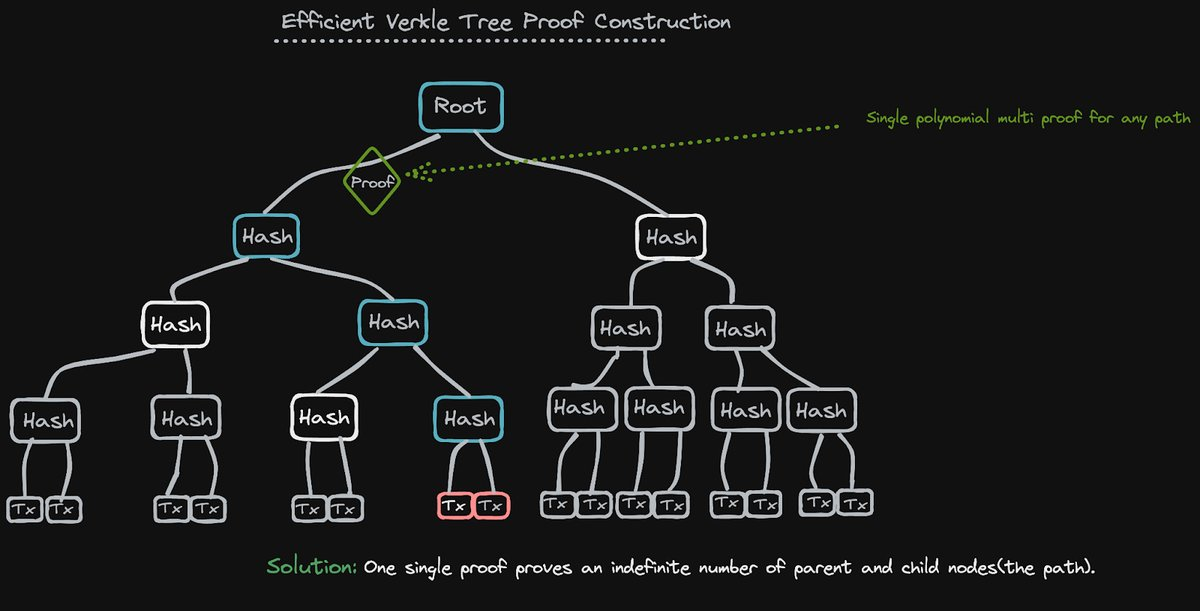
The Lagrange zero-knowledge big data framework utilizes dynamic data structures similar to Verkle trees, allowing applications to efficiently store proofs and combine them with any distributed computation, such as MapReduce or distributed SQL.
With the help of LagrangeJS SDK, developers can easily request state proofs from any chain and specify any computation to run on a subset of stored states. This enables developers to utilize secure cross-chain state and storage proofs in a user-friendly interface.
Lagrange SDK also simplifies the process of generating proofs of state that span multiple chains. These proofs enable DApps integrated with the Lagrange protocol to integrate multiple state verifications into a single chain transaction.
The Lagrange protocol facilitates cross-chain state verification by integrating major blockchains. Initially, it is compatible with all EVM L1, L2, and rollup. In the future, there are plans to support non-EVM chains such as Solana, Sui, Aptos, and Cosmos SDK-based chains.
In addition, Lagrange is also committed to improving the security of existing cross-chain bridging and messaging protocols by utilizing economic bond declarations, creating a strong economic single-slot guarantee of finality for Optimistic Rollup. This can significantly improve the interoperability between isolated Rollups on Ethereum.
Its working principle is essentially to generate ZK light client proofs for Optimistic Rollup, rather than the "light client" implementation currently on Ethereum - that is, the Ethereum Sync Committee.
The current Ethereum Sync Committee only has 512 randomly selected validators, who receive higher rewards every day to provide light client functionality.
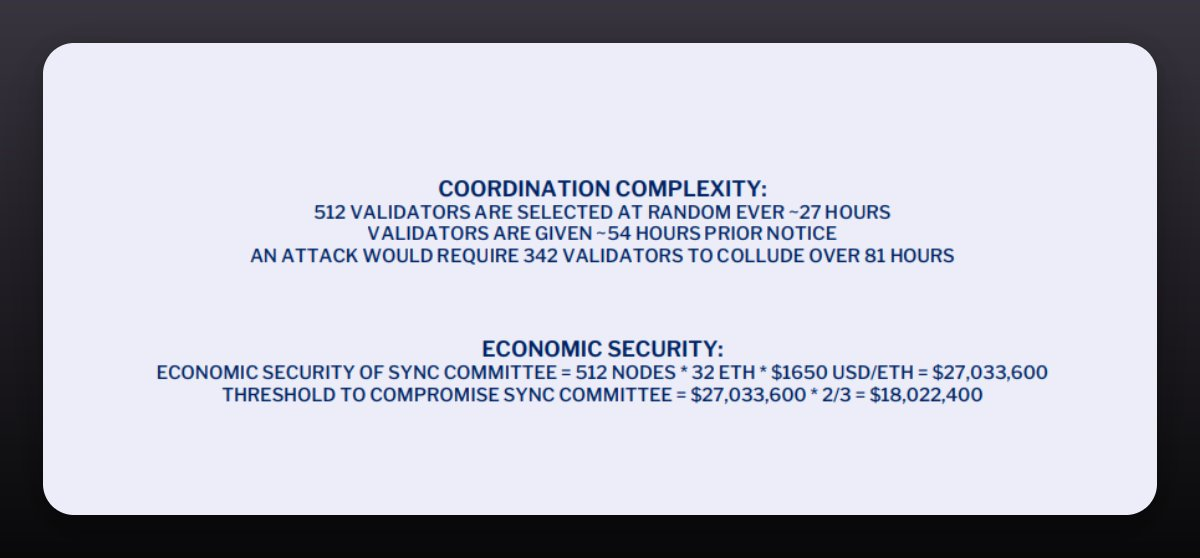
The security of the Lagrange cross-chain state committee comes from a constantly growing and dynamically sized set of nodes, which have economic bonds. These nodes either re-stake with EigenLayer or use liquidity derivatives such as Rocket Pool for staking.
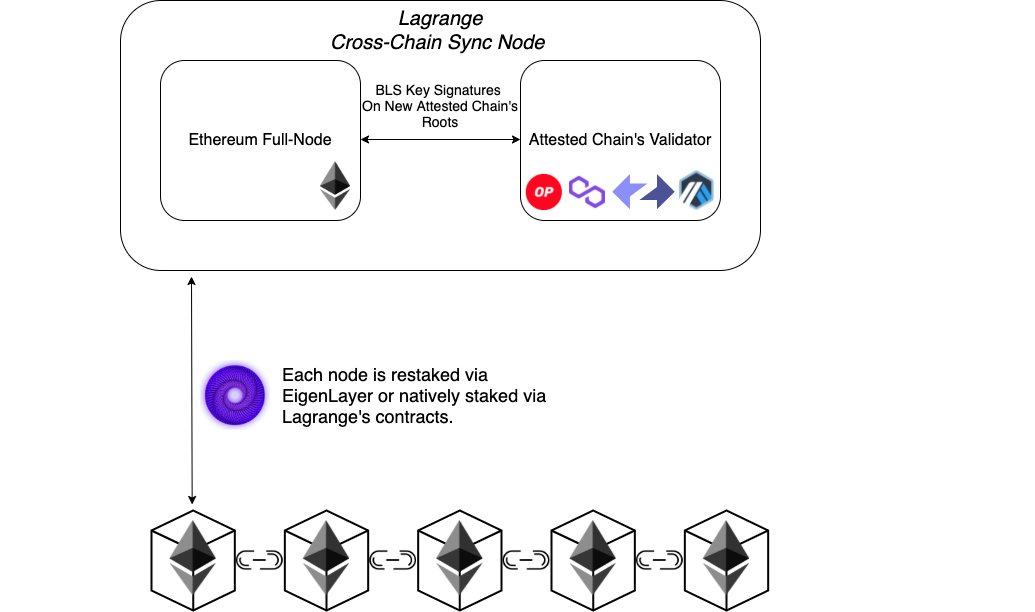
The
node must sign each new block that reaches the final result on the chain they prove. Unlike the 512-node limit for Ethereum light client sync committees, cross-chain state committees support unlimited nodes. Therefore, the collateral behind each proof can dynamically expand as needed, creating secure proofs for each given chain or Rollup.
State proofs have important use cases in protocols such as sharding and can help improve cross-rollup communication, as well as solve oracle problems in implementations like SUAVE.


