

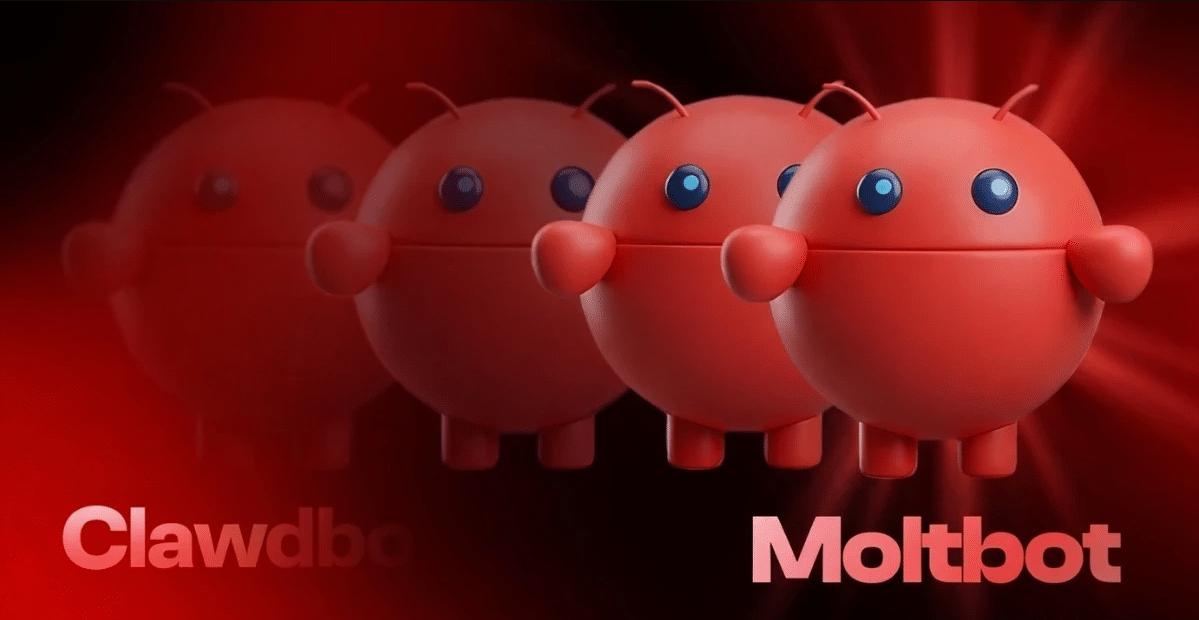
In the fast-moving world of Web3, it usually takes months for a technology to go from a niche developer tool to a viral sensation. However, Clawdbot–the open-source AI agent that was recently rebranded to Moltbot–managed to do it in a matter of days.
If you’ve been scrolling through Crypto Twitter (X) lately, you’ve likely seen the lobster emojis and the frantic charts of unofficial tokens. But behind the 100,000% price spikes and the “forced” rebranding lies a deeper story about the intersection of artificial intelligence (AI) and decentralized finance (DeFi). For the crypto community, Moltbot represents a double-edged sword: a powerful tool for automation and a fresh playground for sophisticated scammers, at least for a very short time.
The “Jarvis” Factor: More Than Just a Chatbot
Unlike ChatGPT, which primarily functions as a conversational interface, Clawdbot (Moltbot) is a true ” AI agent.” This is the distinction that has the tech world buzzing. It doesn’t just live in a browser tab; it runs on your own hardware (local-first) and has “hands” to actually execute tasks.
Think of it as an open-source Jarvis. Because it has system-level access, it can perform complex workflows that traditional AI cannot:
Deep research: It can autonomously research a new token across multiple platforms.
Digital triage: It can manage your emails, Slack, and Discord messages, filtering for “alpha” while you sleep.
Active execution: If granted API access, it can even execute trades or move funds based on specific triggers you define.
The Rebrand Drama: Shedding the Shell
The project’s meteoric rise, surpassing 60,000 GitHub stars within days, caught the attention of industry giants. On January 27, 2026, the creator, Peter Steinberger, revealed he had to rename the project to Moltbot following a “polite,” but firm trademark nudge from Anthropic (the makers of Claude AI).
In the crypto world, “Molt” is a perfect metaphor. Just as a lobster molts its old shell to grow larger, the project is shedding its original identity to scale further. However, the transition was chaotic. Steinberger noted that during the 10-second gap of renaming his accounts, “crypto shills” snatched up the old @clawdbot handles.
Had to rename our accounts for trademark stuff and messed up the GitHub rename and the X rename got snatched by crypto shills.
— Peter Steinberger ? (@steipete) January 27, 2026
That went wonderful.@moltbot it is.
The Scam Wave: A Warning to Investors
Because the project went viral so quickly, scammers immediately launched fake $CLAWD and $MOLT tokens on Solana, Base, and other blockchain networks. One imitation token saw a staggering 129,000% spike before crashing to near-zero.
As a result, Steinberger has been forced to spend his launch week fighting off token speculators. He has explicitly stated on multiple occasions: There is no official coin.
To all crypto folks:
— Peter Steinberger ? (@steipete) January 27, 2026
Please stop pinging me, stop harassing me.
I will never do a coin.
Any project that lists me as coin owner is a SCAM.
No, I will not accept fees.
You are actively damanging the project.
“To all crypto folks: Please stop pinging me, stop harassing me. I will never do a coin. Any project that lists me as coin owner is a SCAM,” Steinberger said.
Real-World Use Cases for the Crypto “Power User”
Strip away the scam tokens, and you could explore a tool that could genuinely change how we interact with the internet; and for us crypto people, its blockchain. For a crypto analyst or trader, Moltbot offers several high-impact applications:
Sentiment monitoring: It can bridge multiple channels (Telegram, Discord, X, and Signal) to scan for specific alpha or sentiment shifts across the entire ecosystem.
Automated trading guards: One viral post from a user known as “Legendary” showcased the potential of giving an AI agent a small trading wallet to earn its own hardware upgrades.
My clawdbot just asked me for an RTX 4090. Instead of buying it, I gave it a $2K trading wallet on Hyperliquid.
— Legendary (@Legendaryy) January 24, 2026
I said: If you want the GPU, earn it. It now trades crypto, stocks, and commodities 24/7.
It scans Twitter sentiment, tracks Trump posts, and decides trades on its… pic.twitter.com/5Yfa33UbnQ
On-chain security alerts: Developers are using the agent to monitor smart contract deployments, pinging private chats the second a whale wallet moves or a liquidity pool is altered.
Security Risks: Don’t Leave the Front Door Open
With great power comes great vulnerability. Blockchain security firm SlowMist recently issued a TI Alert regarding “Clawdbot gateway exposure.” They discovered hundreds of exposed API keys and private chat logs online.
?SlowMist TI Alert?
— SlowMist (@SlowMist_Team) January 27, 2026
Clawdbot gateway exposure identified: hundreds of API keys and private chat logs are at risk. Multiple unauthenticated instances are publicly accessible, and several code flaws may lead to credential theft and even remote code execution (RCE).
We strongly… https://t.co/j2ERoWPFnh
Because the tool is designed to be a “digital butler,” it often holds the keys to your most private accounts. Security researcher Jamieson O’Reilly compared misconfigured installations to “hiring a butler and leaving your front door wide open.” If your agent has access to your Telegram or browser, an exposed API key is effectively a key to your vault.
How to Stay Safe in the Moltbot Era
If you are looking to integrate Moltbot into your crypto workflow, the lessons are clear:
Self-host with caution: Lock down your ports and ensure your gateway is password-protected.
Isolate your keys: Never give an AI agent access to your all “hot wallets” containing significant funds. Use “burner” wallets for any automated trading experiments if possible.
Beware of fakes: There will be multiple exploiters ready to drain your wallet via phishing and social engineering scams. Make sure you are interacting with the official one.
Final Thoughts
Moltbot represents a shift from AI that talks to AI that does. While the technology is a game-changer for sovereign individuals, the surrounding “scam-nado” is a reminder that in crypto, hype always moves faster than security.
The lobsters have molted, but the “Dark Forest” of the blockchain remains as dangerous as ever.


