


SUI jumped 37% in seven days on the back of a single institutional supply removal event, pierced its MA 200 intraday on the highest volume day in its chart history, but closed below it, making the next daily close the most consequential session in SUI's structure since January.
Key Takeaways
SUI at $1.2680, up 10.7% in 24h and 37% in seven days.
May 10: SUI surged from $0.92 to a peak of $1.39 – 51% in approximately 36 hours.
High of $1.3517 pierced MA 200 ($1.3297) intraday.
MA 50 at $0.9457 and MA 100 at $0.9543 – both well below price.
RSI at 74.92, signal at 56.92 – 18-point spread, overbought on daily.
Break above $1.3297 could reopen the path toward $1.90 .
What Caused the 50% Move in 36 Hours
On May 10, SUI surged from a $0.92 baseline to a peak of $1.39, a 51% move in approximately 36 hours, before pulling back to $1.2680 by May 11, where it currently sits up 37% on the week and 10.7% on the day. 108.7M SUI moving from liquid DeFi into staking in a single day removed 2.7% of total supply from liquid float on top of 74% already staked, which means 76.7% of all SUI is now illiquid, and the 50% price move happened on a float that was already severely constrained before the transfer.
SUI Group Holdings, listed on NASDAQ as SUIG, executed the transfer on May 10, moving its entire SUI treasury out of DeFi protocols and into direct staking. The immediate effect was a supply shock on an already thin float. When 2.7% of a constrained supply disappears from liquid markets in a single session, price does not need significant new buying pressure to move significantly. The existing order book simply has less supply to absorb demand.
Two additional catalysts compounded the move. CME Group is launching SUI futures on May 29, making SUI only the fifth layer 1 blockchain to receive regulated derivatives access.
What’s behind $SUI’s recent +50% move? (Explored with Santiment MCP + Claude):
? Price: $0.92 baseline → $1.39 peak (May 10) → $1.26 now. Trading volume surged from $213M to $2.5B.
? The trigger: SUI Group Holdings (NASDAQ: SUIG) transferred its entire 108.7M SUI treasury… pic.twitter.com/ayRd0eNZwD— Santiment Intelligence (@SantimentData) May 11, 2026
That is not a retail catalyst: it is an institutional infrastructure event that signals a new category of capital can begin building exposure. The Paga partnership for cross-border African payments adds a utility dimension: real-world payment infrastructure that increases SUI’s transaction base and addressable market. Three catalysts arriving simultaneously, supply shock, regulated derivatives, and payments partnership, produced a compounding effect that a single catalyst would not have generated alone.
The MA 200 Test and What the Close Means
The high of $1.3517 pierced the MA 200 at $1.3297 intraday but the close at $1.2680 did not hold above it, which means SUI has shown it can reach the MA 200 but has not yet shown it can close above it, and that distinction is the entire difference between a breakout and a failed test. The intraday pierce confirms that buying pressure is sufficient to push price above the MA 200. The close below it confirms that selling pressure at that level is currently absorbing the breakout attempt. The next daily close is the session that determines which force prevails.
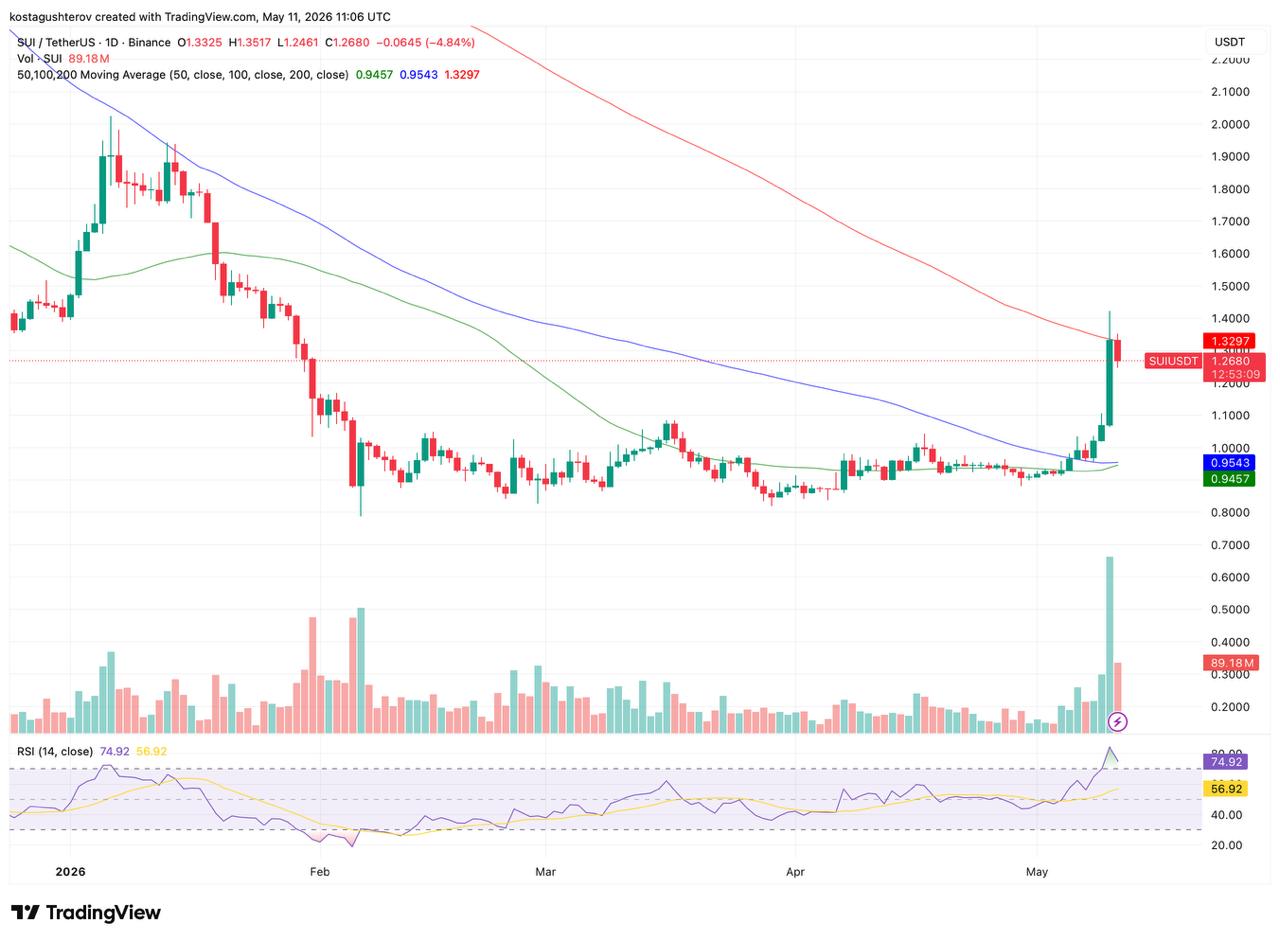
The MA structure below current price is supportive but distant. The MA 50 at $0.9457 and MA 100 at $0.9543 are both approximately $0.32 below current price, more than 25% lower. That distance means a pullback from the MA 200 would not find dynamic moving average support until significantly lower levels. The $0.92-$0.95 area, where price was consolidating before the move, is the structural support that matters on a deeper retracement.
The RSI at 74.92 against a signal of 56.92, an 18-point spread, is the most elevated RSI reading visible on the chart since the February collapse low. At 74.92, RSI is deep into overbought territory.
That does not automatically produce a reversal. During strong momentum moves RSI can remain elevated for extended periods. What it does mean is that the window for a clean close above the MA 200 is compressed. Every session of sideways price action at current levels brings the RSI closer to its signal, reducing the momentum available for the breakout attempt.
The Social Data That Changes the Interpretation
A 50% price move with social dominance at 0.14%, below the 0.38% that preceded the rally, is the on-chain fingerprint of institutional supply removal, not retail FOMO: retail has not arrived yet, and the question is whether it does before or after the MA 200 confirms. Santiment’s data shows social dominance for SUI during the 50% move stayed between 0.13% and 0.15%, actually lower than the 0.38% spike that preceded the rally. In a retail-driven move, social dominance rises with price as participants share and discuss the asset. The fact that it fell during the move indicates the conversation did not follow the price, which is the defining characteristic of an institutional supply shock rather than a momentum-driven retail rally.
The social data points to an unfinished move. If retail has not yet arrived and the move has already produced 50% gains, a retail arrival would represent a second wave of demand on top of a supply that is already 76.7% illiquid. That is the scenario that produces the larger moves: not the initial institutional trigger but the subsequent retail recognition of what the trigger created. The counter-argument is that RSI at 74.92 with an 18-point spread and a failed close above the MA 200 in the same session is a technically unfavorable setup for immediate continuation. A move of this speed without a confirmed MA 200 close is more likely to consolidate or retrace before attempting the breakout again than it is to continue immediately.
SUI posting a daily close above $1.3297 with volume sustaining above recent averages would confirm the MA 200 break with institutional conviction rather than fading momentum. The denial signal is a daily close below $1.15 within five days, which would indicate the supply shock has been fully absorbed by sellers and that the MA 200 test has failed structurally.


