

BlackRock CEO Larry Fink declared he is “quite bullish on the opportunity to invest in Venezuela”, citing the oil-rich nation’s potential to return to economic prominence following Nicolas Maduro’s removal and the political overhaul it triggered. What does it mean for Bitcoin?
Well, the statement is structurally significant because it places the world’s largest asset manager, $11.5Tn in AUM, on record as willing to deploy capital into one of the highest-risk frontier markets on the planet.
The open question is whether that same risk-frontier expansion is already reshaping BlackRock’s positioning in digital assets, and through what mechanism the two signals connect.
BlackRock Crypto News: What the Fink Pivot Actually Signals About Institutional Risk Appetite And Bitcoin
Fink’s Venezuela comments are not an isolated data point. They reflect BlackRock’s consistent macro strategy in 2026: seek asymmetric upside in markets where geopolitical stabilization or structural reform creates a return profile unavailable in developed-market fixed income.
Venezuela fits that template precisely: depressed asset prices, significant oil reserves, and a post-Maduro political reset that Fink believes could bring the country “back into its glory.”
The mechanism matters here. When the world’s largest asset manager publicly signals appetite for frontier markets, economies characterized by thin liquidity, high volatility, and outsized upside, it recalibrates what counts as acceptable risk within institutional portfolio construction broadly.
BlackRock CEO Larry Fink just said: “Markets will rise and fall. Bubbles come and go. The only thing that matters is staying invested through every cycle.” ? pic.twitter.com/0WI4yfkGXq
— CryptoSavingExpert ® (@CryptoSavingExp) May 11, 2026
BlackRock does not operate in isolation; its stated positions function as permission structures for the wider institutional allocator community. Pension funds, endowments, and sovereign wealth funds that track BlackRock’s positioning treat Fink’s public statements as forward guidance on where the risk frontier is being redrawn.
What makes this moment distinct from prior EM enthusiasm cycles is that BlackRock already has the regulated crypto infrastructure in place to act on an expanded risk mandate.
The iShares Bitcoin Trust (IBIT) has grown into the dominant institutional vehicle for Bitcoin exposure in the US market. Separately, BlackRock’s European Bitcoin ETP (IB1T) crossed $1Bn in AUM, establishing a global product footprint. The institutional investment architecture is built. The Fink Pivot signals that the appetite to fill it is expanding.
Why Frontier Market Risk Tolerance Positions Bitcoin as the Primary Institutional Beneficiary
The analytical bridge between Venezuela and Bitcoin runs through risk-profile logic, not geographic correlation. Fink’s bullish Venezuela stance signals that BlackRock is actively seeking assets with high beta, limited developed-market correlation, and asymmetric upside, precisely the characteristics that institutional allocators have used to justify Bitcoin exposure since 2020.
If BlackRock is prepared to navigate Venezuelan sovereign risk, the incremental risk of expanding a Bitcoin ETF allocation is structurally minor by comparison.
The flow data supports this reading. Bitcoin ETFs recorded $857M in net inflows over a 6-week period through mid-May 2026, a streak that reflects sustained institutional accumulation rather than retail-driven momentum.
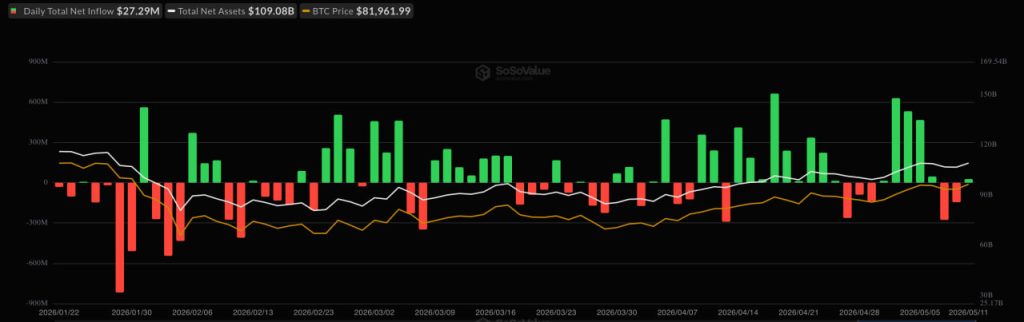
That pace does not emerge from speculative trading; it reflects deliberate portfolio construction decisions by allocators operating within compliance frameworks. The same allocator base that watches Fink’s frontier market signals is driving those inflows.
BlackRock’s Bitcoin ETF already commands the largest share of institutional Bitcoin exposure in the US market, having overtaken Grayscale’s GBTC on AUM. IB1T’s European milestone further demonstrates that the firm is running a coordinated global crypto expansion – not a single-market experiment. The Fink Pivot does not create this infrastructure; it signals that the mandate to deploy through it is widening.
The regulatory environment compounds the signal. The Digital Asset Market Clarity Act, currently advancing through the Senate with a committee markup already noticed, is creating the legislative framework that allows institutional capital to formally categorize crypto allocations within existing compliance structures.
For allocators who have waited on regulatory clarity before expanding digital asset exposure, that threshold is approaching – and BlackRock’s existing Bitcoin ETF products are positioned to absorb the resulting flows.


