

Bitcoin News Today: Donald Trump has disclosed a direct equity position in MARA Holdings , the Nasdaq-listed bitcoin mining and AI infrastructure company formerly known as Marathon Digital, marking the first time a sitting U.S. president has filed a personal stake in a publicly traded Bitcoin mining firm.
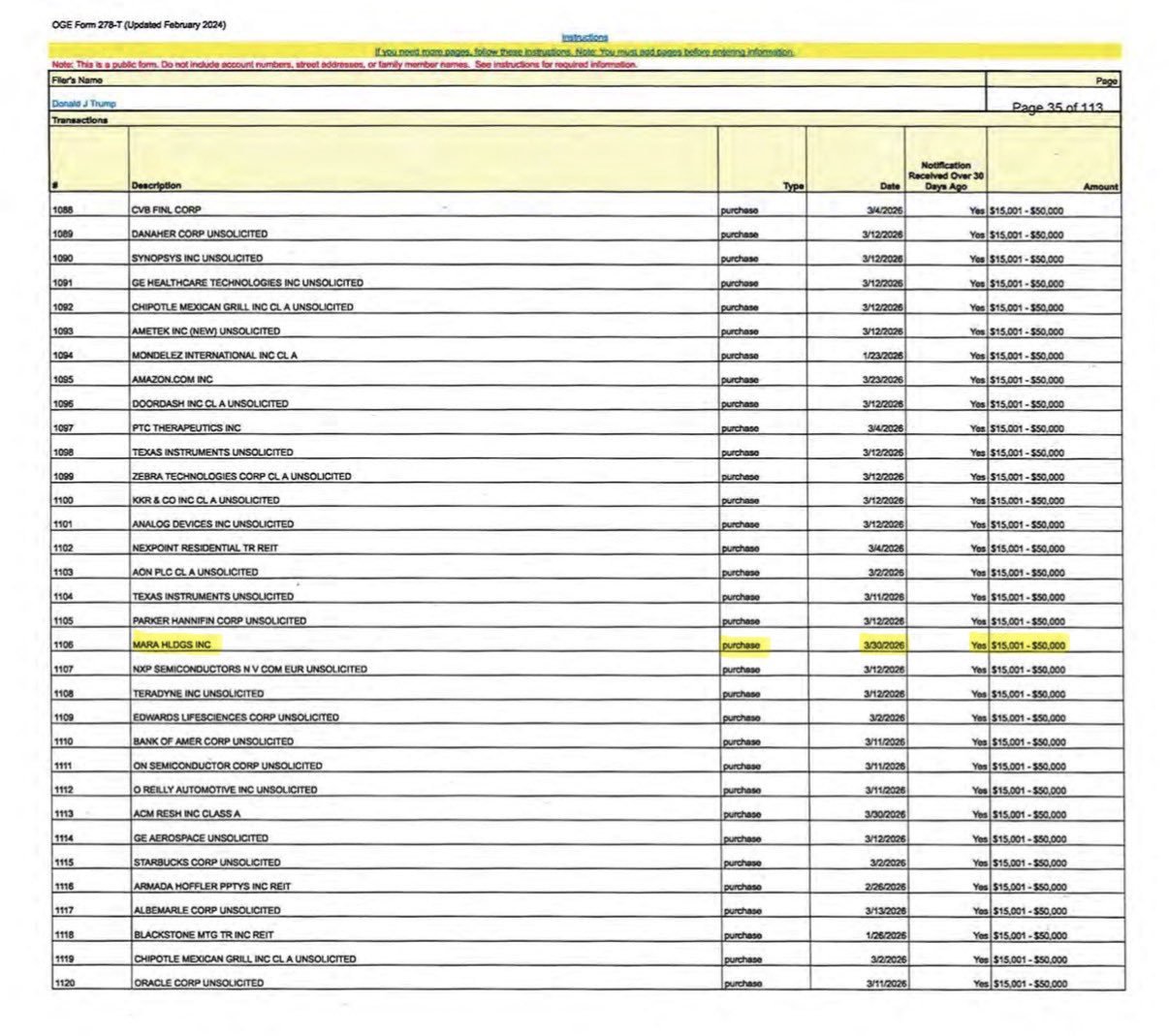
The disclosure, surfaced through OGE Form 278-T filings covering Q1 2026 activity, shows MARA appearing alongside purchases of Coinbase, Robinhood, and positions widely interpreted as MicroStrategy, as part of an estimated $220–$750 million in trust-executed trades during the quarter.
Where Trump’s earlier crypto exposure was structured around passive licensing and royalty income, this is equity ownership in an operationally intensive, capital-heavy miner, a categorically different risk profile.
The analytical question is not why Trump invested in a bitcoin miner; it is whether direct equity ownership in mining infrastructure now structurally aligns his financial incentives with the regulatory outcomes his administration controls.
Bitcoin News Today: Trump’s Crypto Portfolio Before MARA: What the NFT and Licensing Phase Actually Represented
Trump’s public crypto exposure first crystallized through the Trump Digital Trading Cards, NFT collections issued on the Polygon network that generated at least $4.9 million in licensing income by mid-2023.
Those proceeds flowed primarily as Ethereum and Wrapped Ethereum, giving Trump a crypto-denominated balance sheet without any exposure to the operational mechanics of the underlying industry.
The model was not merely passive, it was structurally insulated. Licensing fees arrive regardless of the network’s hash rate, mining difficulty, or energy costs; the licensor collects a toll on cultural attention rather than betting on industrial throughput.
That phase also carried no regulatory entanglement with agencies whose decisions materially affect crypto economics. The NFT market’s legal and intellectual-property debates were largely confined to trademark and secondary-market royalty disputes, commercially consequential, but not existentially shaped by EPA energy rules or Treasury tax proposals.
Source:
Source: Finsee.ai
Trump’s trust executed what filings characterize as two smaller MARA purchases within a broader portfolio construction that spans crypto-adjacent equities. The precise share count and percentage stake have not been disclosed at the level of granularity that would allow a clean ownership calculation, but the filing confirms directional exposure.
MARA holds over 26,000 BTC on its balance sheet, maintains energy partnerships across Texas and other states, and is pursuing a planned $1.5 billion acquisition of Long Ridge Energy & Power, a 505 MW asset intended to anchor a pivot toward AI compute and high-performance infrastructure.
The intersection of bitcoin mining infrastructure and AI data center buildout is precisely where MARA is attempting to reposition, and where Trump’s equity now sits.
Connecting to a broader pattern: institutional and political figures taking equity positions in mining infrastructure, rather than holding BTC directly, represent a distinct crypto investment thesis.
Direct BTC ownership is a bet on monetary properties; mining equity is a bet on industrial economics, energy procurement, and regulatory tolerance. Those are different underwriting decisions, and they carry different conflict-of-interest implications when the equity holder also sets federal policy.


