

Guys, today we’re going to talk about one of those crypto problems that sounds abstract until it hits your trade directly: Liquidity Fragmentation And more importantly: Liquidity Fragmentation Handling.
Yeah, the phrase looks like it belongs in a system architecture diagram. But the idea is very real.
Because in crypto, liquidity is not sitting neatly in one place. It is spread across exchanges, chains, pools, market makers, and protocols And when liquidity is scattered, your trade can become more expensive, slower, or harder to execute.
That’s why handling liquidity fragmentation matters.
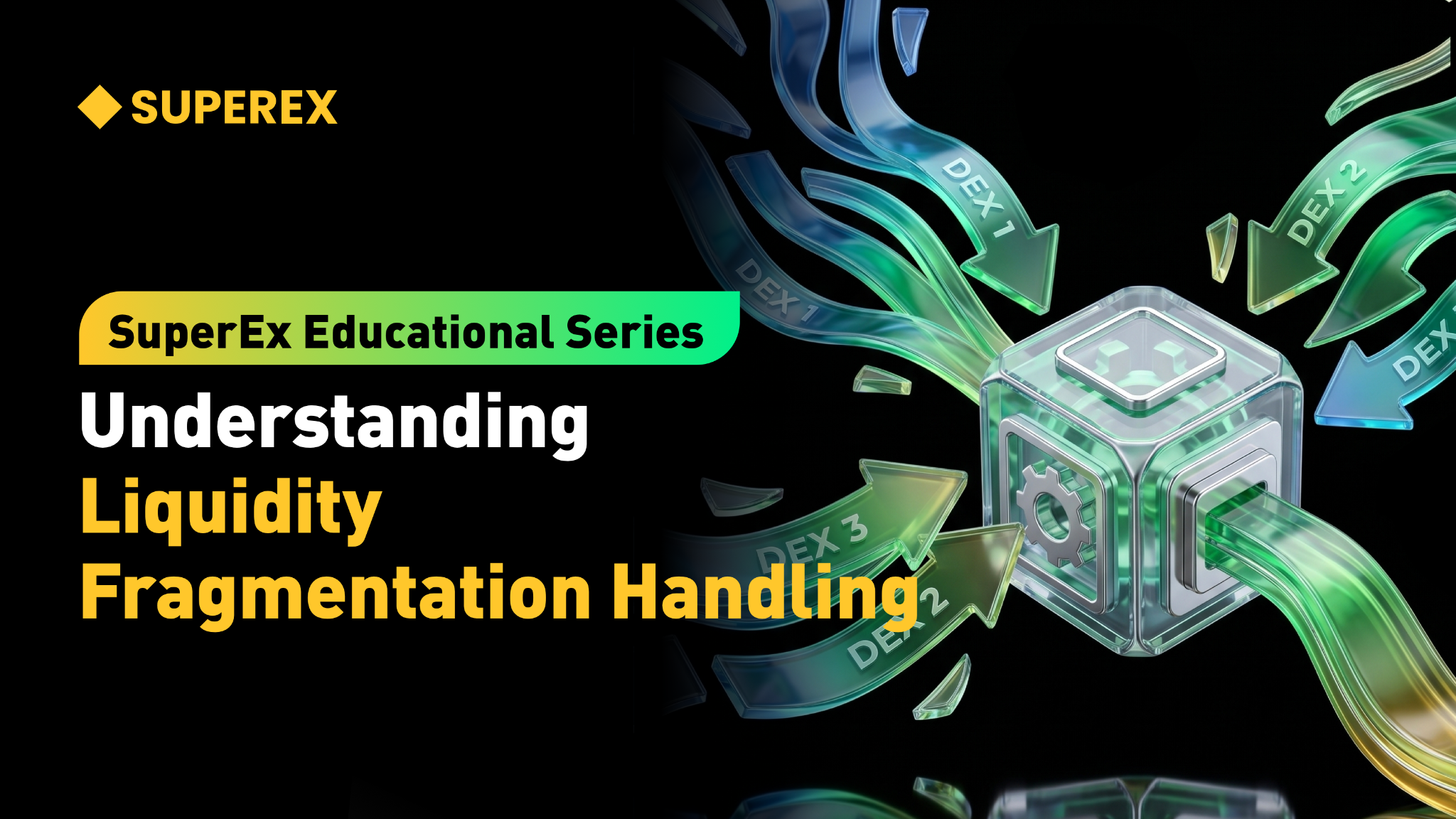
First, What Is Liquidity Fragmentation?
Let’s start simple.
Liquidity means how easily an asset can be bought or sold without causing a big price change.
Fragmentation means that liquidity is split across many different places.
So liquidity fragmentation means:The available buying and selling liquidity for an asset is distributed across multiple venues instead of being concentrated in one market.
In crypto, that can mean liquidity is spread across:
- Centralized exchanges
- Decentralized exchanges
- AMM pools
- Order books
- OTC desks
- Market makers
- Layer 2 networks
- Different blockchains
- Wrapped asset versions
- Cross-chain bridges
The same token may have liquidity on Ethereum, Arbitrum, BNB Chain, Base, Solana, and several exchanges like SuperEx at the same time.
Sounds flexible, right?
It is.
But it also creates complexity.
Why Fragmentation Is a Problem
Imagine you want to buy a token.
On one DEX, the pool looks available but shallow.
On another DEX, the price is better but gas is higher.
On a centralized exchange, liquidity is deeper but you need to move funds.
On another chain, liquidity is strong but bridging takes time and adds risk.
So where should your trade go?
That is the problem.
When liquidity is fragmented, a user may face:
- Higher slippage
- Worse execution prices
- Failed transactions
- More manual searching
- Cross-chain complexity
- Uneven market depth
- Price differences across venues
- Higher operational risk
The market may look liquid overall, but if that liquidity is scattered, one single route may still be weak.
That is the trap.
A token can have “enough liquidity” in total, while still offering poor execution in any one place.
A Simple Example
Let’s say Alice wants to buy $100,000 worth of Token X.
Token X has liquidity across several venues:
DEX A has $30,000 of useful depth.
DEX B has $25,000.
A centralized exchange has $60,000.
A market maker can quote part of the trade through RFQ.
Another chain has a deep pool, but bridging is required.
This example sounds familiar, doesn't it? Indeed, we covered it in a recent science article. The fact that it feels familiar indicates that everyone has studied it thoroughly.
If Alice sends the whole order to DEX A, the price may move heavily against her.
But if a system can handle fragmentation properly, it may split or route the order across different sources.
Part through DEX A.
Part through DEX B.
Part through an RFQ quote.
Part through another venue if the cost makes sense.
The result may be a better average execution price and lower slippage.
That is liquidity fragmentation handling.
What Does “Handling” Fragmentation Mean?
Handling liquidity fragmentation means building mechanisms that can discover, compare, access, and combine liquidity across multiple sources.
It is not just “checking prices.”
A strong fragmentation handling system needs to understand:
- Where liquidity exists
- How deep each source is
- What fees apply
- How much slippage each route creates
- Whether routes are reliable
- Whether settlement is fast enough
- Whether cross-chain movement is worth it
- Whether execution risk is acceptable
In simple terms: Liquidity fragmentation handling is the process of turning scattered liquidity into usable liquidity.
That is the key.
Fragmented liquidity only helps users if the system can actually access it efficiently.
Why Crypto Has So Much Fragmentation
Crypto is naturally fragmented because it is open.
Anyone can create a token.
Anyone can launch a liquidity pool.
Anyone can build a DEX.
Any chain can develop its own ecosystem.
Assets can exist in native, wrapped, bridged, or synthetic forms.
This openness creates innovation, but it also creates scattered markets.
Unlike a single centralized venue where all liquidity sits in one book, Web3 liquidity lives across many independent systems.
That is both the beauty and the headache of crypto.
You get permissionless markets.
You also get messy execution.
Key Methods for Handling Liquidity Fragmentation
Now let’s talk about how platforms actually deal with this problem.
1. Liquidity Aggregation
The first method is aggregation.
A platform connects to multiple liquidity sources and compares them before executing a trade.
This may include DEXs, AMMs, order books, market makers, and RFQ systems.
Aggregation helps users avoid being trapped in a single weak liquidity source.
Instead of asking one venue, the system asks many.
2. Smart Order Routing
Smart order routing decides where an order should go.
It may send the full trade to one place or split it across multiple venues.
A good router considers:
- Price
- Depth
- Fees
- Slippage
- Gas
- Execution speed
- Failure risk
The goal is not just to find the best displayed price.
The goal is to find the best final outcome.
3. Order Splitting
When one liquidity source cannot handle the full trade efficiently, the system can split the order.
For example, 40% of the trade may go to one pool, 35% to another DEX, and 25% through an RFQ quote.
This can reduce price impact and improve average execution.
Order splitting is especially useful for larger trades or thinner markets.
4. RFQ Integration
RFQ, or Request for Quote, allows platforms to request prices directly from liquidity providers or market makers.
This can help when public liquidity is limited.
Instead of relying only on visible pools, the system can ask professional liquidity providers:“What price can you offer for this exact trade?”
RFQ can be powerful for large orders, volatile assets, or low-liquidity pairs.
5. Cross-chain Liquidity Access
Sometimes the best liquidity is on another chain.
Handling fragmentation may require cross-chain routing or bridge integration.
But cross-chain routes must be evaluated carefully because they add:
- Bridge fees
- Time delays
- Security risks
- Settlement uncertainty
- Additional transaction costs
A good system does not use cross-chain liquidity just because it exists.
It uses it only when the final benefit is worth the added complexity.
6. Liquidity Normalization
This part sounds technical, but it matters.
Different venues may quote prices differently, charge different fees, use different token standards, or represent assets in different forms.
A platform needs to normalize this information so it can compare routes fairly.
For example:
Is this USDC native or bridged?
Are fees included?
Is the quoted price before or after gas?
Is this token taxed on transfer?
Is the pool using stable-swap or constant-product pricing?
Without normalization, comparisons can be misleading.
7. Real-time Market Data
Liquidity changes quickly. A route that looked good ten seconds ago may be bad now.So fragmentation handling depends on real-time or near-real-time market data.
This includes:
- Pool reserves
- Order book depth
- Market maker quotes
- Gas prices
- Chain congestion
- Token prices
- Execution success rates
Old data creates bad routing.
In crypto, stale liquidity is almost the same as no liquidity.
Fragmentation Handling Is Not Only About Getting a Better Price
Most people think this is only about price.
It is not.
Handling fragmentation also affects:
- Trade reliability
- Settlement speed
- Risk control
- Capital efficiency
- User experience
- Platform competitiveness
- Market stability
A trade that gets a slightly better quote but fails during execution is not a better trade.A route that saves $20 but adds bridge risk may not be worth it.A system has to balance execution quality with reliability.
That is why good fragmentation handling is closer to risk-aware optimization than simple price comparison.
Why This Matters for Regular Users
Even if you never think about fragmentation manually, it affects you.
Every time you swap, trade, or move assets, the platform has to find liquidity somewhere.
If it finds liquidity well, your execution improves.
If it finds liquidity poorly, you may pay for that mistake through slippage, failed transactions, or worse pricing.
So when you hear a platform talk about liquidity, do not only ask:“How much liquidity exists?”
Ask:Can the platform actually access and use that liquidity efficiently?
That is the real question.
Final Thoughts
Liquidity fragmentation handling is the process of managing scattered liquidity across different venues, chains, pools, and providers so trades can be executed more efficiently.
Its value includes:
- Better execution prices
- Lower slippage
- Deeper liquidity access
- Smarter order routing
- More reliable trades
- Better use of cross-market liquidity
- Improved user experience
In one sentence: Liquidity fragmentation handling turns scattered liquidity into usable liquidity. And that matters because crypto markets are not one single marketplace.
They are many markets connected loosely, sometimes beautifully, sometimes messily.
The platforms that handle fragmentation well can give users a smoother, smarter, and more efficient trading experience.
Because in crypto, liquidity existing somewhere is not enough.
What matters is whether your trade can actually reach it.



