


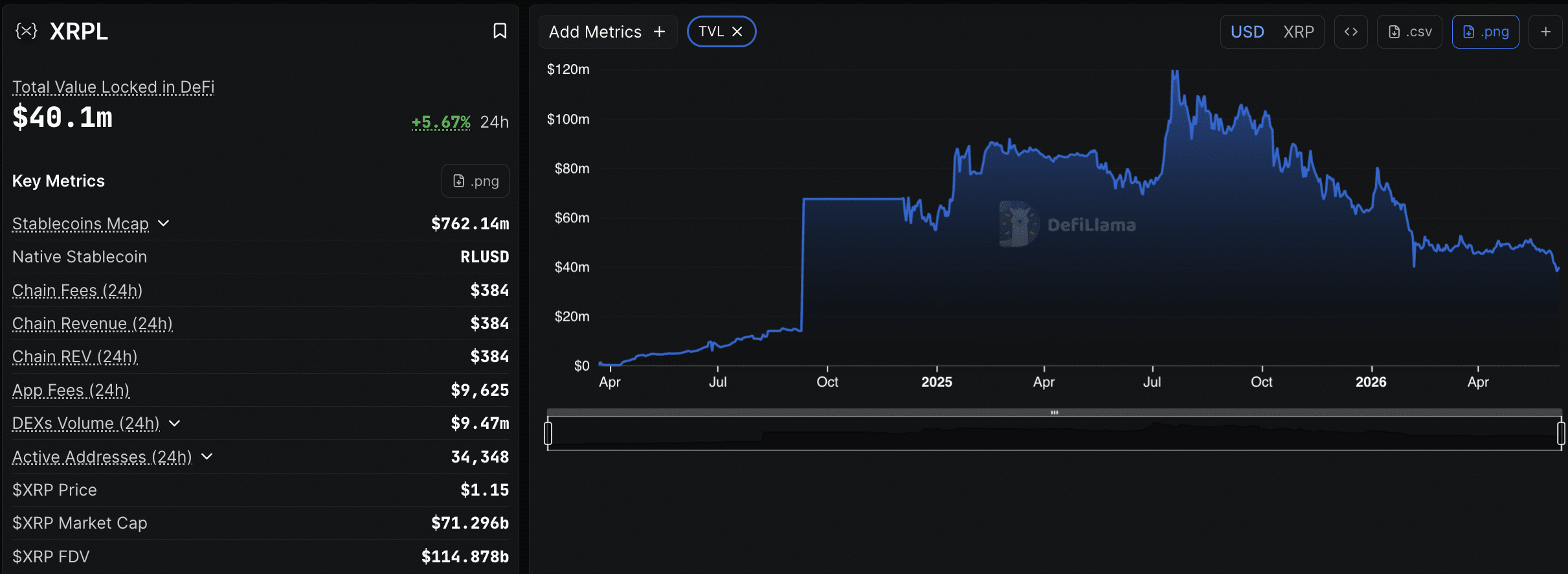
XRPL’s total stablecoin supply has surged 22% in recent weeks to approximately $762M, and this is not simply a liquidity milestone. It is evidence that Ripple’s own RLUSD stablecoin has quietly consolidated institutional control over the Ripple Ledger’s dollar layer, commanding roughly 83–88% of the network’s stablecoin liquidity.
Transfer volume jumped 123% month-over-month to $4.71Bn, and stablecoin capitalization has since crossed $888.5M on a 30-day basis, suggesting the expansion is not a single-event artifact but a structural shift in how the ledger is being used.
(SOURCE: DefiLlama)
The rails, in other words, are being built at a pace. The passenger count of 110 RWA holders as of the latest available data is another matter entirely, and that gap is the story.
This drop in XRPL stablecoin supply comes as XRP has surged +3.2% over the past 24 hours, reclaiming $1.10 and now trading at roughly $1.16, with a daily trading volume of $2Bn.
Historical $XRP bear markets typically last 400-790 days with 85-96% drops. In 2026, we've only corrected for about 350 days, and are down just 71% from the July 2025 ATH.
The duration and % depth of these bears are diminishing over time, therefore the territory for marking a… pic.twitter.com/cNVRf1vDJH
— ?? ChartNerd ? (@ChartNerdTA) June 8, 2026
XRPL Ripple Stablecoin Supply: What Is Actually Driving the $762M Growth
Ripple launched RLUSD in December 2024 as a fiat-backed stablecoin regulated by the New York Department of Financial Services, holding reserves 1:1 against U.S. dollars at BNY Mellon.
This regulatory framework established its credibility with institutional counterparties. Minting of RLUSD accelerated through 2025, with significant issuances tied to exchange and pilot activities.
For most of 2025, the total XRPL stablecoin capitalization remained below $100M, with the asset primarily recognized for cross-border payments. A turning point occurred in November 2025, with supply surpassing $200M, indicating a sustained phase of expansion. By June 2026, XRPL stablecoin supply reached $762M, largely driven by RLUSD.
It’s important to note that the 83-88% RLUSD dominance figure applies to XRPL-native stablecoins, not its total presence. About 77-82% of the RLUSD supply is on Ethereum, serving as DeFi collateral, a choice made by Ripple at launch.
The $762M reflects XRPL’s share of a larger cross-chain stablecoin. The significant 123% monthly increase in transfer volume suggests rising utilization, though the nature of these transactions remains unclear.
XRPL’s $3.57B RWA Layer: Infrastructure at Scale, Adoption Still Thin
Is $XRP about to flip $TON for stablecoin supply?!
At time of writing, the stablecoin market cap on @Ripple's $XRPL is up an insane +23% on the week, reaching a total of $762M .
It now ranks #15 behind @ton_blockchain which has a stablecoin supply of $802M . pic.twitter.com/O8qNUbD9Up
— BSCN (@BSCNews) June 8, 2026
The XRP Ledger’s tokenization has expanded significantly, with an asset value of $3.57 billion and $385M in distributed on-chain asset value, reflecting the difference between registered and actively circulating assets.
Messari’s Q1 2026 report highlighted XRPL’s RWA market cap at $2.25Bn, up 124% quarter-over-quarter, placing it fourth globally. Major contributors include OpenEden’s TBILL Vault, Ondo Finance’s U.S. government bond fund, and RLUSD.
A key institutional proof point is the May 2026 tokenized US Treasury redemption pilot, involving Ondo Finance, JPMorgan Kinexys, Mastercard, and Ripple. This successful cross-border transaction of Ondo’s tokenized Treasury product, worth about $250M in AUM, showcased XRPL’s speed and efficiency, completing in 4.2 seconds.
JPMorgan’s participation signals institutional confidence in XRPL as a credible settlement layer, raising questions about the potential for scalable operational workflows.
The Passenger Problem: XRPL Has the Rails, But Only 110 RWA Holders Are on the Train
As of June 2026, there are 110 RWA holders recorded on XRPL, representing a total asset value of $3.57Bn. This translates to an average position size of over $30M per holder, suggesting potential institutional concentration rather than widespread adoption. However, this number could also reflect that much of the asset value is registered but not actively held.
On a positive note, the 110 holders indicate early-phase institutional pilots testing the network, which could lead to broader adoption. Conversely, it also shows that despite Ripple’s efforts in tokenization, there’s limited participation from market makers and fund managers, which is necessary for liquidity.
Additionally, it’s crucial to understand whether the number of holders is increasing, whether institutions are consolidating positions, or whether significant off-chain activity is occurring prior to on-chain deployment. The disparity between the $3.57Bn in represented value and the $385M in distributed on-chain value raises questions about asset circulation on XRPL, leaving the future of these holdings uncertain.


